
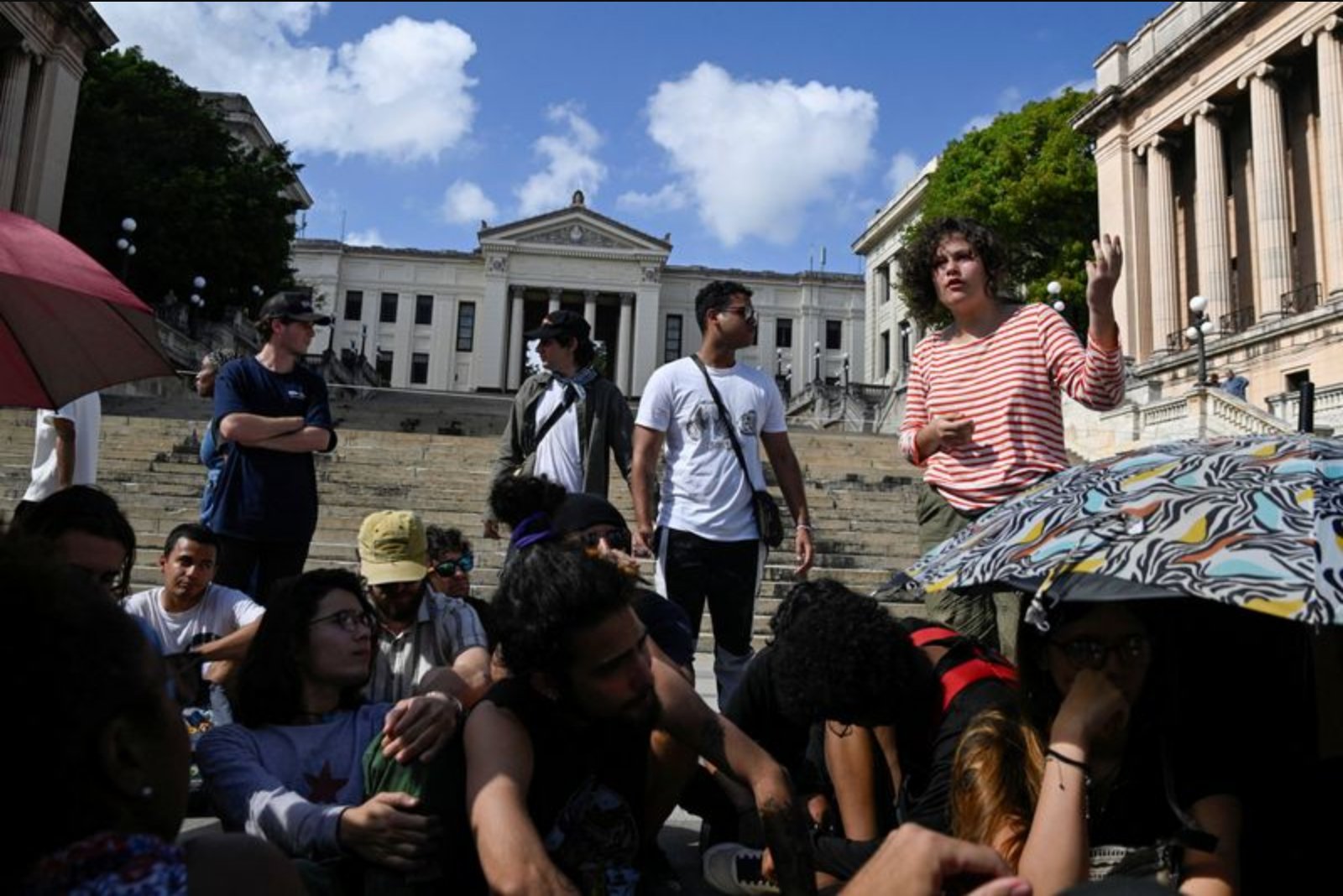
HAVANA, March 9 - A group of just over 20 students at the University of Havana staged a rare, several-hour protest on Monday to press authorities over frequent class interruptions tied to a deepening energy and communications crisis.
The students sat on the stone steps of the university in the mid-morning heat, shading themselves with umbrellas as professors and administrative staff arrived and exchanges grew tense. The demonstration, described by participants as a sit-in, drew attention to the practical impact of recent energy shortages on campus life and instruction.
"None of us wanted to get up early today in the dark, make a thermos of coffee, and sit here in the sun," said Anabel Oliva, a 20-year-old student, addressing the assembled group. "But there was no other way."
Students said officials had not implemented sufficient measures to prevent widespread disruptions to classes after the United States tightened sanctions and, in January, curtailed oil shipments from Venezuela. That reduction in fuel deliveries further weakened an already fragile electrical grid, depriving power plants of the fuel they need and triggering knock-on effects across transportation, food supply chains and internet communications.
In response to the crisis, Cuban authorities announced a set of measures in January intended to preserve continuity in higher education, including a shift to distance-learning arrangements similar to those used during the COVID-19 pandemic. Students at the protest said those steps fell short of what was necessary to protect classroom instruction and academic schedules, and they chose direct action to ensure their grievances were heard.
Jose Julian Diaz, a university professor and former student representative, said the exceptional circumstances required conversation between staff and students. "These kinds of scenarios are really rare," he told reporters. "I think we have to learn to have these discussions with students."
University security initially barred the protesters from occupying the main entrance steps, stringing a rope across the approach and placing a sign to discourage sitting on the stairs. Undeterred, the students walked past the rope and took positions on the steps, prompting security personnel to move in. The confrontation eased after Higher Education Vice Minister Modesto Ricardo Gomez arrived on site.
Vice Minister Gomez told reporters the students had legitimate concerns and attributed the problems to the tightening of U.S. sanctions. He said the government would not punish those who took part in the demonstration. "There are no consequences whatsoever. They have a concern, and we are addressing it. It will always be like this," he said.
While the vice minister spoke with reporters, the group left the steps and entered the university alongside administration officials and faculty; the students declined requests for interviews at that time. Gomez said the dialogue would continue inside the campus.
An unidentified student, speaking to cameras but not giving his name to reporters, warned that further protests were possible if the issues were not resolved. "We are willing to engage in dialogue if it is to represent our demands, but if dialogue, as has already happened, does not work, we will sit down here again," he said.
Protests of this nature are rare in Cuba. Although the 2019 constitution grants citizens the right to protest, a law more explicitly defining that right remains stalled in the legislature, leaving those who take to the streets in a degree of legal uncertainty.
Summary
A sit-in by just over 20 students at the University of Havana highlighted the impact of severe fuel and power shortages on higher education. The demonstration came after January cuts to Venezuelan oil shipments and increased U.S. sanctions, which students and officials say have intensified blackouts and disrupted transport, food distribution and internet services. Higher Education officials met the protesters on campus, pledged dialogue and said there would be no repercussions for participants.
Key points
- Roughly 20 students staged a prolonged sit-in at the University of Havana to protest repeated class disruptions caused by power and internet outages.
- Officials say January cuts to Venezuelan oil shipments and tighter U.S. sanctions have further impaired Cuba's already fragile electrical grid, producing cascading effects on transport, food supply and communications.
- Higher Education Vice Minister Modesto Ricardo Gomez met the protesters, acknowledged their concerns, blamed sanction-related pressures for the situation and promised no penalties while arranging further dialogue.
Risks and uncertainties
- Continued fuel shortages and grid instability could prolong disruptions to university instruction and distance-learning arrangements, affecting the education sector.
- Ongoing blackouts and limited internet access risk further straining transportation and food distribution networks, with potential market and supply-chain implications for those sectors.
- Legal ambiguity surrounding the right to protest could create uncertainty for civic actions on campus and elsewhere, complicating institutional responses and public engagement.