
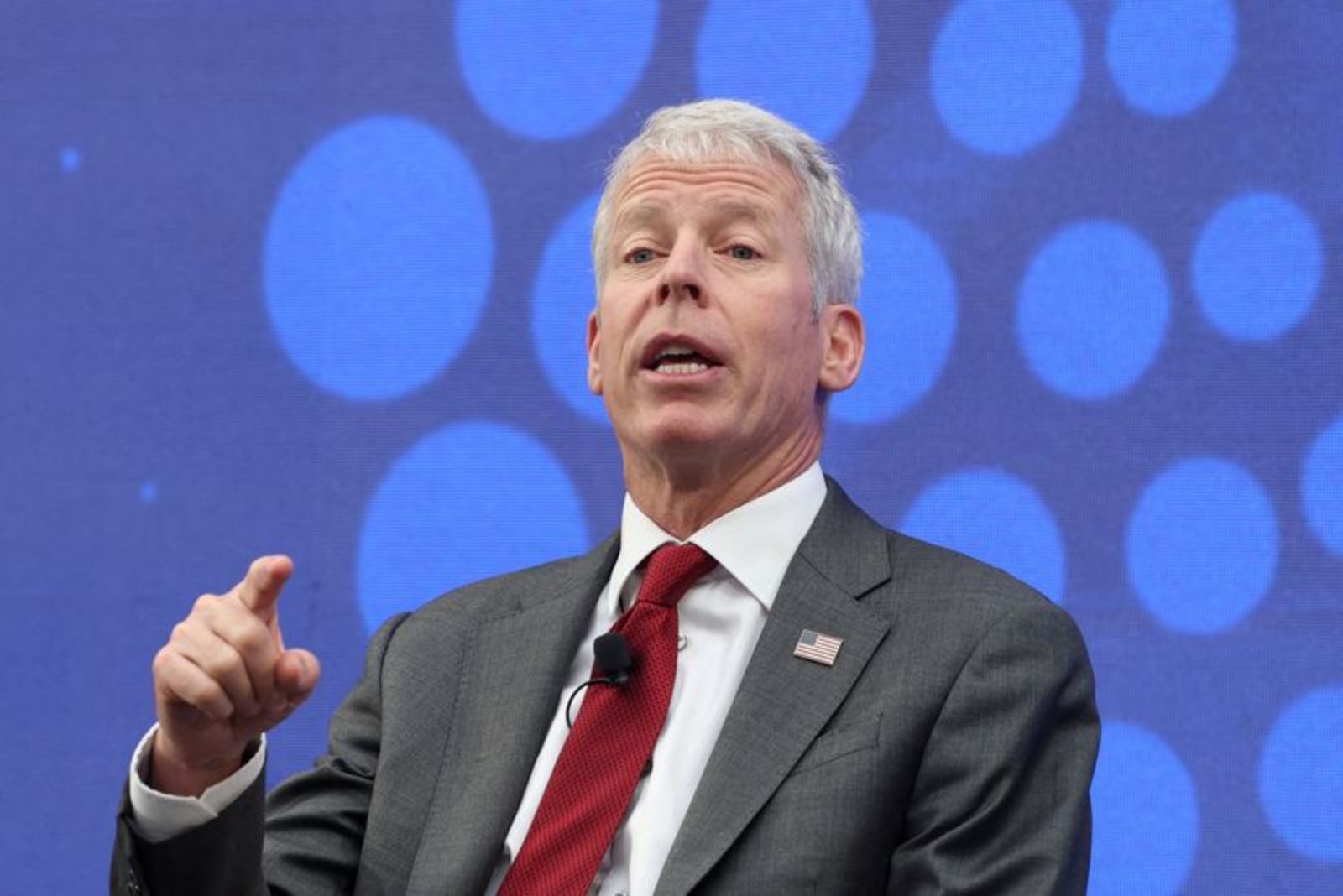
PARIS, Feb 19 - U.S. Energy Secretary Chris Wright on Thursday delivered a warning to the International Energy Agency (IEA): the United States will press the agency to move away from its net zero-by-2050 climate agenda within about a year, and could withdraw membership if it does not change course.
Wright said the IEA has for a decade operated with a "group mentality" around the goal of achieving net zero greenhouse gas emissions by 2050. He described that commitment as a "destructive illusion" and said the U.S. will apply all available pressure to push the agency to abandon that policy direction within the next year or so.
"There has been such a group mentality, 10 years invested in a destructive illusion of net zero by 2050, that the US will use all the pressure we have to get the IEA to eventually, in the next year or so, move away from this agenda," Wright said.
Wright stressed that the United States does not want to trigger an outcome in which China gains greater influence over the IEA as a result of a U.S. withdrawal. "There’s always a risk (that China will gain dominance in the IEA), which is why our goal is not to withdraw," he said.
According to Wright, a number of countries privately share the U.S. view that net zero targets should be abandoned in favor of policies that allow for increased production and consumption of fossil fuels, including oil and gas. He said diplomats and officials from several nations are, at least behind closed doors, expressing a desire to bolster industrial competitiveness and military strength through expanded energy production.
"We are certainly seeing a lot of nations, at least privately, talking about wanting to become competitive again, wanting to re-industrialize their countries, wanting to have strong militaries," Wright said.
At the same time, Wright acknowledged political constraints in some parts of the world. He suggested that many European politicians have publicly tied their political platforms and international relevance to pursuing net zero policies, making public reversals unlikely absent significant electoral shifts.
"A number of the European nations have staked their political platforms and frankly, their desire to be relevant in some area in the world on a net zero agenda. Only the cold, hard reality, the uprising of people and voting out political parties can change things," Wright said.
Separately, independent advisers to the European Union said on Tuesday that the bloc is not adequately prepared for worsening climate impacts and urged a rapid increase in investments to protect people and infrastructure. The United Nations has estimated that countries' current national climate pledges, even if fully implemented, would still result in 2.3 to 2.5 degrees Celsius of global warming this century.
This standoff highlights a clash between the U.S. administration's push to recalibrate international energy policy and the established climate-oriented positions within parts of the IEA and several European governments. Wright's one-year timeline places pressure on the agency to alter its analytic and policy framing or risk a realignment of membership and influence at a geopolitically sensitive moment for global energy markets.