
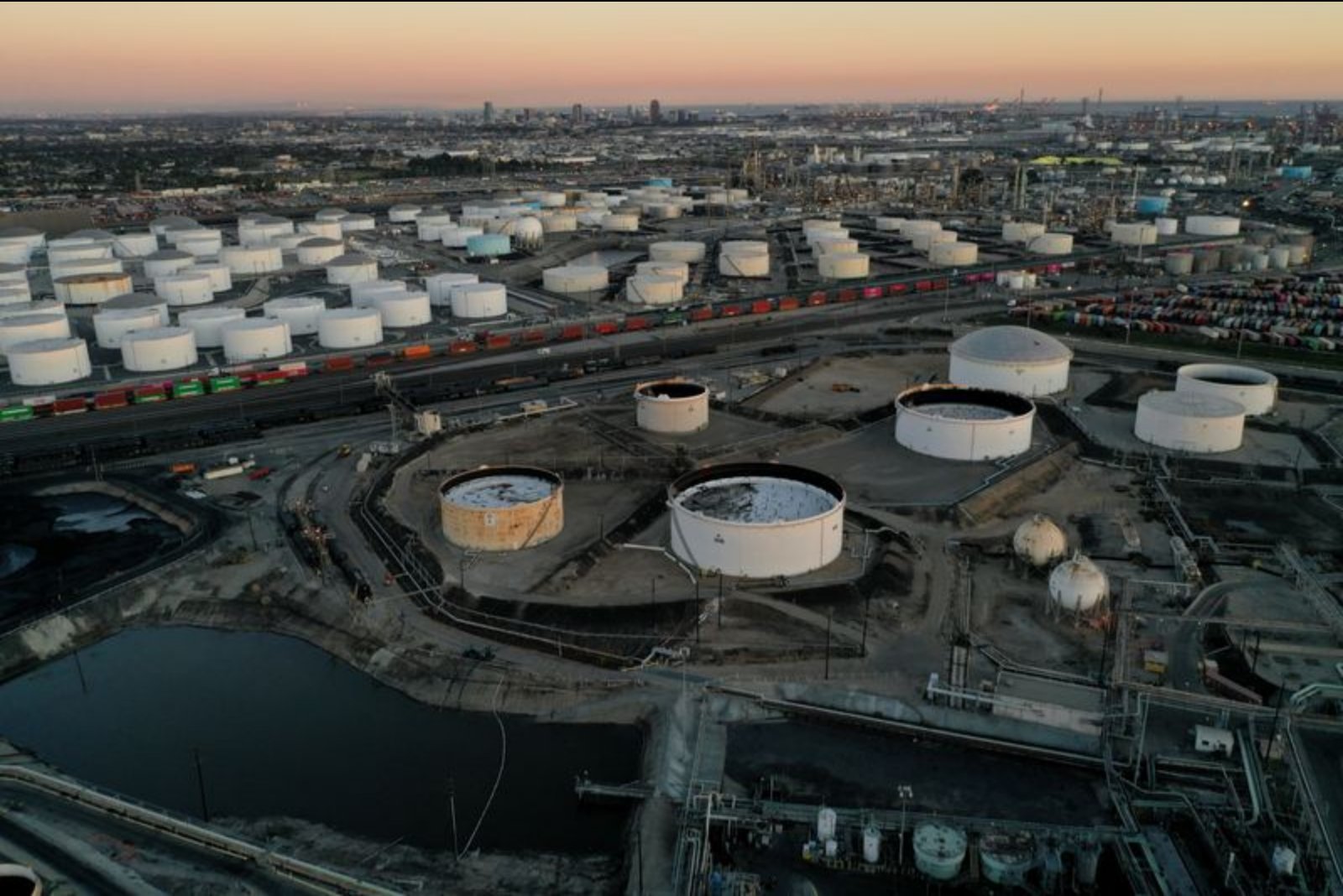
Demand for storage of U.S. distillate fuels - including diesel and jet fuel - has surged markedly since the start of the Israel-U.S. war with Iran, as traders seek to position barrels for export to Europe and Asia, according to a storage broker.
Tank Tiger, a storage marketplace, reported that weekly bids for distillate fuel storage on its platform have climbed 242% to 1.3 million barrels so far this month compared with February, Chief Operating Officer Steven Barsamian said. The bulk of that activity is focused around export hubs in Texas on the U.S. Gulf Coast and on the New Jersey coast of the U.S. East.
"This is the clearest physical-market signal yet that traders are positioning for sustained Hormuz disruption," Barsamian said, pointing to the way trading activity has shifted toward locations with ready access to international tanker routes.
The conflict has tightened shipping through the Strait of Hormuz, a chokepoint through which roughly one fifth of global oil supplies transit, and it has had an outsized effect on middle distillates. Distillate markets were already under strain because of refinery problems worldwide that had kept supplies relatively tight in recent years; the latest disruption has amplified that imbalance.
Higher jet fuel prices have already contributed to flight cancellations, while elevated diesel costs threaten to push up transportation and finished-goods prices across sectors ranging from food distribution to furniture delivery. Traders are responding by buying storage and planning exports from U.S. supply centers.
Independent oil traders based in Dubai, Shohruh and Bekzod Zukhritdinov, said: "As Middle East flows remain disrupted and freight costs rise, U.S. barrels are becoming the marginal supply for the global distillate market." Their observation underscores the shift of marginal supply away from the Middle East toward Atlantic Basin sources.
Competition for U.S. distillates is driven by shortages both in Europe and Asia, regions that previously relied heavily on Middle Eastern exports. Ship-tracking firm Kpler's data show that about three quarters of jet fuel and roughly a quarter of gasoil and diesel exports transiting the Strait of Hormuz went to Europe last year. With those flows curtailed, European buyers are now competing with Asian customers for available barrels.
U.S. refiners have reacted by routing distillate cargoes to less common long-haul destinations, including shipments from the Gulf Coast to Australia, reflecting the global scramble for product. Traders appear to be betting that such routes will remain attractive until Middle East output and shipping normalize.
Regional inventories are adding to the urgency. U.S. East Coast distillate fuel stocks were 27.6 million barrels last week, 18% below the five-year average for this time of year, according to U.S. government data. Total U.S. distillate stocks stood about 3% below the five-year seasonal average, leaving limited domestic slack to support expanded exports without drawing down inventories.
Market structure has shifted as a result. The April HOGO swap - which measures the spread between U.S. benchmark ultra-low sulfur diesel and European ICE gasoil - widened from 18.5 cents a gallon on February 26 to 31 cents a gallon on Tuesday, Sparta Commodities data showed. That widening reflects stronger U.S. domestic values relative to Europe, and influences the economics of routing barrels between basins.
Analysts note that Europe may have briefly benefitted from a record release of emergency stockpiles coordinated by the International Energy Agency, which is expected to include distillates held in Europe. However, the broader disruption of Middle East flows means Europe has lost a substantive portion of its middle-distillate supply, driving the current scramble for replacements.
"Europe has lost a meaningful chunk of Middle East middle-distillate supply and is scrambling for replacement barrels from the Atlantic Basin," Barsamian said, tying the pressure on European markets directly to shifts in tanker routing and storage demand in North America.
How market spreads evolve will be critical to trade flows going forward. Sparta Commodities' Noel-Beswick said the HOGO spread will need to reverse and tighten to make exports from the U.S. to Europe more commercially viable. "I have a bearish view on the HOGO from here as it needs to move to a position to open the U.S. Gulf Coast ultra-low sulfur diesel medium-range tanker route to Europe," he said.
For now, traders appear to be using storage as a tool to arbitrage international price differences and to ensure cargoes can be assembled quickly for buyers in Europe and Asia. The concentration of bids in Texas and New Jersey signals where exporters expect demand to be strongest while uncertainty persists over future shipping through Hormuz and the pace at which regional refining and shipping patterns normalize.
Summary
Since the onset of the Israel-U.S. war with Iran, weekly bids for U.S. distillate storage have risen 242% to 1.3 million barrels versus February, with activity concentrated in Texas and New Jersey as traders position for sustained export demand. The Strait of Hormuz disruptions have cut Middle East middle-distillate flows, intensifying competition between Europe and Asia for Atlantic Basin supplies and tightening regional inventories in the U.S. East Coast.
Key points
- Storage bids on Tank Tiger's platform rose 242% to 1.3 million barrels so far this month compared with February, signaling increased export preparation.
- U.S. East Coast distillate stocks are 27.6 million barrels, 18% below the five-year average; total U.S. distillates are 3% below the five-year seasonal average, tightening domestic availability.
- Markets are responding to cuts in Middle East supplies - about three quarters of jet fuel and a quarter of gasoil and diesel exports through the Strait of Hormuz last year went to Europe - intensifying transatlantic and transpacific competition.
Risks and uncertainties
- Ongoing shipping disruption through the Strait of Hormuz could keep global distillate markets tight, affecting transport, aviation and goods sectors dependent on diesel and jet fuel.
- Inventory drawdowns on the U.S. East Coast limit domestic buffer stocks and may constrain the pace of sustained exports to Europe without further price-driven incentives.
- Movement in the HOGO spread will determine whether U.S. Gulf Coast barrels become economically viable for medium-range shipments to Europe, creating uncertainty for future flow patterns.