
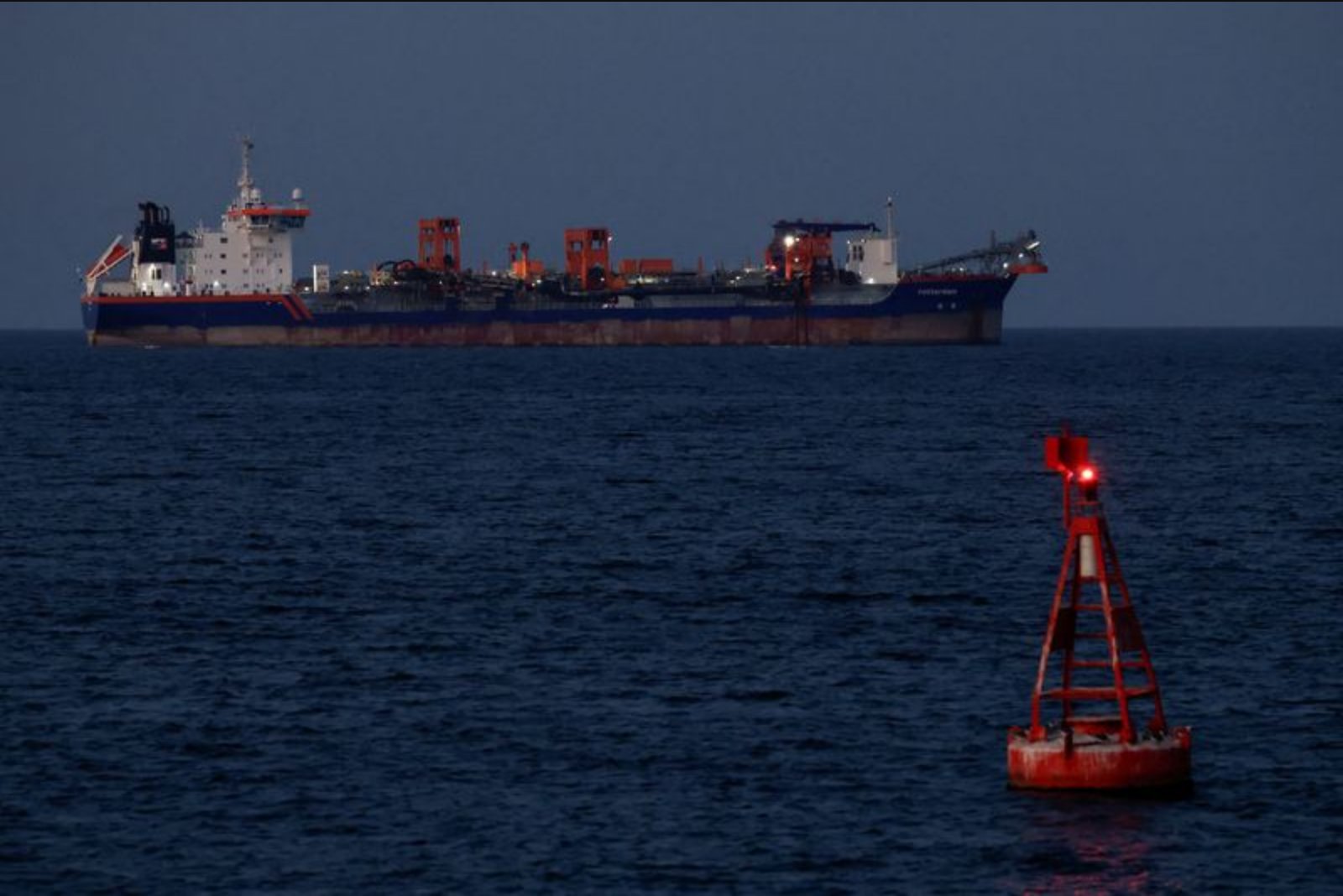
The Pentagon is examining ways to provide protective escorts for commercial shipping transiting the Strait of Hormuz, General Dan Caine, U.S. Chairman of the Joint Chiefs of Staff, said on Tuesday. The move follows a near-total cessation of normal traffic through the narrow waterway, a development with clear implications for global oil, liquefied natural gas and fertilizer flows.
Approximately a fifth of the world’s oil and liquefied natural gas normally move through the strait, which links the Gulf to the Gulf of Oman and serves as the only maritime outlet for producers including Kuwait, Iran, Iraq, Qatar and the United Arab Emirates. United Nations data indicate traffic through the strait has fallen by 97% since the U.S.-Israeli war against Iran began on February 28.
What is at stake
The immediate economic concern is oil. Oil prices spiked to the highest intraday level since 2022 on Monday, reflecting market anxiety over a potential prolonged disruption. Elevated oil prices risk triggering another wave of cost-of-living pressures similar to those seen after the 2022 surge, according to United Nations commentary cited in the reporting.
Beyond crude, the strait is a critical artery for fertilizer components. Analytics firm Kpler estimates about 33% of the world’s fertilizers, including sulphur and ammonia, pass through the Strait of Hormuz. A sustained interruption to these flows could create a fertilizer shortage and pose risks to global food security.
Iran’s posture and the immediate effect on shipping
Iran’s Revolutionary Guards have warned they will fire on any ship passing through the strait. Since the conflict began, at least 11 vessels have been attacked. Much of the remaining shipping traffic has been suspended, driven both by direct security concerns and a surge in insurance premiums for vessels operating in the area - premiums in some cases have risen by as much as 300%.
Commitments from the United States and other states
U.S. leadership has signalled a willingness to step into a protective role. President Donald Trump said on March 3 that the United States would provide protection for oil tankers transiting the strait, and that he had directed the United States Development Finance Corporation to offer insurance and guarantees for shipping companies.
European and Asian actors have also weighed in. French President Emmanuel Macron said several European countries, India and other Asian states planned a joint mission to protect commercial shipping, but he added that such an operation could only occur once the broader conflict ends. France is deploying about a dozen naval vessels, including its aircraft carrier strike group, to the eastern Mediterranean, the Red Sea and potentially the Strait of Hormuz.
British Prime Minister Keir Starmer has discussed options for supporting commercial shipping in the strait with German and Italian leaders, according to a government spokesperson. On the operational front, General Caine told reporters at the Pentagon: "We’re looking at a range of options there," without elaborating on specific measures.
Why the Strait of Hormuz is hard to secure
Several geographic and tactical factors make the strait exceptionally difficult to defend. Shipping lanes narrow to roughly two nautical miles, and vessels are required to negotiate a turn opposite Iranian islands and a mountainous coastline that provides cover for Iranian forces, according to analysis from shipping broker SSY Global. Those constraints compress transit corridors and limit maneuvering space for merchant ships and their potential escorts.
How feasible sustained escorts would be
Assessments by retired and current maritime analysts indicate that short-term, limited escort operations are technically possible but would be resource-intensive and risky to maintain over months.
Tom Sharpe, a retired Royal Navy commander, noted that while Iran’s conventional navy has largely been degraded, the Islamic Revolutionary Guard Corps retains an array of asymmetric weapons capable of inflicting harm. Those include fast attack craft, uncrewed surface vessels, speedboats, mini submarines, mines and explosive-laden jet skis. Additionally, the Centre for Information Resilience, a non-profit research group, estimates Tehran has the capacity to manufacture around 10,000 drones a month.
Sharpe said it would be feasible in the near term to escort three or four merchant vessels a day through the strait using seven or eight destroyers to provide air cover, assuming the threat from mini submarines could be reduced. However, he cautioned that sustaining such a tempo for months would demand significantly more resources.
Adel Bakawan, Director of the European Institute for Middle East and North African Studies, observed that even if Iran’s ability to launch ballistic missiles, drones and floating mines were neutralized, shipping would still be vulnerable to suicide operations.
Kevin Rowlands, Editor of the RUSI Journal at the Royal United Services Institute, said that if the conflict continues for weeks some form of escort is likely to be organized: "The world needs oil to flow through from the Gulf, and so there is planning ongoing to put protection measures in place."
Lessons from other regional choke points
Events in nearby maritime corridors underline the difficulty of keeping major shipping routes open in the face of determined asymmetric forces. Yemen’s Houthi movement, which is allied with Tehran but operates with a smaller military capability, succeeded in closing most traffic through the Red Sea and the Bab al-Mandab Strait on the route to the Suez Canal for more than two years despite protective measures by forces led by the United States and European Union.
Because of those disruptions, much shipping is currently rerouted around the Cape of Good Hope at the southern tip of Africa, a voyage that materially lengthens transit times. Some carriers have begun a phased return to the Suez route; Danish shipping company Maersk had indicated it planned a staggered resumption of Suez transits from January.
By contrast, an EU-led operation has been more effective at countering piracy off Somalia, where adversaries have been less well equipped than Iran’s Revolutionary Guards. Those differing outcomes underscore that the nature and capability of the opponent shape the effectiveness of naval protection efforts.
Are there alternatives to the strait?
Some Gulf states have attempted to reduce reliance on the Strait of Hormuz by developing pipeline routes that bypass the waterway. The United Arab Emirates and Saudi Arabia have pursued such pipeline projects, but the pipelines are not currently operational. Moreover, past attacks - notably an assault by Houthi militia on an east-west Saudi pipeline in 2019 - demonstrate that overland or alternative maritime routes can also be vulnerable.
Conclusion
Securing the Strait of Hormuz for sustained commercial transit involves confronting a mix of geographic constraints, heightened enemy capabilities and the logistical limits of naval forces. Short-term escorted transits appear feasible at a limited scale, but maintaining a continuous, safe conduit for the volume of oil, gas and fertilizer that normally passes through the strait would require substantially greater resources and risk tolerance. With insurance costs spiking and many carriers already avoiding the route, planners face the dual challenge of neutralizing a diverse set of maritime threats and coordinating an international response capable of operating over an extended period.