
Oil futures strengthened on Thursday amid mounting concerns about extended closures of the Strait of Hormuz and constrained Middle East flows brought on by the U.S.-Iran military confrontation. By 0141 GMT, Brent crude was trading up $1.67, or 2.05%, at $83.07 per barrel, while U.S. West Texas Intermediate rose $1.94, or 2.60%, to $76.60 per barrel.
The conflict expanded on Wednesday after a U.S. strike struck an Iranian warship off Sri Lanka. In parallel, U.S. Senate Republicans sided with President Donald Trump’s military campaign by voting against a bipartisan resolution that sought to halt the air war and require Congress to authorise hostilities against Iran.
Regional supply has been hit as well. Officials told Reuters that Iraq, the second-largest crude producer in OPEC, has cut output by nearly 1.5 million barrels a day because of a lack of storage and an available export route. At the same time, Qatar - the Gulf's largest liquefied natural gas producer - declared force majeure on gas exports on Wednesday, with sources indicating that returning to normal volumes could take at least a month.
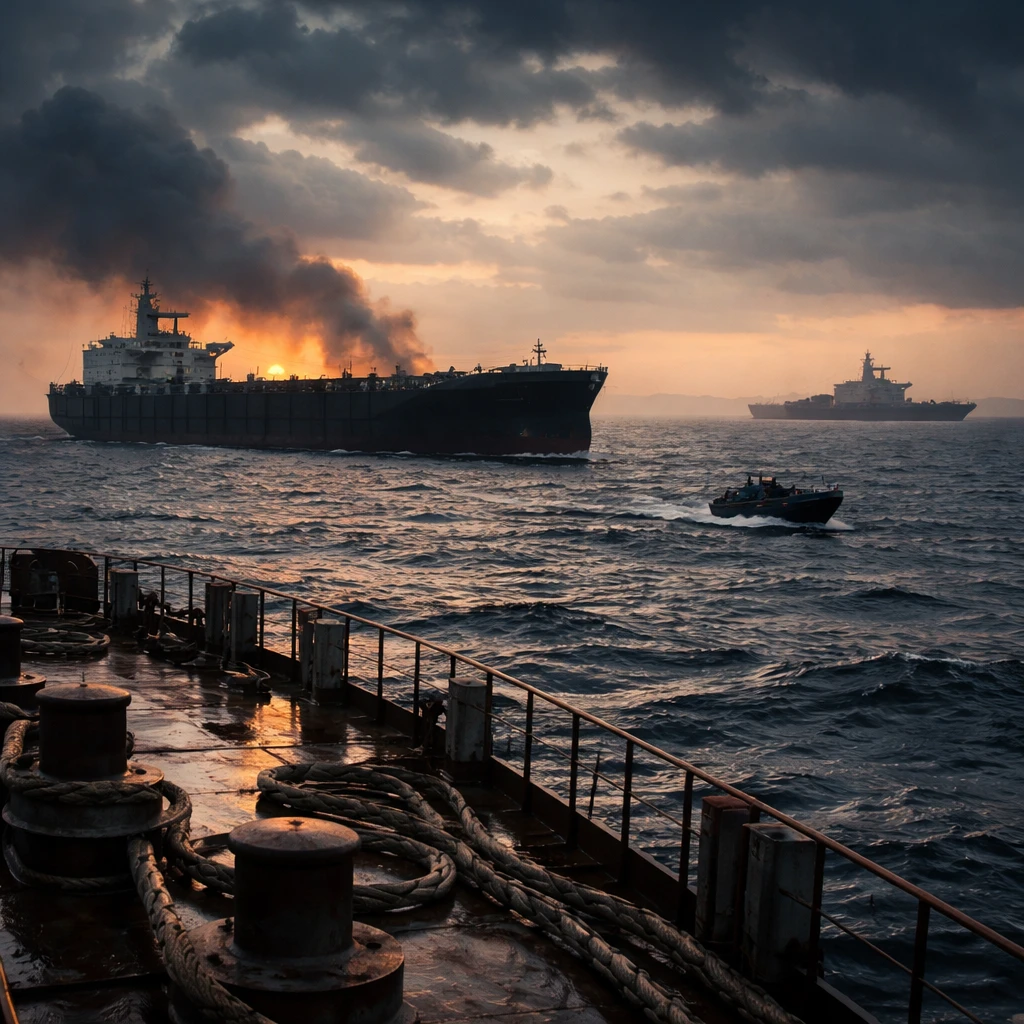
Shipping through the Strait of Hormuz - a critical channel that handles nearly a fifth of the world's energy consumption - has been brought to a near-halt for a fifth consecutive day amid the war and Tehran's retaliatory actions. Britain's maritime trade operations agency reported a large explosion heard and seen by the master of a tanker anchored 30 nautical miles southeast of Kuwait's Mubarak Al Kabeer, and said a small craft was later observed leaving the area.
J.P. Morgan noted that Iran has avoided strikes on most critical energy infrastructure even while keeping shipping risk exceptionally high, and estimated that about 329 oil vessels are currently stuck in the Gulf.
In a client note, J.P. Morgan added that "storage capacity in the Gulf Cooperation Council countries and prevailing energy prices are limiting factors on the length of the U.S. campaign." The bank referenced the Gulf Cooperation Council as the political and economic alliance of Saudi Arabia, the United Arab Emirates, Qatar, Kuwait, Oman and Bahrain.
J.P. Morgan also assessed the potential pace of recovery for shut-in fields. The firm said most oil fields can be restarted within days, with full capacity typically restored within two to three weeks. It noted, however, that while operators must gradually rebuild reservoir pressure - particularly in Iraq, where water injection is critical - the principal constraint at present is logistical rather than geological.
Market participants are closely watching both the physical disruption to shipments and the operational constraints facing producers. The combined effects of halted shipping, storage shortages and export bottlenecks have translated into higher spot and futures prices as traders reassess near-term supply availability.