
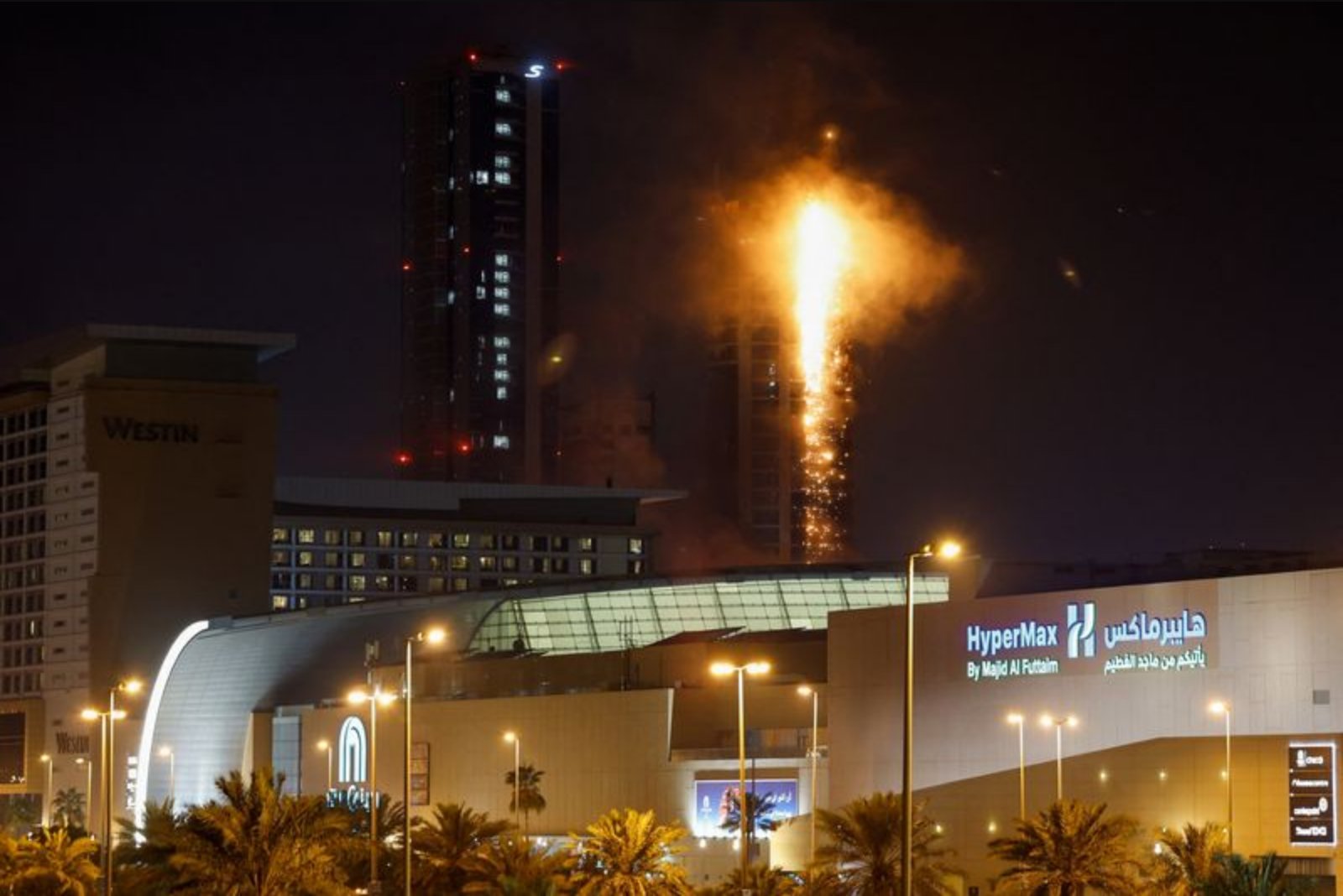
DUBAI - Thunderous detonations and towering columns of fire from missiles launched by Iran tore across skies above Gulf states, underscoring leaders' long-standing fear that Tehran can project force into their territories and likely solidifying Arab rulers' backing for U.S.-Israeli military actions.
The strikes were felt as far afield as Palm Jumeirah, where explosions shook buildings and struck a luxury hotel, sending residents into the streets as interceptors and incoming warheads crisscrossed the sky. The scale and visibility of the blasts made clear that the confrontation had moved beyond Iran's borders - a move Tehran had previously warned it might take.
"What has now been proven is that we - not the United States - are in the line of fire," said Dr Ebtesam Al-Ketbi, President of the Emirates Policy Center. "When Iran struck, it struck the Gulf first under the pretext of targeting U.S. bases."
Analysts interpret Iran's strikes into Gulf states as a message designed to show that no American ally in the region is out of range, and to increase the strategic cost of supporting Washington's campaign. Such demonstrations of reach are viewed as attempts to deter or dissuade regional backing for the U.S.-led actions.
"The danger is that any miscalculation could push the region from an exchange of signals into an open war," Dr Al-Ketbi added, underlining the precarious balance between signalling and a broader conflagration.
Gulf officials and analysts say Tehran's decision to target oil-rich states effectively internationalises the battlefield, threatening not only regional security but also global energy flows. For fast-growing Gulf economies that depend on open airspace, secure shipping lanes and uninterrupted trade, the prospect of a wider conflict would be profoundly disruptive.
Mohammed Baharoon, director-general of the Dubai Public Policy Research Center (B'huth), said the current framing of the confrontation as a campaign aimed at regime change in Tehran makes the contest existential and elevates the probability that Iran might lash out.
"If Iran miscalculates and carries out an act of war against Gulf Cooperation Council countries, the conflict will change fundamentally. People can’t stand by while lives are being lost and assets destroyed and do nothing," Baharoon said.
Other Gulf analysts are more direct in their assessment of Tehran's calculations. Abdelkhaleq Abdulla described the strikes as a strategic error that risks alienating Iran's nearest neighbours.
"It is foolish of Iran to alienate the people nearest to it," Abdulla said. "Tehran may believe it is targeting U.S. military bases, but Gulf states see this as a blatant act of aggression - a violation of their sovereignty and an attack on their land."
In recent weeks, indirect talks between the United States and Iran aimed at averting a full-scale war produced an agreement in principle to discuss Iran's nuclear programme. Those engaged in the exchanges said Iran insisted that its ballistic missile capabilities and its backing for regional militias be excluded from the discussions, setting conditions that any talks over missiles and allied groups occur only in a broader regional forum without Washington's direct involvement.
Gulf Arab states, many of them longstanding partners of the United States with prior experience of being struck by Iran or its proxies, contend that sidelining Washington would weaken rather than strengthen regional security arrangements. From their perspective, Tehran's missile inventory and proxy relationships represent direct security threats.
Tehran did propose a regional security forum that would exclude U.S. participation, but Gulf capitals judged it to have limited value without external security guarantors. One source close to government circles remarked on the implications for the region, saying the strikes have had a unifying effect among U.S. allies across the Gulf.
Observers also noted a marked shift in U.S. rhetoric and objectives. Paul Salem of the Middle East Institute pointed out that the tone from the U.S. leadership has moved quickly from using the prospect of strikes as leverage for a nuclear negotiation to explicitly calling for regime change in Iran. That change in stated goals raises the stakes and alters calculations across the region.
The current U.S. approach appears to favour a limited campaign of air strikes intended to produce rapid, visible results while minimising U.S. casualties and domestic political exposure. That strategy contrasts with the large-scale ground invasion model used in Iraq in 2003, where the U.S. deployed hundreds of thousands of troops and pursued a prolonged occupation.
Yet analysts warn that if the confrontation expands - bringing U.S. bases, diplomatic facilities, energy infrastructure, or the Strait of Hormuz into the fight - the economic and political costs would rise sharply for the United States, Gulf partners and global markets. Disruption to oil shipments or shipping lanes would have significant consequences for trade and energy prices worldwide.
As Gulf states assess the immediate tactical threat to their territories and economic lifelines, governments face a choice about how closely to align with external security partners or pursue alternative regional arrangements. The strikes have, at minimum, reinforced anxiety about direct vulnerability and strengthened the incentive among Gulf allies to coordinate their response to Tehran's actions.