
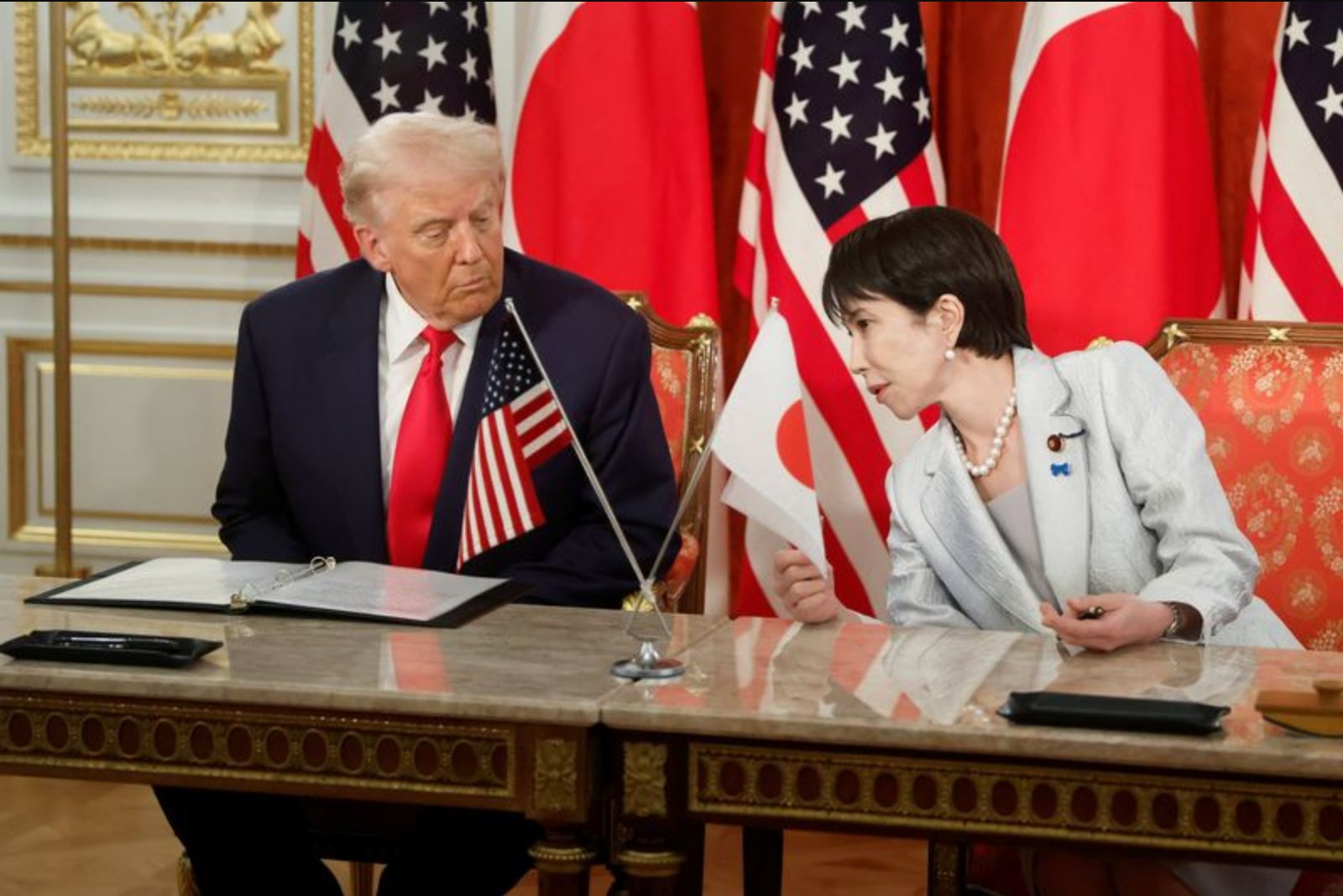
President Donald Trump plans to use a long-scheduled White House meeting with Japan’s prime minister to press Tokyo for assistance related to the war on Iran, a request that places Japan’s leader in a complicated position as she evaluates what support her country can offer.
The centerpiece of the expected request is military and materiel support to address problems arising from the conflict in the Gulf. The White House is seeking more ships to help clear mines and escort tankers through the Strait of Hormuz, which Iran has largely closed in the course of the conflict. Separately, Washington is expected to ask Tokyo to produce or co-develop missiles to help replace U.S. munitions that have been drawn down by the Iran war and by Russia’s war in Ukraine.
Those asks come as Japan contemplates the legal and political limits on committing forces or directly participating in operations outside its narrow constitutional constraints. The Japanese prime minister has told parliament that her government has not received an official U.S. request but is reviewing the options available within the limits of Japan’s constitution. Domestic opinion in Japan is broadly cool toward the Iran war, and Tokyo has so far not offered to assist in clearing the Strait of Hormuz.
“This has suddenly become a very fraught visit for Takaichi,” said Chris Johnstone, a former White House official who is now a partner at the Asia Group consultancy. “She was hoping to be effectively the last voice in the room that could influence the president’s approach to his trip to China. Instead, she’s going to be basically the first ally in the room responding to Trump’s request for assistance in the Middle East.”
The visit is officially framed as a chance to reinforce the decades-old security and economic partnership between Washington and its closest East Asian ally. The two leaders are due to discuss implementation of a trade deal the countries signed in 2025, along with energy, secure supply chains, regional security matters, and bilateral cooperation in science, technology and defense, a White House official said, declining to directly comment on how Trump’s demands over the Iran war would feature in talks.
Japan also expects that the U.S. president will press for Japanese involvement in a missile production role to help refill Western stocks. Tokyo is reportedly still assessing how to respond to such requests, according to Japanese government sources.
Tokyo’s foreign posture adds complexity. Unlike Washington, Japan maintains diplomatic relations with Tehran, a channel that could theoretically be used for diplomatic approaches toward ending the war, though Japan’s own past efforts to mediate with Iran in 2019 did not succeed.
Compounding the diplomatic awkwardness, U.S. intelligence agencies recently highlighted remarks the Japanese leader made last year in support of Taiwan as marking a “significant shift” for a Japanese leader. That characterization has added sensitivity to her position as she seeks to balance messages to Washington and Beijing, particularly ahead of a planned U.S. presidential visit to China that has now been postponed from an earlier plan for a visit in two weeks.
Trump has previously criticized allies for what he views as tepid backing of the U.S.-Israeli military campaign, and at times has said the United States does not need allied help. Yet the administration’s present requests for more ships to secure the Strait of Hormuz and for additional missile production capacity indicate Washington is pursuing allied contributions even as it expresses frustration with their limitations. Several U.S. allies, including Germany, Italy and Spain, have explicitly ruled out participation in any Gulf mission, a stance that has drawn the ire of the U.S. president.
Domestically in Japan, the prime minister has sought to steer the country away from the strictly pacifist posture embedded in the constitution that was imposed after World War Two. Even so, the unpopularity of the Iran war at home has constrained how far Tokyo has been willing to go in offering direct military assistance.
Officials in Tokyo have said the prime minister will highlight concerns about a more assertive China in her discussions in Washington, and had hoped to influence the U.S. president’s approach to his planned China trip. Instead, Japanese sources say she could be first among allies to face an explicit request from Trump to help with the Middle East situation.
In addition to security cooperation, the meeting is expected to yield new Japanese private and public investment pledges tied to projects in the United States that have the president’s approval. The Japanese government previously committed $550 billion as part of an effort to secure relief from tariffs the U.S. president imposed last year. For the second tranche of investments, Japan could pledge some $60 billion across sectors including critical minerals and energy, according to a person familiar with meeting plans. Tokyo has already committed to three projects worth $36 billion.
Japan also plans to join the “Golden Dome” missile defense initiative, intended to improve detection, tracking and potential countermeasures against incoming threats from orbit, Japanese government sources said. That announcement is expected to be part of the package of defense cooperation that Tokyo will present in discussions with Washington.
How Tokyo ultimately responds to American requests - whether for ships to operate in the Strait of Hormuz, participation in missile production, formal involvement in regional security efforts, or increased investment in U.S. projects - will depend on its constitutional limits, domestic political calculations, and existing diplomatic ties with Tehran. For now, the visit is shaping up as a high-stakes diplomatic moment in which Japan must navigate between strategic partnership with the United States and legal and political constraints at home.
Summary: In a White House visit that was intended to reinforce U.S.-Japan ties, the Japanese prime minister faces likely U.S. requests for military support linked to the Iran war, including ships to secure the Strait of Hormuz and missile production cooperation. Tokyo is weighing constitutional limits, domestic opposition, its diplomatic relations with Tehran, and ongoing economic commitments to the United States as it decides how to respond.