
The International Energy Agency (IEA) reported on Thursday that the current conflict in the Middle East has produced the most significant supply disruption ever recorded in the global oil market. The agency sharply revised down its annual supply outlook while noting that IEA members unanimously approved the largest emergency stock release in the agency's history.
A now more than week-old joint U.S. and Israeli assault on Iran has unsettled oil markets, provoking large price swings and renewed concern that inflationary pressures could re-emerge for economies worldwide. Brent crude was last trading at roughly $97 a barrel, after briefly topping $100 earlier in Asian trading. Earlier in the week, the global benchmark surged to nearly $120 a barrel.
Central to the supply shock is an effective stoppage of tanker traffic through the Strait of Hormuz, the narrow waterway south of Iran through which roughly one-fifth of global oil supplies flowed before the conflict. The IEA said flows of crude and oil products via the strait have slowed to a "trickle" from about 20 million barrels per day prior to the outbreak of war late in February.
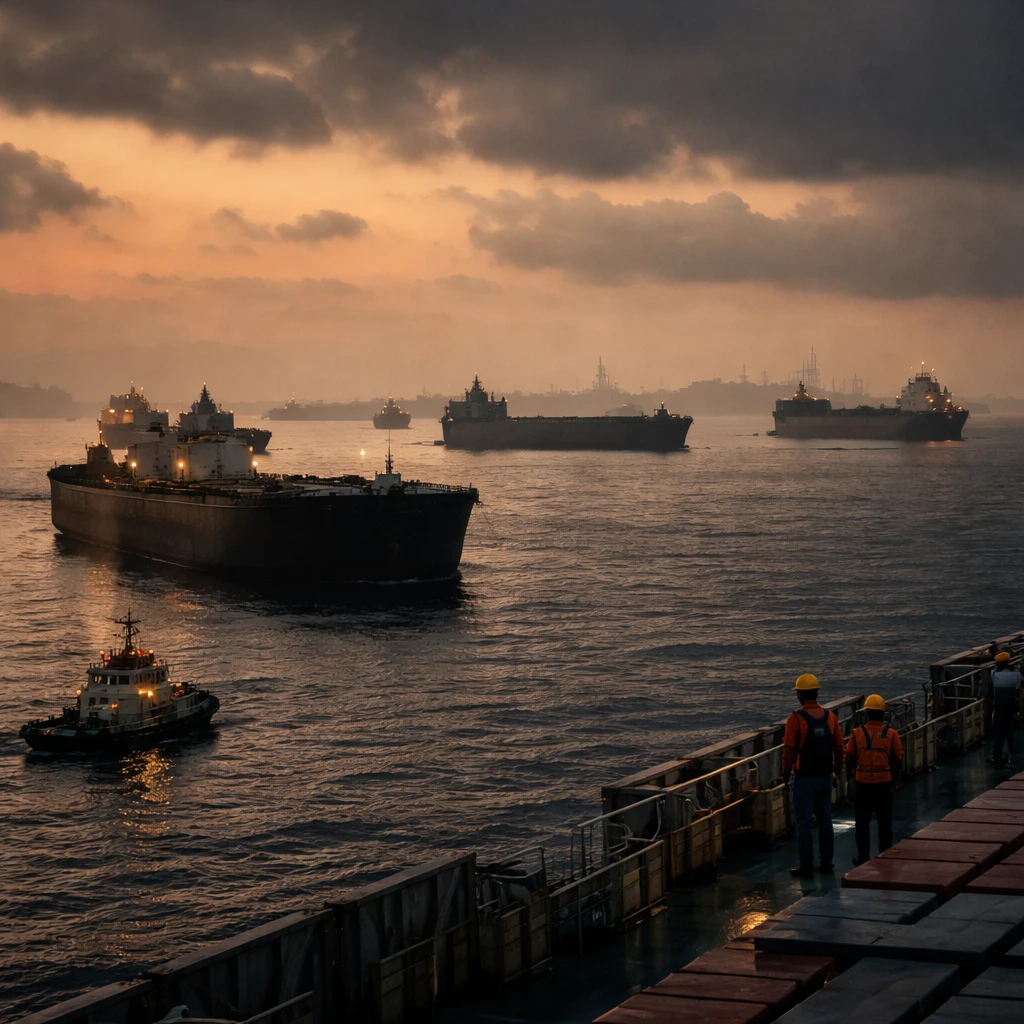
Container shipping companies and tanker operators have grown increasingly reluctant to send vessels through the strait, citing concerns about crew safety and difficulty obtaining insurance for voyages that cross the choke point. With few vessels willing to make the passage and with limited capacity available to reroute around the narrow waterway, downstream storage has begun to fill.
Those constraints have forced major producing nations in the Gulf region to cut total oil output by at least 10 million barrels per day, according to the IEA. The agency warned that "in the absence of a rapid resumption of shipping flows, supply losses are set to increase." Globally, the IEA now expects oil supply to drop by 8 million barrels per day in March, with the Middle East curtailments only partly offset by higher output from Russia, Kazakhstan and non-OPEC+ producers.
On an annual horizon, the IEA has markedly reduced its 2026 supply forecast. The agency now projects a 2026 average increase in global oil supply of 1.1 million barrels per day, largely driven by non-OPEC+ producers. That is down from a February projection of 2.4 million barrels per day, a figure that had anticipated growth balanced evenly between OPEC+ and non-OPEC+ countries.
The conflict has also affected demand expectations. Widespread flight cancellations across the Middle East and significant disruptions to liquefied petroleum gas supplies are seen trimming global oil demand by roughly 1 million barrels per day during March and April compared with previous estimates. The IEA cautioned that higher oil prices and a more precarious outlook for the global economy add further downside risks to its forecast.
Despite the turmoil, the agency still projects an increase in oil consumption for 2026, but at a lower rate. The IEA said oil consumption is set to rise by 640,000 barrels per day year-on-year in 2026, a downgrade of 210,000 barrels per day from its estimate a month earlier.
In an effort to steady volatile markets, IEA members unanimously approved the release of a record 400 million barrels from emergency reserves on Wednesday. Analysts cited in the IEA report suggested that the stock release may only provide temporary support, and noted that a sustained improvement in market sentiment will likely depend on the restoration of shipping through the Strait of Hormuz.
The IEA's account underlines how a chokepoint in global maritime logistics, coupled with sharply reduced willingness by carriers to transit risky waters, can rapidly translate into large-scale physical shortages, rising prices and downward pressure on global economic forecasts.
Summary
The IEA says the Middle East conflict has caused the biggest oil supply disruption in history by effectively halting most flows through the Strait of Hormuz, forcing Gulf producers to cut at least 10 million barrels per day and leading to an estimated 8 million barrel per day global supply drop in March. The agency reduced its 2026 supply outlook to a 1.1 million barrel per day increase and IEA members approved a 400 million-barrel emergency stock release.
Key points
- Shipping through the Strait of Hormuz slowed to a "trickle" from around 20 million barrels per day, prompting major Gulf output cuts and disrupting global energy flows - sectors affected: shipping, oil production, insurance.
- Global oil supply is estimated to fall by 8 million barrels per day in March, partially offset by higher output from Russia, Kazakhstan and non-OPEC+ nations - sectors affected: energy markets, refining, trade.
- IEA members approved a record 400 million-barrel release from emergency reserves to calm markets, though analysts say this may only be short-term relief - sectors affected: strategic reserves management, financial markets.
Risks and uncertainties
- Absent a rapid resumption of shipping through the Strait of Hormuz, the IEA warns that supply losses are likely to increase - impacting global oil supplies and energy-dependent industries.
- Higher oil prices and a more precarious global economic outlook could further alter demand and supply dynamics, posing downside risks to forecasts - impacting financial markets and broader economic activity.
- Storage capacity constraints and limited rerouting options around the chokepoint may prolong disruptions and pressure freight and insurance markets - impacting shipping, logistics and cargo insurers.