
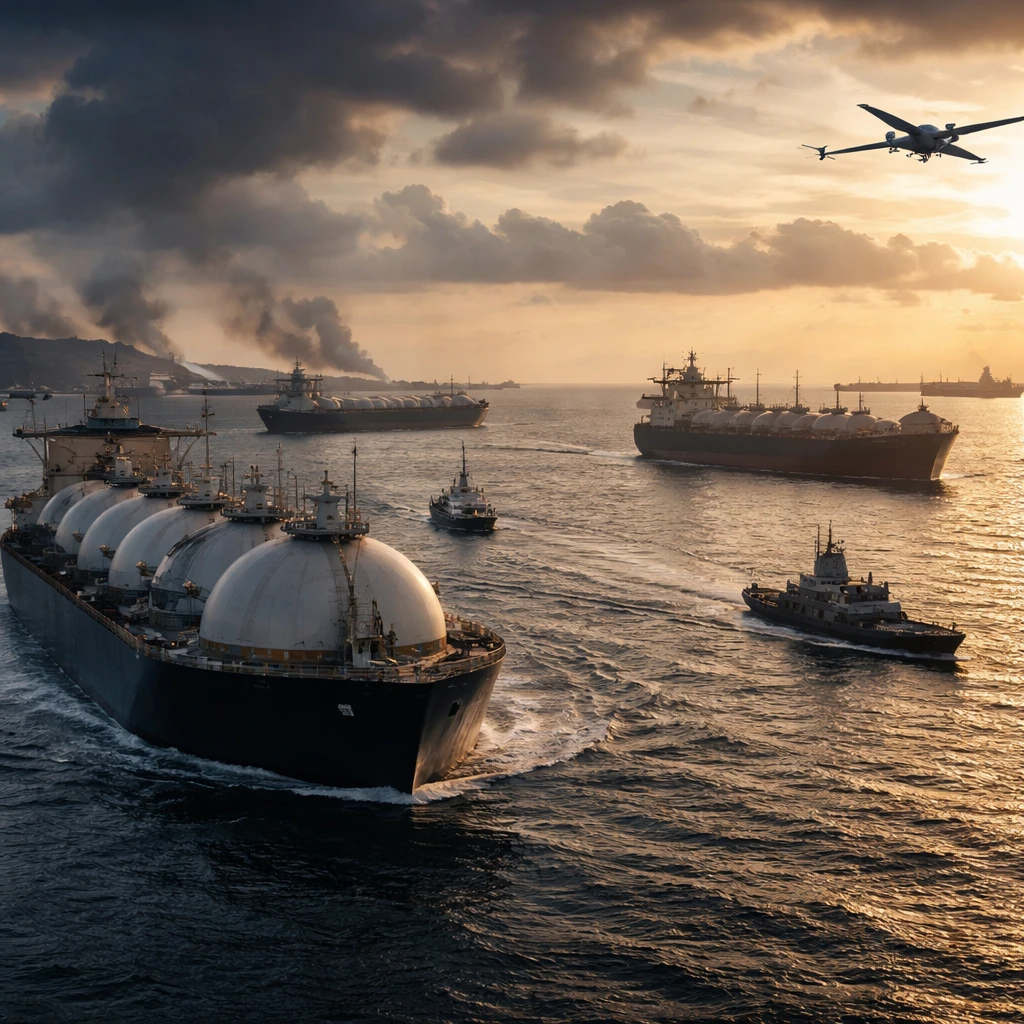
Goldman Sachs analysts have modeled a severe market scenario in which tanker movements through the Strait of Hormuz stop entirely following recent military strikes and counterstrikes involving Iran and other regional actors. The brokerage concludes that a complete one-month shutdown of LNG flows through the waterway would lift Dutch TTF natural gas prices toward 74 EUR/MWh ($25/mmBtu), an increase of roughly 130% from current levels.
Under that same framework, a disruption lasting longer than two months would likely push European natural gas prices above 100 EUR/MWh ($35/mmBtu), according to the note. Goldman highlighted that price thresholds of the magnitudes cited have in the past triggered large demand responses during periods of acute tightness in Europe, such as the 2022 energy crisis.
The brokerage emphasizes the strategic volume that transits the Strait: roughly 80 million tonnes per annum of LNG, equivalent to about 19% of global LNG supply, much of it originating in Qatar. The note connects the prospect of major supply interruptions to a visibly disrupted tanker corridor after Israel and the United States launched military operations against Iran's leadership, and Iran then fired ballistic missiles and drones at U.S. assets and allied facilities across the region. The list of locations identified as targeted includes Israel, Bahrain, Kuwait, Qatar, Oman, the United Arab Emirates, Saudi Arabia and Jordan.
Goldman also reported that three oil tankers were damaged in the region over the weekend referenced in the note. Those incidents, combined with the broader security concerns, have already shown up in crude markets as an immediate risk premium. The brokerage estimated that crude prices embedded an estimated $18 per barrel real-time risk premium at the March 1 market open, a figure inferred from a 15% weekend rise in WTI retail prices. Goldman said that $18 premium corresponds to the 98th percentile of risk premiums since 2005 and is consistent with markets pricing in roughly a one-month full halt in Strait oil flows, after accounting for some offset via spare pipeline capacity.
The importance of the Strait extends beyond LNG: it is a conduit for nearly 20 million barrels per day, or about one-fifth of global oil production. Goldman noted that Saudi Arabia, Iraq and the UAE together exported 13.1 mb/d via the Strait in 2025, with China identified as the main destination for these flows that year.
To quantify possible oil-market impacts, Goldman offered a range of fair-value estimates. In a full, one-month closure with no offsets, the consultancy quantified a $15 per barrel effect. If instead a 50% partial closure occurred and all estimated 4 mb/d of spare pipeline capacity was utilized, the fair-value impact would be closer to $4 per barrel. The note also set out Iran's production and export figures for 2025: Iran produced around 3.5 mb/d of crude and 0.8 mb/d of condensate, and last year its exports averaged 1.7 mb/d for crude and condensates.
Despite the stressed scenarios, Goldman kept its baseline Brent/WTI price forecast unchanged at $60/$56 by the fourth quarter of 2026, on the assumption that there are no sustained supply disruptions.
On European gas markets, the brokerage said TTF prices had carried little-to-no geopolitical risk premium until the recent market moves, trading in the lower half of Goldman's estimated hard coal-to-gas switching range and modestly below the firm's 36 EUR/MWh forecast for March 2026. If the Strait closure were to be complete for one month, Goldman's fuel-switching models indicate that Europe would need to maximize switching into both hard coal and oil products for more than three and a half months to offset the tightening. That level of switching is equivalent to roughly 8% of northwest European storage capacity.
Global LNG market linkages amplify the exposure. Spot LNG prices in Asia, measured by JKM, face comparable upside risk because the Pacific bound flows are managed against TTF to allocate Atlantic-basin cargoes. By contrast, U.S. Henry Hub prices face limited upside risk under these scenarios. Goldman pointed out that the United States is a large net LNG exporter and that U.S. export facilities typically operate at capacity, leaving little room to expand exports even if global prices spike.
The brokerage also flagged U.S.-specific market signals: prompt U.S. gas prices below $3/mmBtu and a very negative October 2026 to January 2027 spread indicate elevated storage congestion risks for the year.
The disruptions touch product markets beyond crude and gas. Approximately 9% of global gasoil and diesel exports and 18% of global jet fuel exports transited the Strait in 2025, the note said. Freight-cost dynamics have already reacted: Goldman recorded that its average global dirty crude freight rate rose 50% year-to-date, while Very Large Crude Carrier rates from the Arab Gulf to China had tripled over the past month as of the most recent Friday close cited in the note.
Finally, the brokerage set out the limits of spare supply. Global spare production capacity was estimated at 3.7 mb/d, concentrated in Saudi Arabia and the UAE, but Goldman warned that a sustained Strait closure would physically impede OPEC's ability to deploy that capacity. Separately, OPEC+ had announced that it would raise required production by 0.21 mb/d in April.
Summary
Goldman Sachs warns that a one-month complete halt of tanker traffic through the Strait of Hormuz could raise Dutch TTF natural gas to about 74 EUR/MWh, roughly 130% above current levels, while an interruption extending beyond two months would probably push prices above 100 EUR/MWh. The note details corresponding stresses across LNG, crude, refined fuels, freight rates, and spare production capacity, and preserves a base-case oil forecast assuming no prolonged disruptions.
Key points
- European TTF gas could reach 74 EUR/MWh in a one-month full LNG flow shutdown, and exceed 100 EUR/MWh if disruptions last longer than two months - this materially affects European gas pricing and energy-intensive sectors.
- The Strait of Hormuz accounts for about 80 million tonnes per annum of LNG (19% of global supply) and nearly 20 mb/d of oil flows, concentrating market risk for global oil, LNG and refined fuel supply chains.
- Freight rates and spare production dynamics are already reacting - dirty crude freight rates rose 50% year-to-date and VLCC rates from the Arab Gulf to China tripled in the month cited, while global spare production capacity is limited to an estimated 3.7 mb/d.
Risks and uncertainties
- Duration of the Strait disruption - longer closures drive far larger price moves in gas and oil and could physically prevent deployment of spare capacity concentrated in Saudi Arabia and the UAE.
- Fuel-switching and storage limits - Europe's ability to offset LNG losses through coal and oil switching would need to be maximized for months and would consume a notable share of NW European storage capacity.
- Limited U.S. export flexibility - U.S. LNG facilities typically operate at capacity, so Henry Hub prices may be insulated but there is little room to increase U.S. exports during a global spike.