
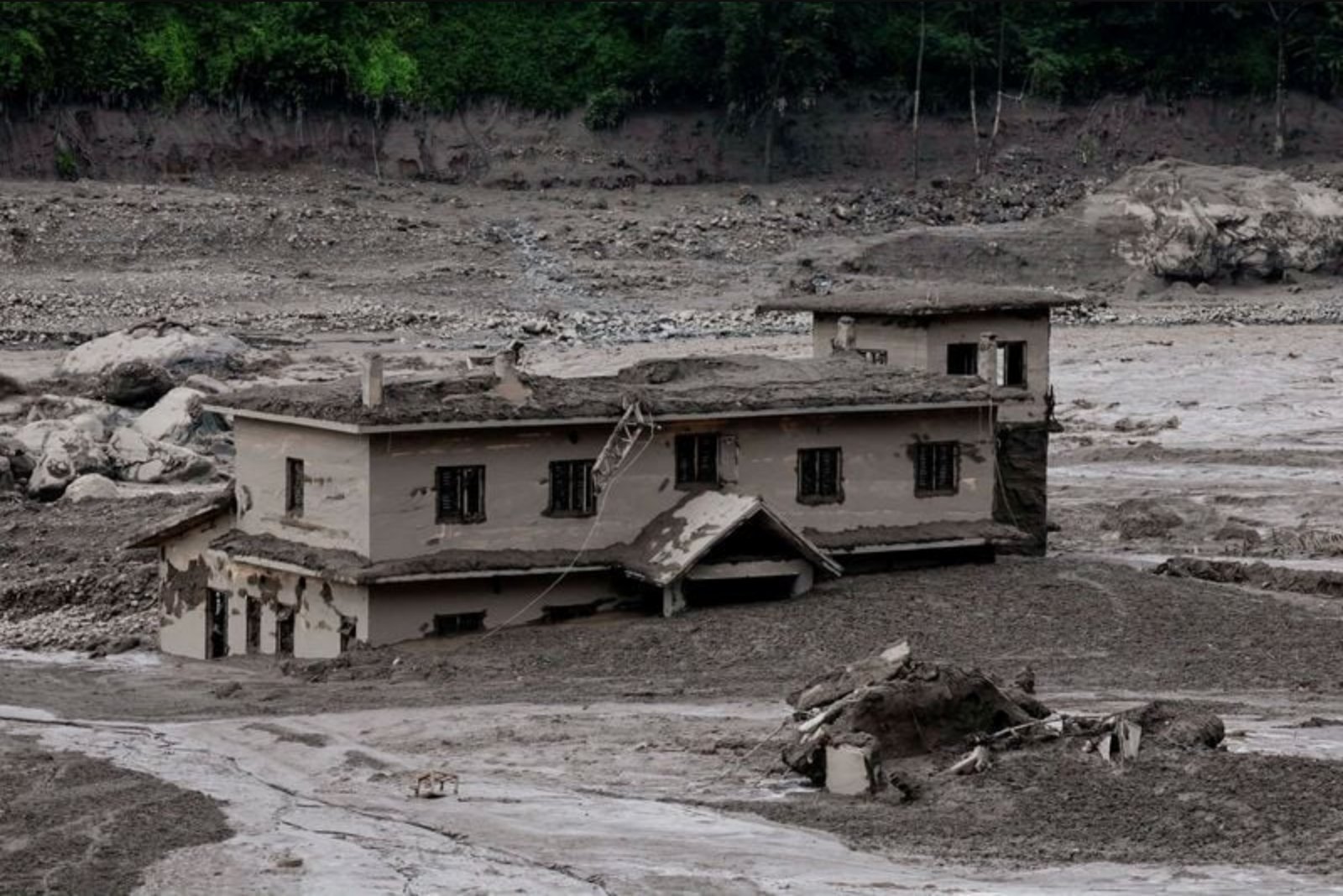
Aug 26 - A dramatic collapse of rock, mud and ice into a Himalayan border river on Wednesday set off catastrophic flooding along the Nepal-China frontier, killing at least nine people and leaving hundreds of visitors unaccounted for, officials said.
Video that has been verified by authorities shows dozens of people being swept away near the border crossing. Officials in Nepal said houses, roads and hydro projects were washed downstream, while Chinese authorities reported fears of "major casualties" and missing people in Gyirong county after a mudslide struck the land crossing at the frontier.
Nepal's tourism authority reported that at least 384 travellers were missing from the affected area, including 105 Indians, 93 Nepalis, three U.S. citizens and 12 British nationals. Separately, South Korea's Yonhap news agency said about eight of its nationals were unaccounted for in Nepal.
Flood alerts were raised in the neighbouring Indian states of Uttar Pradesh and Bihar, which lie downstream where several rivers descend from the mountains into the plains.
What happened
Security camera footage captured on the Chinese side of the border shows people fleeing moments before a towering wall of debris and water overwhelmed buildings and vehicles. The precise trigger for the mudslide remained under investigation. The German Research Centre for Geosciences (GFZ) reported a magnitude 4.4 quake about seven minutes before the time stamp on the security footage.
Qianggong Zhang, head of climate and environmental risks at the Kathmandu-based International Centre for Integrated Mountain Development, said an ice-rock avalanche in the Lhende Khola river on the Nepali side was the immediate trigger, but that the ultimate cause had not been confirmed. He warned that "with a blockage still lodged upstream on the Nepal-China border river, authorities warn a second flood may occur."
Rescue helicopters were unable to land in Syapru Besi and Timure in the Rasuwa district, where the river has swelled beyond its normal channel. Rasuwa, a mountainous district with a population of about 50,000, has seen entire settlements swept away, according to local accounts.
Human and infrastructure toll
Television and witness images from the Nepali side showed collapsed homes, cars floating in floodwaters and a metal bridge being carried away. "There could be heavy casualties or loss of property," district administrator Narendra Pariyar said, urging residents living along the Bhote Koshi river to move to higher ground. Health worker Tula Bahadur BK described the scene succinctly: "There is devastation everywhere we look. The settlements next to the river have been completely swept away. Five of my own relatives are missing."
Chinese state media reported the mudslide struck on the Nepali side but affected the Gyirong port area, severing roads, communications and electricity in the Shigatse region close to the border. At least 574 rescuers had been deployed to the Gyirong land crossing, Chinese state broadcaster CCTV reported. A rescuer filmed by CCTV said travel to the site would take at least four hours due to pathways blocked by 1.5-metre-deep sediment and that debris had surged upstream from Nepal.
President Xi Jinping called for "all-out" search efforts for the missing and urged stronger monitoring and early warning to prevent secondary disasters.
Energy and wider regional impacts
Nepal's energy ministry said 430 MW of electricity supplies were affected, mostly from hydroelectric projects. That amount represents more than 12% of the country's total hydropower capacity of 3.2 GW. Police and military forces joined civilian rescuers in response to the disaster, and Prime Minister Balendra Shah said instructions had been given to relocate residents in lower-lying areas to safer locations and to exercise extra caution along the river.
India's prime minister, Narendra Modi, said New Delhi stood ready to provide humanitarian assistance. He said rescue and relief efforts were being coordinated closely between the two countries' teams.
The Bhote Koshi river, which originates in Tibet, flows into Nepal's Trishuli river and eventually feeds into India as the Gandak river. That hydrological link is part of why downstream areas across national borders were put on alert.
Context and prior events
Last year the Bhote Koshi flood killed nine people and left 24 missing, washing away a "Friendship Bridge" that linked Nepal and China and disrupting cross-border transport and trade for months. That earlier flood was attributed by a regional climate monitor to the draining of a supraglacial lake in Tibet.
Current uncertainties
Rescue and recovery operations continued amid significant uncertainty over the full scale of casualties and damage. With a blockage lodged in the river upstream, authorities explicitly warned of the potential for a secondary flood. Access problems caused by deep sediment and damaged roads have limited immediate relief work, leaving many communities and facilities, including hydroelectric projects, exposed to further risk.
Officials on both sides of the border stressed search and rescue as their immediate priority, while also noting the need for enhanced monitoring in case of further surges or secondary incidents.
Given the evolving nature of the incident, authorities have prioritized evacuations from low-lying riverbanks and the deployment of additional search teams to locate missing people and assess damage to infrastructure that supports local power supplies and cross-border movement.