
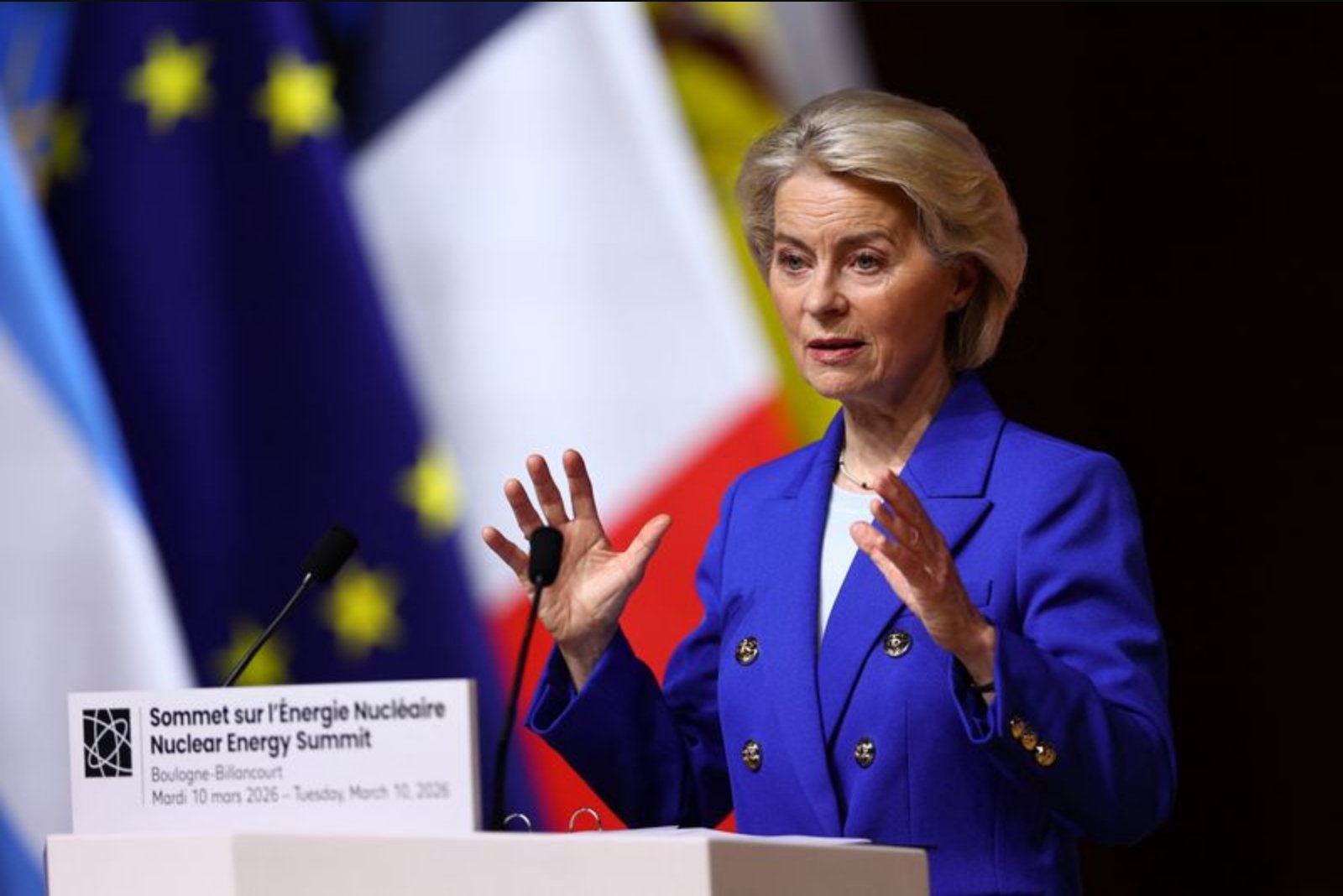
European Commission President Ursula von der Leyen on Tuesday described the contraction of Europe’s nuclear power capacity as a "strategic mistake," linking the decline to greater dependence on imported fossil fuels and rising energy costs as tensions in the Middle East add pressure to markets.
Speaking at an event in Paris, von der Leyen noted that nuclear accounted for roughly one-third of Europe’s electricity production in 1990 but has since fallen to about 15% of the mix. She said that shift was a deliberate choice by governments and one that has left the bloc "completely dependent on expensive and volatile imports" of oil and gas - a reliance that she said disadvantages Europe relative to other regions.
Von der Leyen’s remarks come as European governments confront tighter energy conditions linked to the Iran war, which has contributed to recent spikes in global fuel prices. She framed the debate over baseload options as one of strategic resilience, stressing the role a reliable, low-emissions source of power could play in stabilising prices and supply.
Germany, von der Leyen’s country of origin, adopted a policy under then-Chancellor Angela Merkel to phase out nuclear power plants following the 2011 Fukushima disaster, citing public opposition and safety concerns. Von der Leyen served as a minister in Merkel’s government at the time that decision was taken. The move is contentious: Germany’s Environment Minister Carsten Schneider criticised von der Leyen’s stance on Tuesday, describing it as a "backward-looking strategy" and arguing that electricity from wind and solar is cheaper, has long driven the energy transition, and does not generate radioactive waste.
Despite rapid expansion of renewables across the European Union, gas-fired power stations continue to play a significant role in the power mix, and fossil fuels still dominate in sectors such as transport and heating. The bloc’s heavy dependence on imports of oil and gas was exposed in 2022 when energy prices soared after Russia reduced gas deliveries following its invasion of Ukraine.
On the financing front, von der Leyen said the European Commission would provide a 200-million-euro guarantee to support private investment in innovative nuclear technologies. She said the funds would be sourced from the EU carbon market. The move reflects a cautious shift by the Commission toward enabling private sector activity in nuclear innovation, while recognising that direct EU budget funding for nuclear projects remains constrained by the lack of unanimous support among the 27 member states.
The position of national governments remains mixed. Some countries that previously opposed nuclear power - notably Denmark and the Netherlands - have softened their position as they seek dependable, low-carbon electricity supplies for energy-intensive industry. Other EU members, including Austria and Luxembourg, continue to oppose nuclear energy.
France, the continent’s largest producer of nuclear electricity, has argued that the stable and low-carbon generation provided by reactors is essential to industrial competitiveness. At the Paris event, French President Emmanuel Macron highlighted concerns about fuel supply chains, noting that the EU - where nuclear power producers still imported 15% of their uranium from Russia in 2024 - must diversify its suppliers. He said cooperation would be needed to progress on that front and announced plans for France to increase its own uranium enrichment capacity.
Macron also proposed harmonising reactor designs across Europe, a policy that could prove advantageous to France’s state-controlled nuclear firm EDF, which has faced difficulties winning recent tenders for new builds. The contest for new reactor work has become more international: in 2024 South Korea’s KHNP secured a tender worth at least $18 billion to construct a new nuclear plant in the Czech Republic - a decision that losing bidder EDF sought to challenge in the courts. The reported tender value was at least $18 billion. For reference, the exchange rate cited at the event was $1 = 0.8584 euros.
Von der Leyen’s comments and the Commission’s limited financial backing underscore an ongoing debate within the EU over the role of nuclear power in ensuring energy security, maintaining industrial competitiveness, and meeting climate objectives. With member states divided and supply chains for nuclear fuel partially concentrated, the policy and market outcomes remain uncertain.