
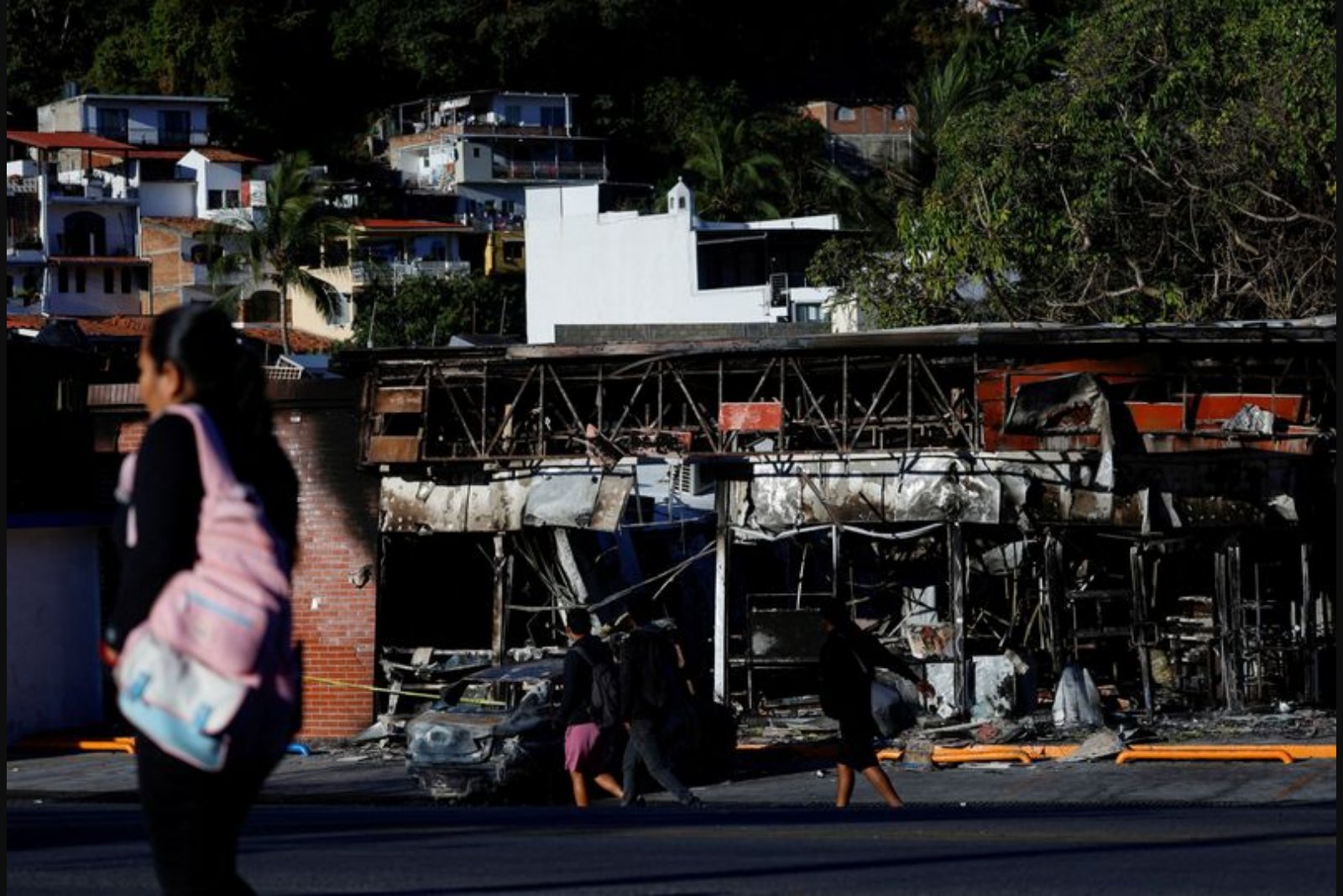
Mexican forces eliminated Nemesio Oseguera, widely known as El Mencho, in a U.S.-backed operation on Feb. 22. The raid removed one of the world’s most prominent drug leaders and was hailed by Mexican authorities as a major tactical victory. Yet security officials in both countries describe a far more persistent problem: the Jalisco New Generation Cartel’s deep and largely U.S.-based logistical and financial systems that support its firepower and revenue generation.
The killing triggered an immediate and violent response on Mexican soil: cartel members set buildings on fire and mounted road blockades in multiple locations, a campaign that underscored the organization’s capacity to coordinate large-scale disruption across territories. That dramatic reaction drew global attention. Behind the scenes, however, a network of activities centered within the United States sustains the cartel’s ability to arm itself, move fuel and convert illicit proceeds into usable capital, according to current and former U.S. and Mexican security officials.
Operational reach inside the United States
Officials interviewed for this reporting described extensive U.S.-based channels that are integral to the cartel’s operations. These include procurement of military-grade weaponry, cross-border fuel flows worth billions of dollars, and elaborate money-laundering schemes that route proceeds through U.S. markets, businesses and financial systems. Those activities, the officials say, are less visible in headlines but are essential to the cartel’s capability to project violence and to consolidate financial power.
Alamdar Hamdani, the former U.S. attorney for the Southern District of Texas, put it succinctly: "The United States has become increasingly important to cartels, especially the Jalisco New Generation Cartel, for it to thrive." That assessment frames a core tension at the center of the bilateral response: Mexico can carry out high-risk operations on its territory, but officials in Mexico and some U.S. observers say that unless Washington addresses the cartel’s U.S. networks, the broader strategic threat will remain largely intact.
U.S. and Mexican statements after the raid
The U.S. White House commented on the operation. White House spokeswoman Anna Kelly said that the Trump administration "has worked closely with the Mexican government to stop the scourge of drugs and criminals entering our country" and that this cooperation led to the "elimination of infamous narcoterrorist 'El Mencho.'" She added: "The president will continue to do everything in his power to keep America safe from these vicious criminals and the drugs they use to poison our country."
On the Mexican side, the president's office did not provide comment for this reporting. Roberto Velasco, Undersecretary for North America at Mexico's Foreign Ministry, reiterated that stopping arms trafficking is a top Mexican priority and said Mexico has pressed the issue repeatedly in bilateral working groups. "While there has been some significant progress, we believe much more can be done to control this flow and to target the networks in the United States that facilitate it, empowering transnational criminal organizations," he said.
Calls for the United States to ramp up domestic action
Before the operation, Washington had intensified diplomatic pressure on Mexico to pursue the cartel leader. The choice by Mexican President Claudia Sheinbaum to escalate enforcement carried known risks: high-profile captures and raids have the potential to trigger violent reprisals in a country where the conflict with cartels has claimed tens of thousands of lives.
That escalation has prompted renewed appeals from Mexican officials and allies for a more forceful U.S. response within American borders. Mexican Congressman Alfonso Ramirez Cuellar, a Sheinbaum ally, said: "The United States can’t turn a blind eye to Mexico’s demands any longer." He urged the U.S. to strengthen efforts against money laundering, fuel smuggling and especially the flow of weapons exported from the U.S. into Mexico. "We can’t stop drug traffickers if the United States continues allowing them to strengthen their military capabilities," he said.
Some U.S. observers point to the shifting allocation of federal law enforcement resources as a factor. In recent years, the U.S. has built and prosecuted many cartel-related cases domestically. But officials say that last year the U.S. administration redirected thousands of agents, including those specialized in drugs, firearms and money laundering, to other priorities, including a mass deportation effort. This reallocation coincided with a reported fall in prosecutions for drug conspiracies and money laundering in that period.
Vanda Felbab-Brown, a security expert, criticized the U.S. approach: "The Trump administration has predominantly focused on highly militarized actions against drugs abroad and has not paid similar attention to actions at home."
The U.S. Department of Justice described a different emphasis. A Justice Department spokesperson said the administration remains "acutely focused on securing the border, prosecuting violent traffickers, deporting any and all members of cartel networks and ensuring they are held accountable for their horrific crimes against the American people." The department also highlighted recent prosecutions targeting high-ranking members of the Jalisco cartel.
Weapons sourced in the United States
Mexican Army officials said that most of the weapons recovered from cartel operations since late 2024 originated in the United States. Mexican Army chief Ricardo Trevilla stated that roughly 80% of the 23,000 weapons seized since President Sheinbaum took office came from the U.S. He also noted that men guarding and defending cartel leaders have used predominantly U.S.-sourced firearms when confronting Mexican special forces.
Authorities in both countries describe how the Jalisco cartel has cultivated networks that acquire heavy, military-grade weapons from gun shops dispersed across the United States. Through a known gun-running channel, the cartel procured weapons from more than a dozen U.S. states, including .50 caliber rifles capable of downing helicopters and FN SCAR assault rifles originally designed for U.S. Special Forces. Those weapons can be purchased legally inside the U.S., but they become illegal once transported into Mexico, which enforces stricter gun controls.
Derek Maltz, former acting administrator for the U.S. Drug Enforcement Administration, framed the issue as a two-way responsibility: "We complain about the Mexicans’ lack of effort to go after the drugs down there, but then why does the U.S. dismiss their argument that we could do better on the guns going southbound?" He said the U.S. needs to intensify not only arms trafficking prosecutions but also domestic public health and mental health initiatives aimed at reducing American demand for drugs.
Fuel smuggling as a major revenue stream
Beyond narcotics, the cartel has diversified rapidly into large-scale fuel operations that now account for a significant, multi-billion dollar trade across the border. Officials described two principal models the cartel uses to move petroleum products and exploit gaps in cross-border commercial oversight.
In the first model, cartel operatives steal crude oil from Mexico's state-owned energy firm and move it northward where it is sold to U.S. buyers. In the second model, cartel networks purchase diesel and gasoline from U.S. suppliers using shell companies. Those products cross into Mexico disguised as legitimate shipments, a flow that officials describe as effectively a form of large-scale tax fraud because the commercial paperwork misrepresents the cargo to avoid legal and fiscal controls.
Observers said this cross-border fuel commerce required cooperation from, or at least the unwitting participation of, a range of U.S.-based commercial actors. Reporting examined by this team identified a range of businesses and professionals implicated in facilitating those flows. The list includes refiners, fuel traders, transport firms, and storage operators. President Sheinbaum has acknowledged that investigations uncovered involvement by U.S. business people in fuel smuggling cases under inquiry, saying: "One cannot explain otherwise how fuel comes from the U.S. to Mexico, and enters illegally."
Guadalupe Correa, a scholar who has studied cartel diversification, described the activity as more than petty theft of fuel. "This is no longer stealing fuel from (state energy company) Pemex," she said. "It’s a huge, transnational business."
Money laundering and assets inside the United States
Money laundering within U.S. borders is central to the cartel's capacity to convert illicit proceeds into legal wealth and to sustain operations. Court records and official statements cited in this reporting illustrate how cartel cash circulates through a variety of U.S. industries and asset classes.
One specific law enforcement action highlighted the reach of cartel money in American real estate. In late 2024, Cristian Gutierrez Ochoa, identified as a son-in-law of El Mencho, was arrested at a $1.2 million house in Riverside, California. Court documents indicate Gutierrez later pled guilty to an international money laundering conspiracy in June 2025 and stated he had purchased the five-bedroom property using drug proceeds funneled through a Mexico-based shell company created to resemble a tequila producer.
Former investigators say that real estate purchases are only one of many methods used to launder the cartel’s revenue. Carlos Olivo, a former DEA agent who specialized in tracing the cartel’s U.S. financial networks, described how cartel money moves through restaurants, textiles, the music industry, agriculture and even transactions on U.S. stock markets. "In total, we’re talking about hundreds of millions in assets in cartel-related money in the United States," he said.
A DEA spokesperson additionally noted that cartels use a wide range of laundering techniques, naming trade-based schemes, cryptocurrency, bulk cash movement and underground banking systems linked to foreign counterparts as among the methods traffickers deploy to fund their operations.
Investigations, court records and expert assessments
This reporting drew on interviews with a number of current and former U.S. and Mexican officials and reviewed U.S. court documents from multiple recent cases tied to the cartel. What emerged is a consistent portrait: the cartel’s U.S. activities are critical to its firepower and financing, and those activities are not likely to be substantially disrupted by the removal of a single leader.
Officials and experts quoted in these conversations urged a complementary approach: Mexican law enforcement can remove leaders and launch operations inside Mexican territory, but the United States must address the domestic networks that enable the trafficking of arms, fuel and money if those gains are to be sustained.
Alejandro Celorio, a former Mexican diplomat, expressed hope that the operation would prompt a stronger U.S. focus on domestic investigation into how money and drugs move within U.S. territory. "As the world’s leading commercial and military power, the U.S. could certainly investigate more deeply how money and drugs move within U.S. territory," he said.
What remains uncertain
Officials emphasize that while the death of a kingpin is a significant tactical event, it does not, in and of itself, resolve the broader problem of transnational criminal infrastructure. The evidence reviewed here indicates that the cartel’s U.S.-based supply chains have long-term structural features that make them resilient: commercial integration with legitimate businesses, the ability to buy heavy weaponry inside U.S. markets, and access to sophisticated money-laundering methods that exploit multiple sectors.
Until those networks are interrupted, the cartel’s capacity for violence and revenue generation is likely to endure, according to U.S. and Mexican officials who contributed to this reporting.
Conclusion
The operation that ended El Mencho’s life was the most consequential takedown of a cartel boss in years. It has forced Mexico to confront immediate retaliation and domestic security challenges. At the same time, U.S. and Mexican security officials say the cartel’s most strategically important capabilities - its access to U.S.-sourced weaponry, its fuel trafficking operations and its money-laundering pathways inside the United States - remain active. Those U.S.-based enablers, officials argue, are likely to sustain the cartel’s influence unless Washington bolsters enforcement efforts on its own soil.