
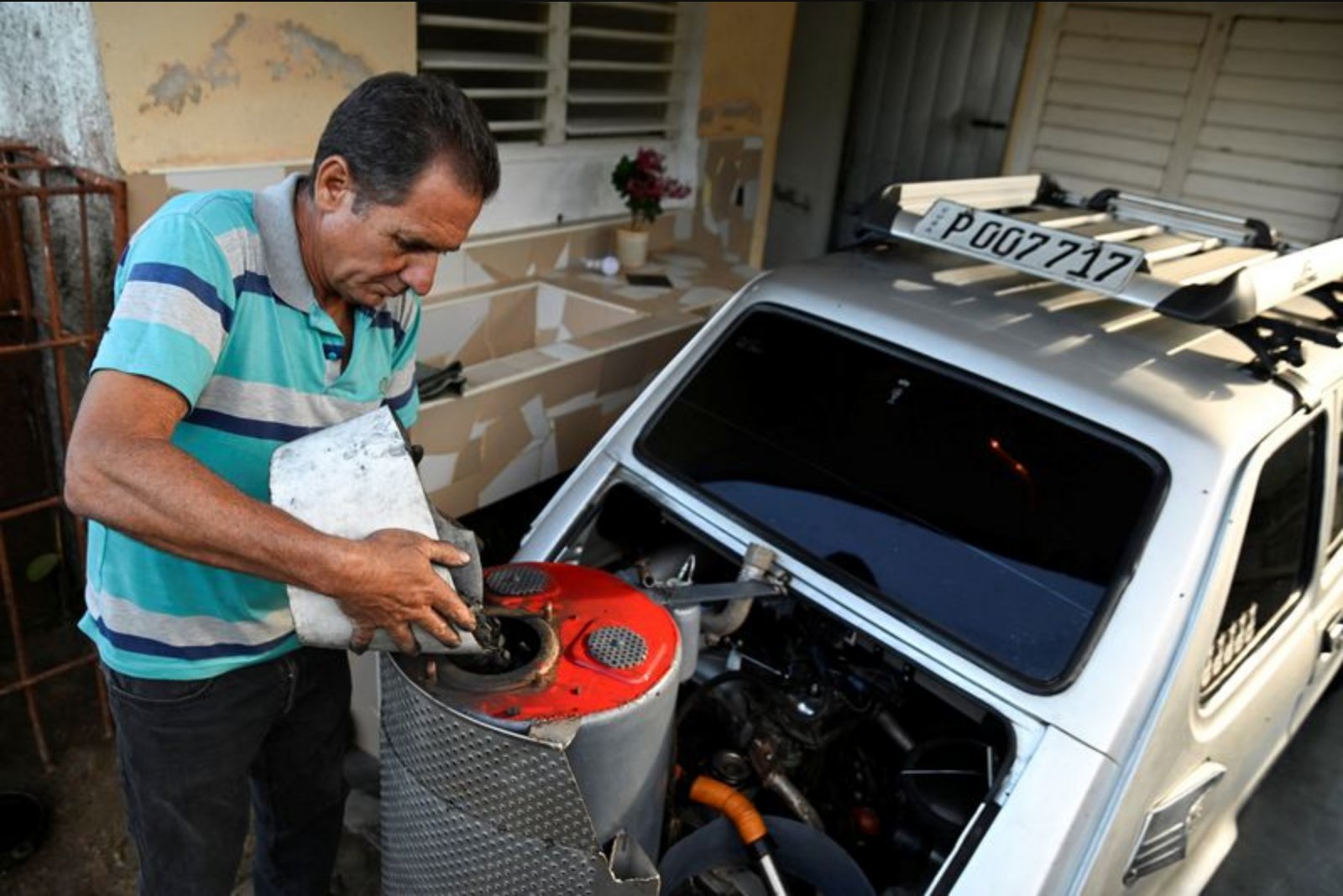
A Cuban mechanic has repurposed a 1980 Polish-built Fiat Polski to run on charcoal, a practical workaround to constrained gasoline supplies that have tightened since Washington halted oil shipments earlier this year. The conversion, completed in the small town of Aguacate, about 70 km east of Havana, illustrates how local ingenuity is being applied to an acute fuel shortage that has worsened as U.S. measures disrupted prior sources of Venezuelan oil.
Juan Carlos Pino, 56, who has an eighth-grade education, built the charcoal system entirely from scrap and salvaged components in his workshop in Aguacate, a town of roughly 5,000 people that once centered on a now-closed sugar refinery. The town today is surrounded by cow pastures and stone quarries, where men walk to work carrying long hand saws slung over their shoulders.
Pino's modified Polski is distinctive on the town's pot-holed streets. The two-cylinder vehicle rolls with a 60-liter (15-gallon) fuel tank soldered to the rear, and its propulsion system uses charcoal combusted inside a converted propane tank. That tank is sealed with the lid of a transformer, and the car's filter is fashioned from a stainless steel milk jug stuffed with old clothes.
“In a crisis like this, it’s the best option we have,” Pino said, describing the motivation behind the project and his intent to extend the approach to agricultural machinery. He said he plans to modify a tractor next, stressing the need for mobility to plant crops.
Pino has a track record of improvised machinery. He previously created a device, built from a motorcycle, capable of milking three cows at once. He said the idea of a charcoal-fired automobile had been on his mind for several years and that he was initially inspired by his late uncle.
He also credited open-source guidance promoted by Edmundo Ramos, the Argentine behind DriveOnWaste.com. Ramos said he has received calls from Cubans seeking technical tips, including one person reportedly powering a neighborhood with a 50-kilowatt generator. Ramos described a sequence of local appeals: “An ice maker contacted me first and said he cannot make ice. Then an ice-cream guy contacted me, then a shop owner.” He added that nearly any engine can be adapted to run on charcoal by drawing hot gas instead of gasoline into the carburetor.
Pino debuted the charcoal-powered Polski on March 4. One early test run covered 85 km (53 miles), and the car reached a top speed of about 70 kph (43 mph). The demonstration has drawn crowds in Aguacate; townspeople gather to photograph the vehicle and take selfies, some skeptical and others hopeful that similar conversions might be made available to them.
Reactions from neighbors were strongly positive. Yurisbel Fonseca, 27, who stopped his motorcycle to inspect the car, said, “This is amazing. It’s left me speechless.” Narvis Cruz, 53, called the device “the invention of the year.” Cruz, familiar with Cuban improvisation, drives a 1953 Pontiac that itself is a composite of parts: a 1940s Perkins engine, a Mercedes transmission, a steering system from the Czech group AVIA, and a differential made by the East German company Ifa. “That’s Cuba,” Cruz said. “A salad made of everything.”
The charcoal conversion arrives against a backdrop of long-standing scarcity in Cuba’s Soviet-style command economy, a scarcity that the article describes as having worsened after the United States deposed Venezuelan President Nicolas Maduro and cut off Venezuelan oil while threatening tariffs on third-party suppliers. Power blackouts have become common and gasoline is now strictly rationed. On the black market, gasoline sells for $8 per liter, or US$30 per gallon - roughly six times the official price.
Pino’s work highlights one practical response to constrained fuel supplies: locally built conversions and shared innovation. While the example in Aguacate remains a localized demonstration, Ramos’s comments indicate that Cubans elsewhere are seeking and, in some cases, implementing similar adaptations, whether for vehicles or to keep small businesses and neighborhood services running.
The broader implications for transport and agricultural activity in Cuba are evident in Pino’s stated intent to adapt a tractor and in residents’ use of improvised machinery to sustain livelihoods. At the same time, the degree to which such conversions can be scaled, standardized, or sustained over time is not detailed in these accounts.