
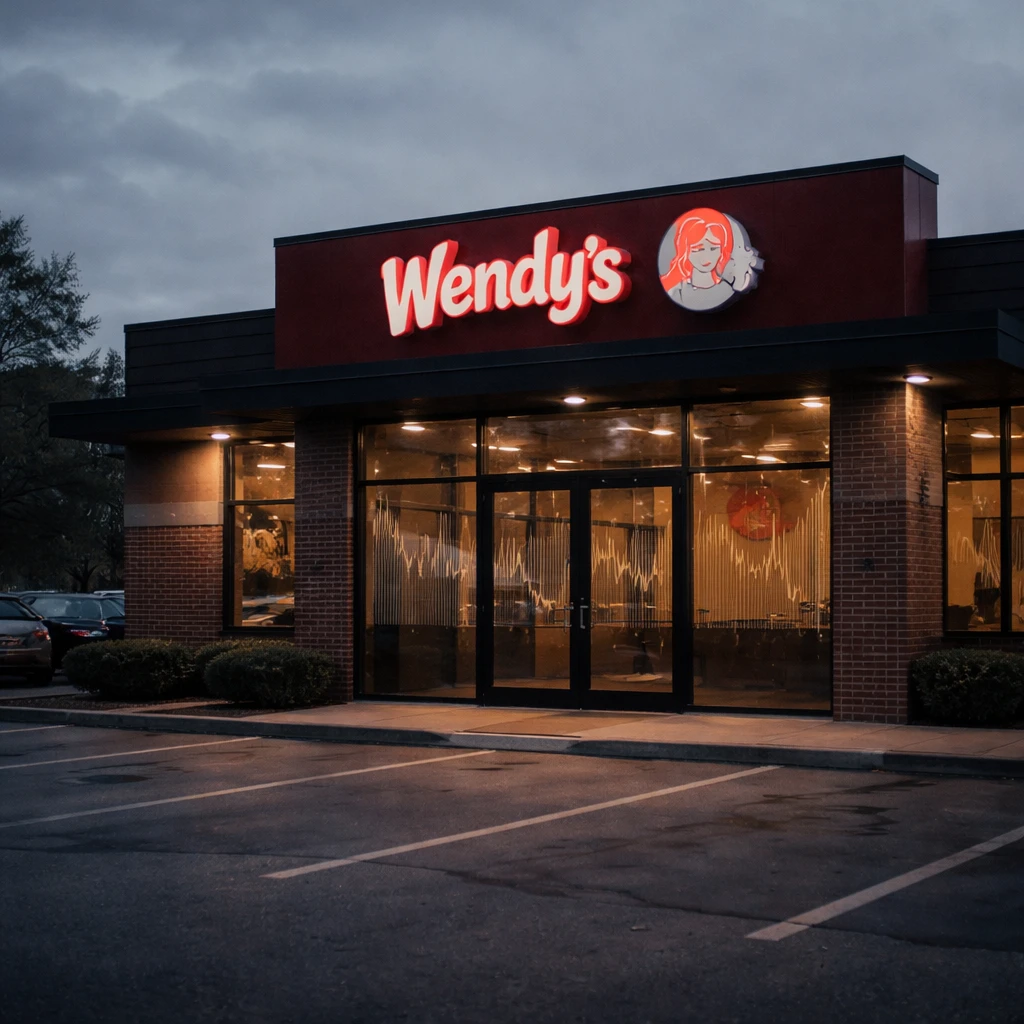
UBS has trimmed its price target on Wendy’s Co. to $7.50 from $8.50 and retained a Neutral rating on the stock, citing recent company results that point to continued pressures on U.S. same-store sales. Wendy’s shares were trading at $6.77 and have fallen 44.54% over the past year, trading near a 52-week low of $7.08.
In explaining the move, UBS pointed to the fast-food chain’s fourth-quarter performance and the accompanying management commentary, which together highlighted difficult prior-year comparisons and issues specific to the Wendy’s brand that weighed on U.S. comparable sales. The firm noted that Wendy’s has provided guidance intended to address these shortfalls, but UBS adjusted its estimates lower to reflect immediate sales pressure, U.S. fleet optimization and higher near-term investment levels.
Wendy’s 2026 guidance lays out a cautious operating plan. The company expects system sales to be approximately flat year-over-year and projects adjusted earnings per share of $0.56 to $0.60. Management also forecast adjusted EBITDA in the range of $460 million to $480 million and free cash flow between $190 million and $205 million.
Unit-growth dynamics will be affected materially by a planned optimization of the U.S. portfolio. Wendy’s stated that this optimization will result in roughly 5% to 6% of U.S. units closing in 2026. By contrast, international development is expected to keep pace with 2025 in terms of net new units.
Despite those operational headwinds, the company continues to offer a substantial dividend yield of 7.49% and has a long history of dividend payments, having paid dividends for 24 consecutive years.
Sales weakness persisted into the first quarter, according to the company, and management is emphasizing execution of Project Fresh as a key lever to support sales improvement in the second half of 2026. UBS lowered its earnings estimates to account for the near-term softness in sales, the impact of U.S. fleet optimization and the need for elevated investments to stabilize performance.
On the liquidity front, Wendy’s reported a current ratio of 1.76, indicating that short-term liquid assets exceed near-term liabilities. UBS also observed that valuation metrics remain depressed versus historical averages: the firm pointed to an approximate 14% free cash flow yield for 2026 at the midpoint of guidance, compared with a five-year average near 7%.
UBS said it would look for clearer evidence of a sustained sales turnaround and an acceleration of multiyear unit expansion as the primary catalysts for upside to its view. Complementing UBS’s assessment, data from InvestingPro indicate Wendy’s trades at a price-to-earnings ratio of 8.01 and appears slightly undervalued on that platform’s Fair Value calculations. InvestingPro further notes that management has been active in repurchasing shares.
The company’s fourth-quarter 2025 results were mixed. Adjusted EBITDA came in at $113 million, slightly above consensus of $112 million. However, same-store sales were weak, with global comparable sales down 10.1% and U.S. comparable sales down 11.3%. Those results prompted several brokerages to revise their outlooks.
Among the analyst reactions, Truist Securities lowered its price target to $10, BMO Capital reduced its target to $9 and RBC Capital cut its target to $8. Wendy’s own guidance for 2026 came in below market expectations, a shortfall the company attributed in part to higher administrative expenses and increased interest costs. KeyBanc kept a Sector Weight rating on the stock, citing the weak sales outlook, while Bernstein SocGen Group adjusted its price target to $9 on similar concerns about sales execution.
In aggregate, the combination of pressured comparable sales, planned U.S. unit closures and the need for elevated investment to restore momentum has weighed on sentiment and analyst forecasts. UBS’s reduced price target reflects those near-term constraints while highlighting the company’s comparatively attractive free cash flow yield at midpoint guidance and a robust dividend yield that may be of interest to income-oriented investors.
Summary
UBS cut its Wendy’s price target to $7.50 and kept a Neutral rating after the chain reported weak comparable sales and outlined a 2026 plan that includes roughly flat system sales, modest adjusted EPS and EBITDA ranges, and a U.S. portfolio optimization that will close about 5% to 6% of domestic units. The company continues to pay a notable dividend and retains a current ratio of 1.76, but multiple analysts have revised estimates downward following disappointing same-store sales.