
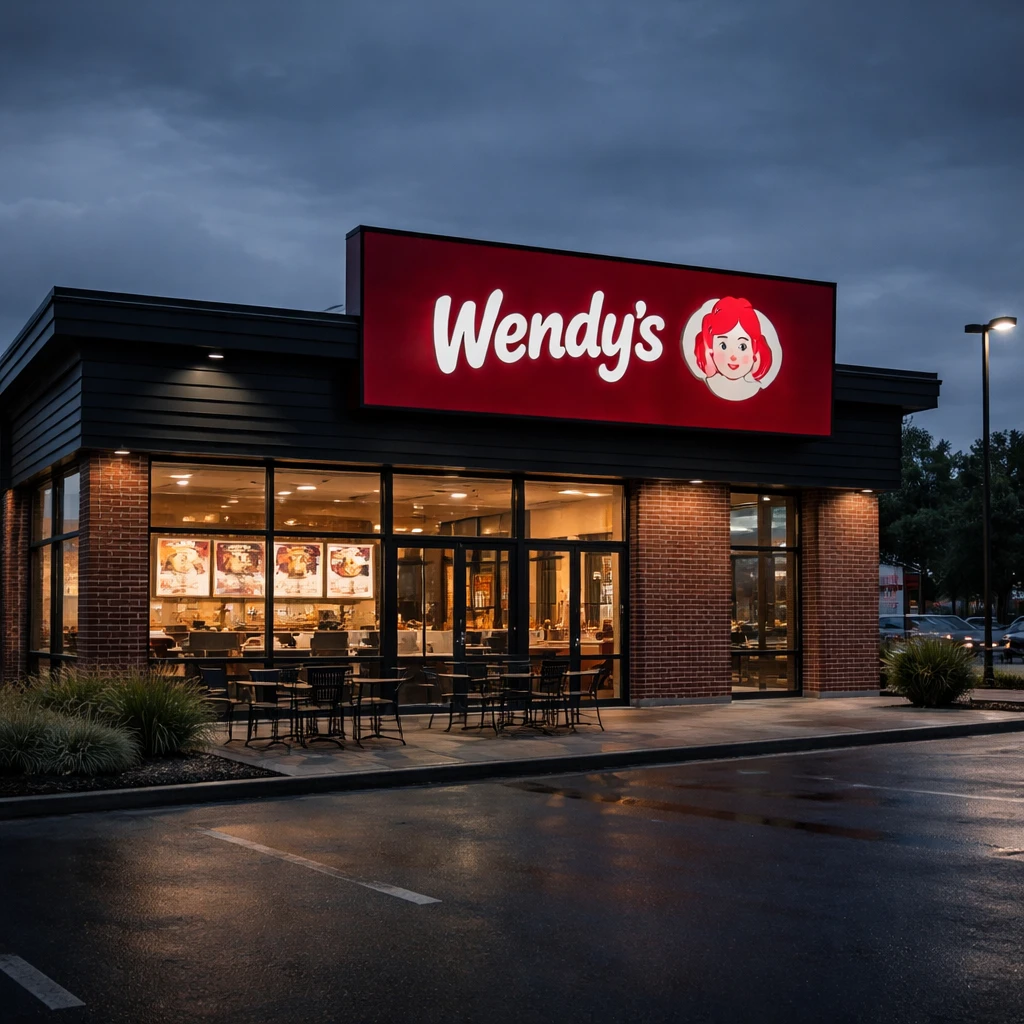
Truist Securities cut its price target on Wendy’s Co. (NASDAQ:WEN) to $10 from $11 on Monday, while leaving its Buy rating unchanged. The brokerage’s move follows a combination of softer sales trends and a cautious outlook for the year ahead.
The stock was trading at $6.79 at the time of the update, well below its 52-week peak of $16.20. According to InvestingPro data cited in the company note, Wendy’s shares have declined 44.5% over the past year.
The revision to Truist’s target came after Wendy’s reported fourth-quarter 2025 results that featured a miss on same-store sales alongside an adjusted EBITDA beat versus consensus. The company reported EBITDA of $506.61 million for the last twelve months.
Management issued guidance for fiscal 2026 calling for revenue growth of just 2%, a projection that Truist and other analysts view as tepid. Truist analyst Jake Bartlett said the firm trimmed its estimates because of the weak start to 2026 and mounting competitive pressure from McDonald’s. Bartlett noted that the company’s turnaround remains an uphill challenge even as Wendy’s attempts to sharpen its marketing on quality and enhance menu innovation and operations.
That more cautious tone is reflected in broader analyst activity: InvestingPro data shows 15 analysts have reduced their earnings estimates for the upcoming period.
From a valuation and income perspective, Truist’s note points to some of Wendy’s attractions. The stock trades at 7.8 times Truist’s 2027 EBITDA estimate and is offering a dividend yield the firm cites at 7.3%, which Truist describes as roughly half of free cash flow. InvestingPro data shows the company has paid dividends for 24 consecutive years and lists the current dividend yield at 7.49%.
Truist added that many of Wendy’s near-term challenges appear to be priced into the shares, which trade at a P/E ratio of 8.07 in the firm’s assessment.
Bartlett highlighted potential near-term triggers that could benefit the business, including limited-time burger promotions and the rollout of a new chicken sandwich. Meanwhile, InvestingPro analysis indicates the company remains profitable, with liquid assets exceeding short-term obligations.
In recent operational disclosure, Wendy’s reported fourth-quarter 2025 adjusted earnings per share of $0.16, narrowly topping the $0.15 analysts had forecast. Revenue for the quarter came in at $543 million, above the $537.55 million consensus estimate.
Despite those beats, several Wall Street firms expressed caution after Wendy’s outlined its 2026 outlook. RBC Capital observed that Wendy’s fiscal 2026 EBITDA and EPS guidance fell short of consensus due to higher general and administrative expenses and rising interest costs. BMO Capital and Bernstein SocGen both trimmed their price targets on the stock, pointing to weak sales performance as a principal reason.
KeyBanc kept its Sector Weight rating intact, calling attention to double-digit same-store sales declines in the U.S. and low-single-digit declines in international markets. Collectively, the analyst moves and guidance suggest the company is contending with pressure to restore sales momentum even as it maintains profitability and a substantial dividend yield.
Summary
Truist reduced its price target on Wendy’s to $10 from $11 but kept a Buy rating after mixed fourth-quarter 2025 results and muted fiscal 2026 guidance. The firm cited a weak start to 2026 and increased competition as reasons for lowering estimates. The shares trade well below their 52-week high and carry a high dividend yield, while several other analysts have also trimmed forecasts or price targets.
- Key points
- Truist cut Wendy’s price target to $10 from $11 but maintained a Buy rating, pointing to a difficult near-term turnaround.
- Wendy’s reported mixed Q4 2025 results - a same-store sales miss but an adjusted EBITDA beat; trailing twelve-month EBITDA was $506.61 million.
- The company’s shares trade at $6.79, down 44.5% over the past year from a 52-week high of $16.20, and offer a high dividend yield (InvestingPro lists the current yield at 7.49%).
- Risks and uncertainties
- Continued competitive pressure, particularly from McDonald’s, could hinder Wendy’s turnaround and sales recovery - impacts operators and quick-service restaurant competitors.
- Higher general and administrative expenses and rising interest costs may compress margins and earnings - affects corporate profitability and investor returns in the restaurant sector.
- Weak same-store sales trends, including domestic double-digit declines and international low-single-digit declines noted by KeyBanc, raise uncertainty around sustaining sales momentum - influences consumer discretionary spending and foodservice operators.
Tags: ["WEN","Restaurants","Earnings","Dividend","Analyst"]