
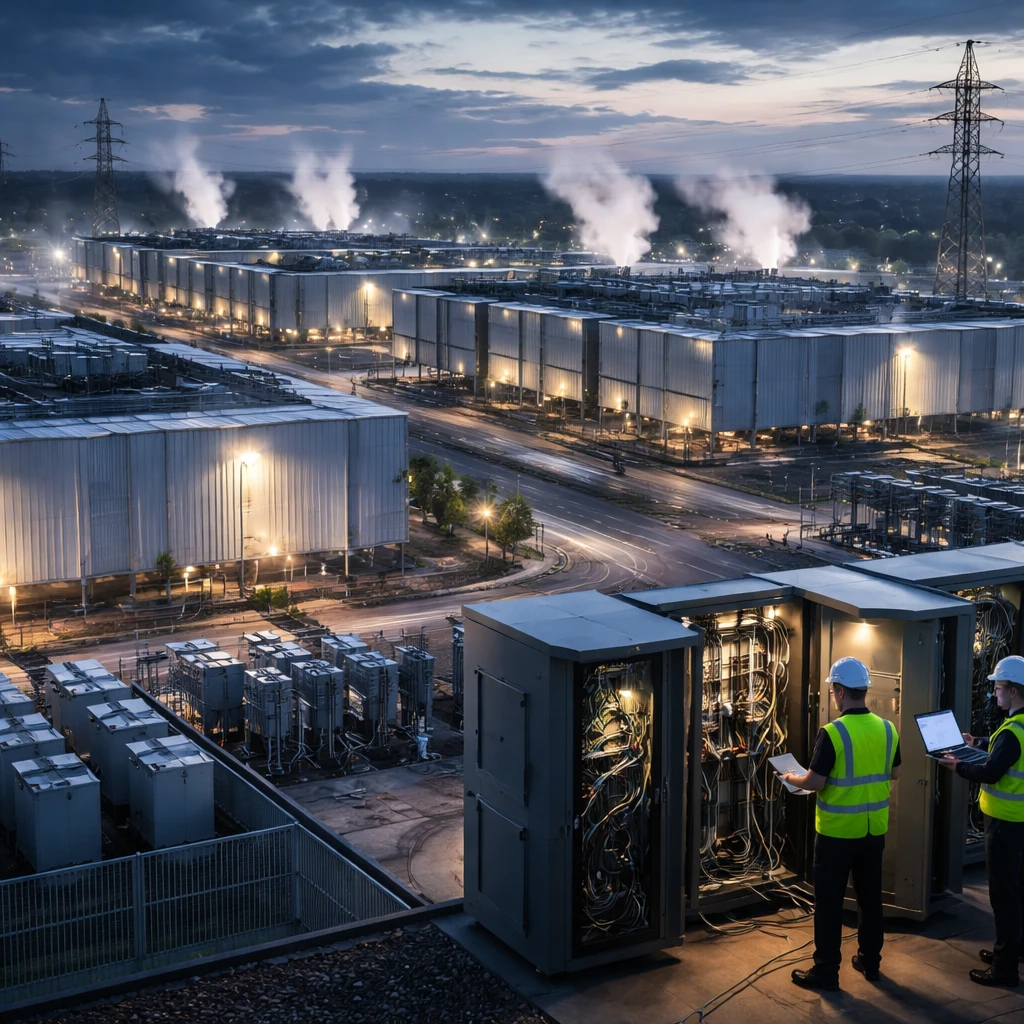
Lynx Equity has published research drawing attention to Amazon’s large-scale data center investment plans and the implications those plans have for the semiconductor industry. The note underscores a multi-year ramp in capacity and a big increase in capital spending that Lynx views as supportive for AI-focused semiconductor vendors and suppliers of semiconductor equipment.
Market moves have been notable: shares of Amazon fell by more than 13% over the last week and were trading at $210.32 at the time the data point was reported. At the same time, valuation metrics cited in the research indicate the company is trading at levels that may not fully reflect its future earnings trajectory.
Capital spending and capacity targets
Amazon has guided 2026 capital expenditure at $200 billion, a figure that represents a 60% year-over-year increase relative to the prior period. While Lynx Equity notes that this growth rate is below the pace at which some peers are expanding their capex - the note references one peer planning to double capex - the firm emphasizes the significance of Amazon’s sustained, multi-year capacity expansion plan.
Specific capacity targets disclosed by the company include an addition of 3.8 gigawatts of data center power capacity in 2025, which is twice the capacity it added in 2022. The company also projected that capacity additions in 2027 would double relative to 2025 levels, with continued growth expected through 2028.
Financial footing and valuation context
Lynx Equity points to Amazon’s financial profile as a supporting factor for the buildout. Over the last twelve months the company generated $716.92 billion in revenue and reported a 50.29% gross profit margin. The firm’s debt level was characterized as moderate, with cash flow sufficient to cover interest payments. A PEG ratio of 0.98 was cited as evidence that the stock is trading at a reasonable valuation relative to expected earnings growth.
Sector implications
The research argues that Amazon’s trajectory in data center power consumption - projected at a 40% compound annual growth rate through 2028 - likely mirrors capacity and power trends at other major cloud providers. Lynx Equity interprets those dynamics as creating a favorable environment for both AI semiconductor vendors and the manufacturers of semiconductor equipment that serve chipmakers.
Reflecting that outlook, Lynx Equity’s recommendations include buys on SanDisk (SNDK), Lam Research (LRCX), Micron Technology (MU), and Taiwan Semiconductor (TSM). Conversely, the firm advised avoiding Nvidia (NVDA) and AMD despite recent weakness in the latter.
Earnings and analyst reactions
Amazon’s most recent quarterly results showed a strong performance in its cloud business, with Amazon Web Services growing 24% year-over-year in the fourth quarter - slightly ahead of the 23% expectation cited in the research note. The AWS growth was attributed to demand in both AI and non-AI workloads.
Despite the positive revenue signals, several sell-side firms adjusted their price targets after factoring in the company’s elevated capital plans. The research summary lists a range of revised targets and ratings: one firm lowered its price target to $280, another reduced theirs to $275 citing the $200 billion capex plan, a third trimmed its target to $260 while keeping an Overweight rating, and another maintained a Buy rating with a $300 target emphasizing revenue strength and AWS acceleration. An additional firm cut its target to $250 while noting that revenue and EBIT had come in above prior estimates. These moves illustrate differing analyst views that weigh strong operational results against higher future spending.
Takeaway
Lynx Equity frames Amazon’s aggressive multi-year data center expansion and large 2026 capex number as constructive for chip and equipment vendors tied to AI infrastructure. The firm’s sector recommendations favor memory and equipment names while taking a cautious stance on certain GPU-focused suppliers. The balance of strong top-line performance, growing capacity commitments and revised sell-side targets presents a mixed but ultimately constructive backdrop for parts of the semiconductor supply chain through 2028.
Key points
- Amazon’s 2026 capex guidance is $200 billion, a 60% year-over-year increase.
- The company plans to add 3.8 GW of data center capacity in 2025 and to double 2025 additions by 2027, with continued growth through 2028.
- Lynx Equity recommends buying SanDisk, Lam Research, Micron and TSMC, and avoiding Nvidia and AMD.
Risks and uncertainties
- Higher capital expenditure has prompted multiple analysts to lower price targets for Amazon - a market reaction that could affect investor sentiment in related sectors such as cloud infrastructure and semiconductors.
- While capacity additions drive demand for chips and equipment, timing and execution risks around buildouts and power consumption growth could affect order flows to suppliers.
- Revenue strength does not eliminate concerns about future spending levels; differing analyst assessments illustrate uncertainty over the net impact of elevated capex on shareholder returns.