
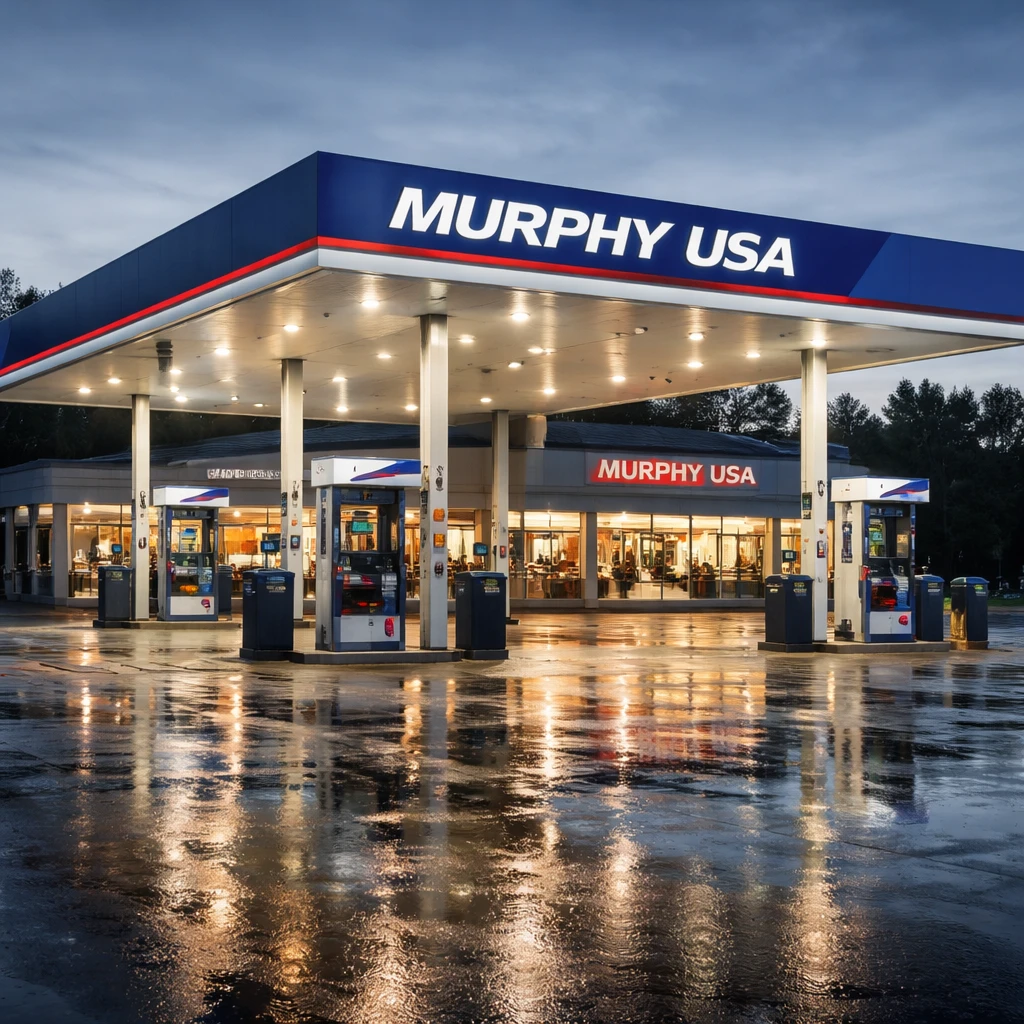
KeyBanc Capital Markets has raised its price target for Murphy USA from $460 to $500 and maintained an Overweight rating following the company’s fourth-quarter report. The new target sits toward the high end of the analyst spectrum, where documented analyst targets span from $340 to $550. At the time of the report, Murphy USA shares were trading at $385.49.
KeyBanc analyst Bradley Thomas noted the outperformance on the bottom line, attributing stronger-than-expected fourth-quarter earnings per share to expanded fuel margins even as fuel volumes were described as slightly softer. Over the trailing twelve months, Murphy USA recorded diluted EPS of $24.1.
Operational cash-flow measures also remain substantial. Management-reported EBITDA totaled $1.02 billion over the past twelve months, and the company generated fourth-quarter EBITDA of $290.9 million, a figure that exceeded both Stephens’ estimates and the broader consensus.
Despite the earnings beat, the company’s fourth-quarter revenue came in below forecasts. Murphy USA reported revenue of $4.74 billion versus an expected $4.88 billion, a shortfall that has prompted investor concern even as profitability metrics outpaced expectations.
Leadership changes and forward commentary were also focal points. New President and CEO Mindy West has cautioned that industry challenges may linger in the short term. That caution is reflected in company guidance that implies 2026 EBITDA could be slightly lower at the midpoint compared with current expectations.
Management is taking steps intended to enhance shareholder value, including active share repurchases. At the same time, the company is pursuing an accelerated store opening program that it expects will support growth over the medium to longer term. Murphy USA’s own view, as presented alongside results and guidance, is that the current industry environment offers more upside opportunity than downside risk over the medium and longer horizon.
Market reaction to the latest developments has been mixed. Stephens lowered its price target on Murphy USA from $475.00 to $450.00 while keeping its Overweight rating, reflecting a more conservative valuation stance despite the company’s profitability beat. The combination of a stronger-than-expected EPS showing, a revenue shortfall, active buybacks and cautious forward guidance has produced divergent views among analysts and investors.
KeyBanc’s decision to raise its target to $500 signals confidence in Murphy USA’s business model and growth strategy, even as the firm acknowledges the potential for short-term industry headwinds. With analyst targets ranging widely and management signaling both risks and opportunities ahead, Murphy USA’s path will hinge on execution across fuel margins, volume trends, store openings and conversion of EBITDA guidance into realized results.
Summary
KeyBanc raised its Murphy USA price target to $500 from $460 and kept an Overweight rating after Q4 results that beat on EPS but missed on revenue. CEO commentary and company guidance suggest 2026 EBITDA could be slightly down at the midpoint, while management continues share buybacks and plans accelerated store openings.
Key Points
- Price target increase to $500 from $460 by KeyBanc; analyst targets range from $340 to $550; stock trading at $385.49 - impacts Specialty Retail and fuel retail segments.
- Q4 EPS beat: $7.53 versus consensus $6.86, driven by higher fuel margins despite slightly softer fuel volumes; trailing twelve-month diluted EPS of $24.1.
- Revenue missed expectations: $4.74 billion vs $4.88 billion forecast; trailing twelve-month EBITDA of $1.02 billion and Q4 EBITDA of $290.9 million exceeded Stephens and consensus estimates.
Risks and Uncertainties
- Near-term industry challenges highlighted by the new CEO and reflected in guidance suggesting 2026 EBITDA could be slightly down at the midpoint - this risk affects the Specialty Retail and fuel retail sectors.
- Revenue shortfall in the quarter has raised investor concern despite an EPS beat - this uncertainty impacts investor sentiment and valuation in the retail and broader consumer markets.
- Slightly softer fuel volumes, even amid stronger margins, could pressure future top-line growth if volumes do not recover - relevant to fuel retail operations and supply-chain considerations.