
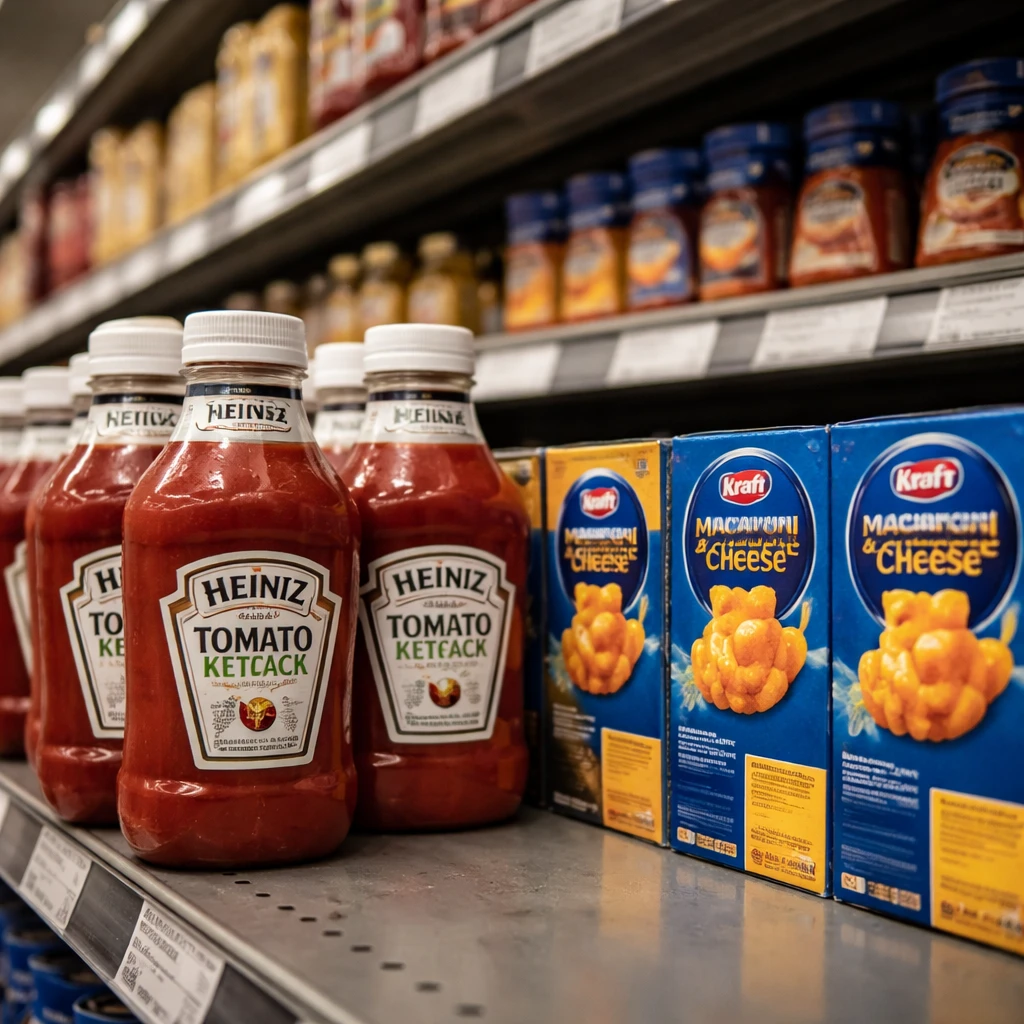
JPMorgan downgraded Kraft Heinz Company from Neutral to Underweight on Thursday and cut its 12-month price target to $22.00 from $24.00, aligning the target with the lowest analyst projection for the shares. At the time of the note, data indicate the stock is trading beneath its calculated Fair Value with shares at $24.99.
The analyst action follows Kraft Heinz’s fourth-quarter 2025 results, in which adjusted earnings per share of $0.67 exceeded the consensus estimate of $0.61. JPMorgan noted that the upside in EPS was aided by favorable SG&A expense trends and lower tax rates. Revenue for the quarter, however, landed at $6.35 billion, narrowly missing the expected $6.38 billion.
Despite the quarter’s EPS beat, JPMorgan focused on the company’s outlook for 2026, noting that management’s projected organic sales growth and earnings per share guidance were both below consensus expectations. The firm said the substantially lowered earnings outlook for 2026 may reduce near-term earnings risk, particularly over the coming quarters, but it also voiced concern about persistent issues that could constrain the company’s ability to regain volume as the year progresses.
One of the central points in JPMorgan’s analysis is the prolonged weakness in the North America segment. Volume in that region has declined by more than 3% year-over-year for 19 consecutive quarters - a pattern the firm says raises questions about the company’s growth trajectory and the durability of any rebound.
JPMorgan also highlighted the company’s investment emphasis, noting that current spending is heavily weighted toward marketing initiatives. The firm emphasized that marketing-driven recoveries typically require time to translate into sustained consumer demand. If those investments deliver slower returns or higher-than-expected costs, the company’s financial flexibility could be constrained.
A specific concern cited in the note is the company’s cash allocation. Management expects dividends to consume nearly 80% of free cash flow this year. While the company currently yields a substantial 6.4% dividend and reports a free cash flow yield of 12%, JPMorgan warned that maintaining a high dividend payout could limit options for incremental investment or other capital redeployment if growth costs rise.
For the fourth quarter, Kraft Heinz reported an adjusted EPS that represented a roughly 9.84% positive surprise versus expectations, while revenue represented a 0.47% negative surprise versus forecasts. Those mixed results - an earnings beat driven by expense and tax items but a slight revenue shortfall - underpinned the divergent views among analysts evaluating the name.
Analysis takeaway
From a financial and operational perspective, the brokerage’s downgrade reflects a cautious stance that weighs a pattern of sustained volume declines in a core market against a shareholder-friendly cash distribution policy. The interaction of slower top-line momentum, marketing-heavy investment, and a high dividend burden are the components JPMorgan identifies as limiting the company’s upside potential in the near term.
The downgrade to Underweight and the trimmed price target to $22 are intended to reflect those risks, even as the company delivers an EPS beat and maintains significant dividend returns to shareholders.