
Analyst action and market context
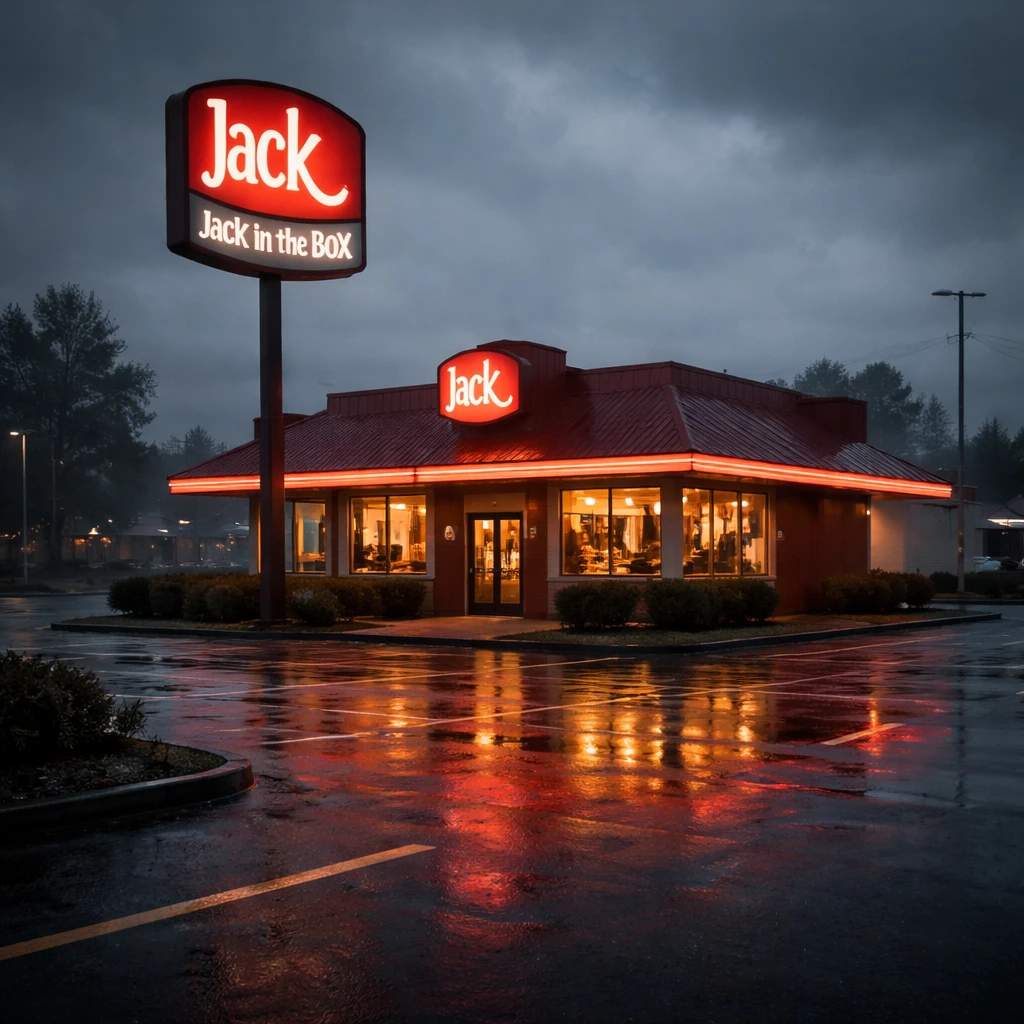
Goldman Sachs reiterated a Sell rating on Jack In The Box and kept a $17 price target in place after the restaurant operator released its fiscal first-quarter 2026 results. The stock is trading at $22.01, which sits close to a fair-value assessment cited alongside the results, indicating that the market currently prices in much of the company’s near-term prospects despite Goldman’s bearish view.
Quarterly results and sales trends
For the quarter, Jack In The Box reported adjusted earnings per share of $1.00. That outcome topped Goldman Sachs’ internal estimate of $0.76 but compared with a Visible Alpha consensus of $1.07. The chain reported systemwide same-store sales declined 6.7% in the period. Goldman had forecast a sharper 7.9% drop, while the Visible Alpha consensus expected a 5.8% decline.
Company commentary and stated priorities framed 2026 as a rebuilding year focused on executing the company’s turnaround plan and revitalizing the brand, noting systemwide same-store sales down 6.7% through the quarter.
Profitability outlook and revenue expectations
Analyst projections reflected in the company materials indicate that Jack In The Box is expected to be profitable for the full fiscal year, with a forecasted EPS of $3.69. At the same time, revenue is projected to decline by 23% for the fiscal year, reflecting the combined effects of recent strategic moves and current sales trends.
Margins and cost pressures
Company-owned restaurant margin for the quarter came in at 16.1%, representing approximately 390 basis points of year-over-year compression. Management attributed the margin contraction to sales deleverage, roughly 7.1% commodity inflation - primarily in beef - and elevated labor costs tied to the company’s market expansion in Chicago. Executives noted that the Chicago market improved over the course of the quarter.
Cash flow and adjusted EBITDA
Consolidated adjusted EBITDA for the quarter was $68 million, down from $97 million the prior year. The decline was driven in large part by the completed divestiture of Del Taco, which removed that business from the consolidated results.
Dividends and balance-sheet context
Although the company was not profitable on a trailing twelve-month basis, it continues to pay a dividend and currently yields 8.0%. The company has maintained dividend payments for 12 consecutive years.
Strategic plan and recent actions
Management is progressing on the JACK on Track plan, which includes the completed sale of Del Taco, targeted restaurant closures and a series of operational improvements intended to stabilize the business and return growth to the core brand.
Market performance and investor response
Despite short-term sales and margin pressures, the shares have posted a year-to-date gain of 16.15% and are up 15.84% over the past six months, demonstrating some resilience in market performance amid the company’s transition.
Additional quarter details
Other reported figures from the quarter included revenue of $349.5 million, which fell short of a consensus expectation of $374.31 million. Adjusted EPS of $1.00 also missed a separate projected figure of $1.15. Management said the results reflected a notable decline in transactions and mix, partially offset by the impact of price increases. Systemwide sales decreased 7.1% during the quarter.
What management says next
Executives framed the current period as one of rebuilding and execution, emphasizing actions taken to rightsize the portfolio and improve operations. The company’s stated priorities are to restore top-line momentum and repair margins while continuing to return cash to shareholders through dividends.
Key points
- Goldman Sachs maintained a Sell rating and $17 target on Jack In The Box after Q1 fiscal 2026 results.
- Adjusted Q1 EPS was $1.00; same-store sales declined 6.7% and company-owned restaurant margin compressed by roughly 390 basis points.
- The company is pursuing its JACK on Track plan following the Del Taco divestiture, while projecting a profitable year at an estimated EPS of $3.69 even as revenue is expected to fall about 23%.
Risks and uncertainties
- Sales and margin risks - ongoing same-store sales declines and commodity and labor cost pressure could further compress margins and profitability, affecting the restaurant sector and consumer discretionary spending.
- Revenue contraction - an anticipated 23% revenue decline raises execution risk for the company’s turnaround plan and could affect investor confidence in the restaurant and quick-service subsector.
- Divestiture impact - the Del Taco sale materially reduced adjusted EBITDA year over year, illustrating how portfolio changes can produce volatile reported results and complicate comparisons for investors and lenders.