
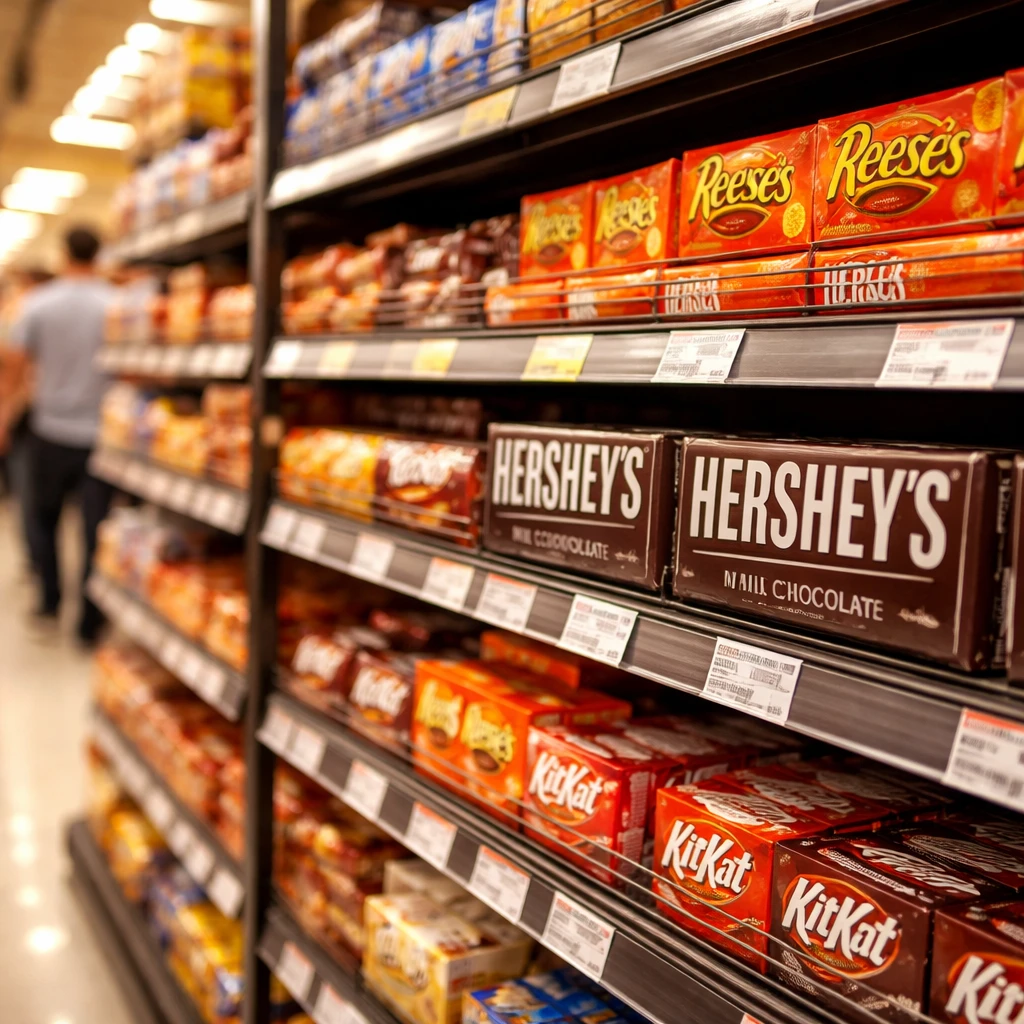
DA Davidson raised its price objective on Hershey Co. to $243.00 from $207.00 on Friday, while maintaining a Neutral rating on the confectionery maker. The updated target sits above the stock's current market price of $230.72, although InvestingPro data flags the share as trading above its Fair Value, where Hershey's price-to-earnings ratio stands at 38.87.
The firm's decision to lift the target follows what DA Davidson described as an "accelerated path to earnings restoration" for the chocolate and confectionery business. DA Davidson noted the stock has already climbed roughly 9% since that trajectory became evident, a move that InvestingPro data places even higher at a 15.21% gain over the past week and a 52.12% gain over the past year.
DA Davidson highlighted two key drivers behind its relatively constructive view on top-line trends: encouraging elasticity for Hershey's products and a robust pipeline of innovation. Those factors underpin an expectation of healthier revenue performance despite anticipated pressures from MAHA, the emergence of GLP-1 medications, and potential adjustments to SNAP program rules.
The analyst team also expects Hershey to step up brand reinvestment, calling for advertising and consumer-facing spending to rise by double digits. That elevated reinvestment is modeled as a strategic allocation aimed at preserving pricing power and supporting volume and mix, according to DA Davidson's analysis.
On the margin side, DA Davidson flagged that several below-the-line items are contributing materially to the company’s earnings recovery in fiscal 2026. Interest expense, other expenses, and tax items were singled out as drivers of the near-term improvement. The firm added that there appear to be multiple avenues for additional upside to fiscal 2027 earnings, provided market conditions do not deteriorate.
Those analyst remarks arrive amid stronger-than-expected company results for the fourth quarter of fiscal 2025. Hershey reported earnings per share of $1.71, beating consensus estimates of $1.40 by more than 22%. Revenue came in at $3.09 billion versus an anticipated $2.97 billion, underscoring the quarter's outperformance.
Market reaction to the quarterly beat included follow-up reassessments from other brokerages. UBS increased its price target to $236 from $210, while maintaining a Neutral stance, citing the strong outlook from the results. TD Cowen raised its target to $210 from $195 and highlighted expectations for a significant margin recovery by 2026 driven by favorable elasticity trends and potential tariff relief, with additional expansion expected from lower cocoa prices in 2027.
DA Davidson's updated target and the peer responses reflect a cluster of analyst views that see meaningful improvement in Hershey's financial trajectory. The firm’s maintained Neutral rating indicates it is weighing the upside potential against risks tied to consumer healthcare trends, programmatic changes, and cost-side dynamics. InvestingPro still notes the stock is trading above its Fair Value measure, underscoring the valuation considerations that accompany the earnings recovery narrative.
Summary
DA Davidson raised its price target on Hershey to $243 from $207 while keeping a Neutral rating, citing an accelerated earnings recovery supported by product elasticity and innovation. The update follows strong Q4 2025 results and additional price-target increases from UBS and TD Cowen. Despite positive operational signals, InvestingPro data shows the stock trading above its Fair Value.
Key points
- DA Davidson increased its Hershey price target to $243 from $207 but left the rating at Neutral - impacts consumer staples and equity markets.
- Hershey’s Q4 2025 results beat expectations: EPS $1.71 vs $1.40 estimated; revenue $3.09 billion vs $2.97 billion estimated - relevant to packaged foods and consumer brand investors.
- Peers UBS and TD Cowen also raised targets, citing strong outlook and margin recovery expectations - affects sell-side coverage and investor sentiment in consumer staples.
Risks and uncertainties
- External demand pressures from MAHA and the growing use of GLP-1 medications could weigh on category volume - relevant to consumer health and packaged food sectors.
- Potential changes to SNAP program rules represent a policy-driven risk that may affect lower-income consumer purchasing dynamics - impacts retail demand and consumer staples sales.
- Below-the-line items such as interest expense, other expenses, and taxes are significant contributors to the near-term earnings recovery; shifts in these items could alter the projected fiscal 2026 trajectory - relevant to corporate finance and equity valuation.