
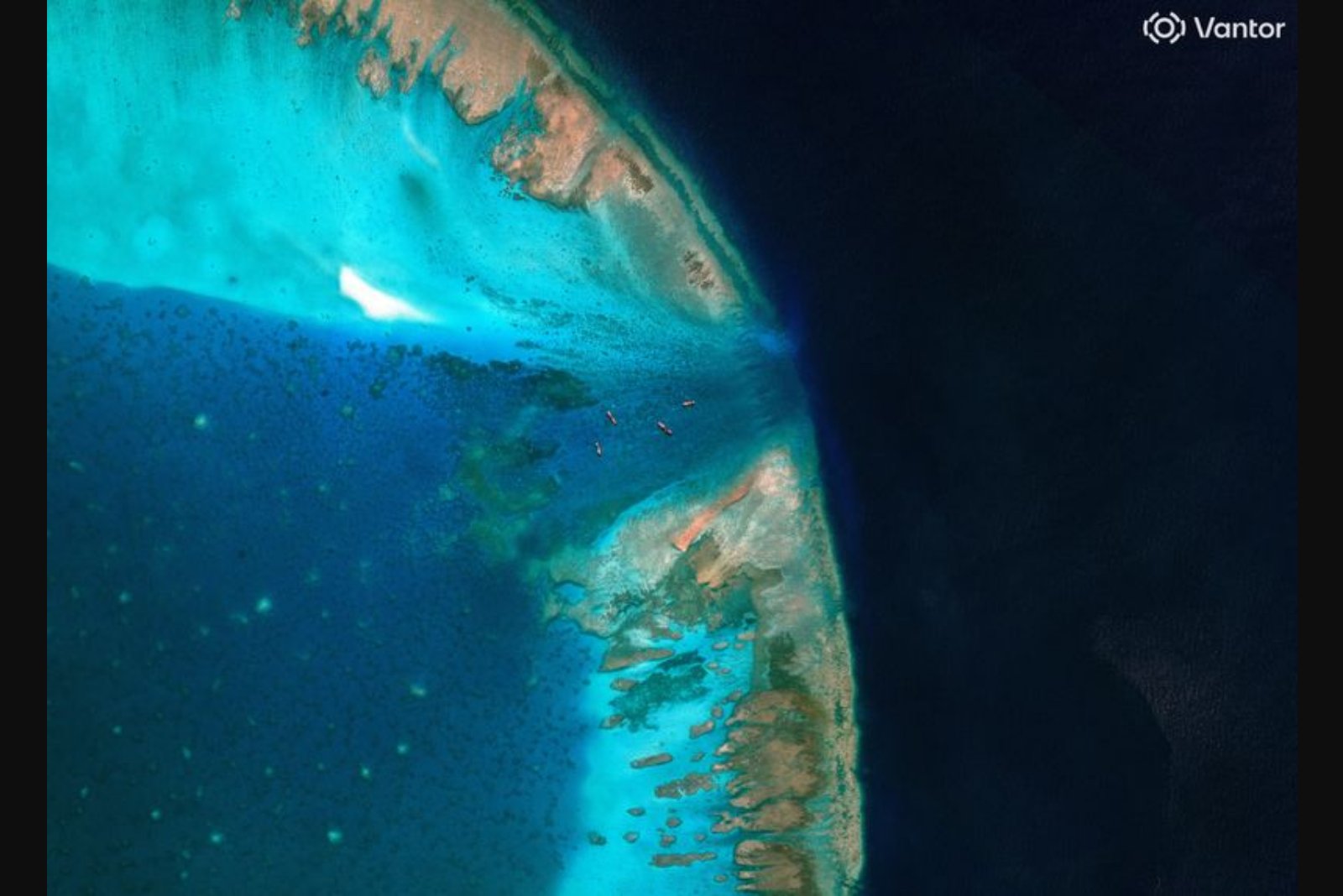
Satellite imagery and official Philippine statements indicate China placed a floating barrier and deployed multiple vessels at the entrance to Scarborough Shoal in the South China Sea, escalating a standoff over the contested maritime feature.
Images taken on April 10 and April 11 show fishing boats anchored near the shoal's entrance and a barrier spanning that entrance in the April 11 photograph. Imagery provider Vantor, formerly Maxar Technologies, identified what it described as a probable Chinese naval or coast guard patrol vessel just outside the shoal on April 10.
The shoal - known in the Philippines as Bajo de Masinloc and referred to by China as Huangyan Island - sits within the Philippines’ exclusive economic zone but is also claimed by China. The area is a traditionally rich fishing ground and has been the focus of recurring confrontations between Chinese and Filipino vessels.
Jay Tarriela, a spokesperson for the Philippine coast guard, told Reuters that a 352-m (1,150-ft) floating barrier was installed by the Chinese government at the shoal entrance on April 10 and April 11. He said six Chinese maritime militia vessels were observed within the shoal while three others were seen outside, "seemingly obstructing the entrance to BDM." Tarriela used the Philippine name for the shoal.
Photographs and satellite imagery show four fishing boats and what was described as a Chinese naval or coast guard ship positioned near the entrance. Philippine officials reported that the Chinese-installed barrier appeared to have been removed since the weekend following the installation, but the Philippine Navy has maintained ongoing patrols in the area.
"According to our assessment in the past, they consistently exhibit suspicion whenever they monitor a group of Filipino fishing boats," Tarriela added, characterizing the interactions between Chinese vessels and Filipino fishermen.
Separately, Philippine Navy spokesperson Roy Trinidad said ten Chinese coast guard vessels were sighted at the shoal from April 5 to April 12.
China's defence ministry did not immediately respond to requests for comment on the deployment or its timing.
Background and regional activity
Despite competing claims, formal sovereignty over Scarborough Shoal has not been established. In practice, however, Beijing has exercised an effective control of the area since it seized the shoal in 2012 following a standoff with the Philippines. Manila continues to send vessels and fishermen to the area even as Chinese activity persists.
In January, the armed forces of the Philippines and the United States conducted a joint sailing at the shoal, marking the 11th such drill by the two treaty allies. Military engagement between Manila and Washington has grown under Philippine President Ferdinand Marcos Jr., who has moved the country closer to the United States in response to China's expanded presence across the South China Sea.
Thousands of troops from both countries are scheduled to begin large-scale exercises across the Philippine archipelago this month, including drills in Zambales - whose coastline lies approximately 120 nautical miles from Scarborough Shoal.
Diplomats cited in reporting say these drills and the heightened tensions around the shoal are being monitored closely amid concerns that Beijing could seek to take advantage of perceptions that U.S. attention is divided by other international crises, including efforts to reopen the Straits of Hormuz. The reporting notes those perceptions as part of the regional geopolitical context.
Legal and long-term context
A 2016 ruling by the Permanent Court of Arbitration addressed multiple South China Sea disputes and sided with Manila on several points. The court did not resolve sovereignty over Scarborough Shoal, however, and it found that Beijing's blockade there violated international law, noting the shoal's status as a traditional fishing ground used by several nations, including China, the Philippines and Vietnam.
Philippine authorities have alleged that Chinese maritime militia operate some fishing trawlers at Scarborough Shoal and other disputed sites in the South China Sea, a claim Beijing has not acknowledged.
China approved the creation of a national nature reserve at Scarborough Shoal last year, a move that alarmed Philippine security officials. They described the action as a "clear pretext for occupation."
Current posture and ongoing operations
Philippine coast guard and fisheries vessels have been deployed to support Filipino fishermen who are frequently turned away by larger Chinese patrol boats. The Philippine coast guard has previously cut through barriers at the shoal, and officials said they continued patrols even after the latest barrier appeared to be removed.
The presence of a floating barrier combined with a mix of Chinese coast guard, maritime militia and probable naval or coast guard vessels at the shoal's entrance has reinforced Manila's concerns about freedom of access for local fishers and the broader question of maritime rights in the zone.
For now, the situation remains fluid: photographic and satellite evidence captures the recent placement of the barrier and vessel positions, while Philippine naval and coast guard patrols continue operations in and around the shoal.