
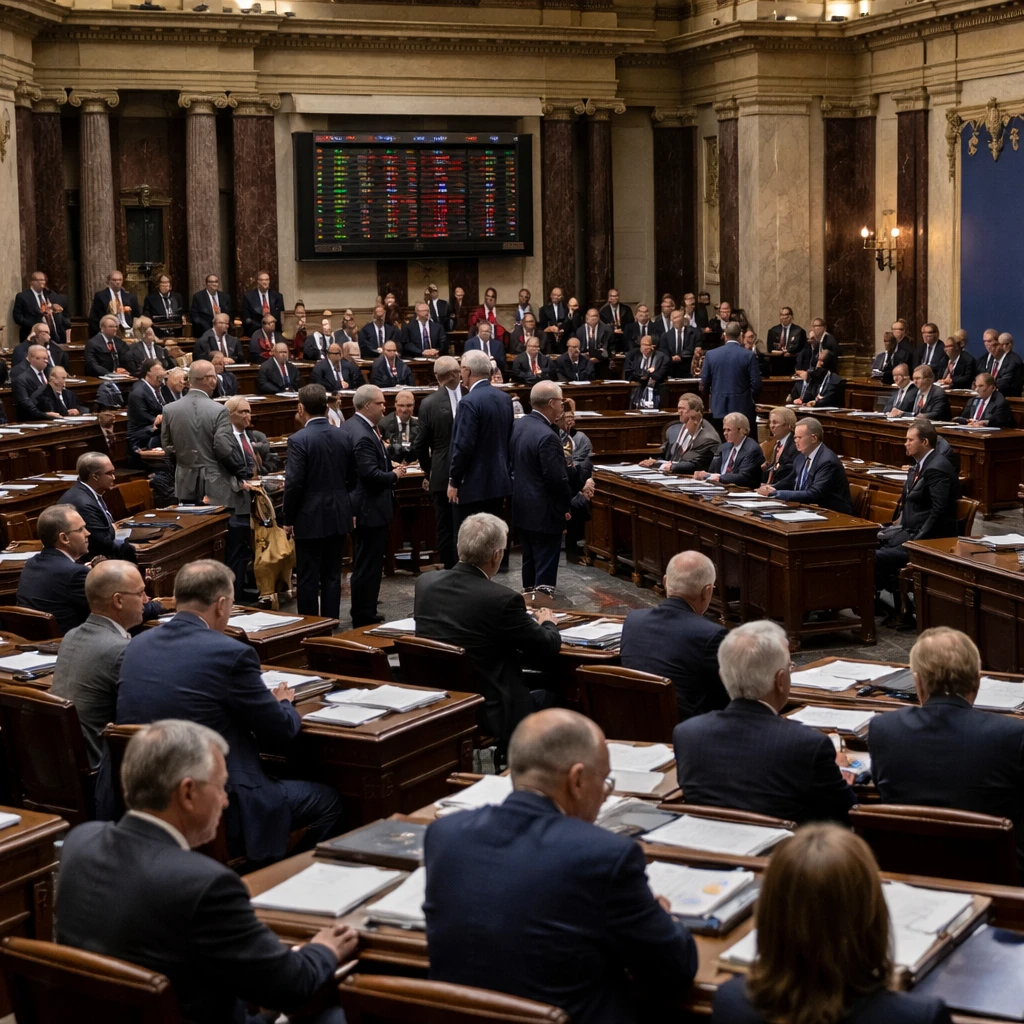
The Senate on Monday approved a procedural motion to move forward with the nomination of Jay Clayton to serve as director of national intelligence, registering a 51-43 vote to advance the former Manhattan U.S. attorney. The tally was strictly along party lines, with Republicans supporting the nominee and members of the Senate Democratic caucus opposing the measure.
With that procedural win in hand, Clayton is widely expected to face a final confirmation vote before the end of the week. The Senate now needs to take the final step to confirm him to lead the government office that oversees the nation’s 18 intelligence agencies.
Context and vacancy
The DNI post has been vacant since June, when Tulsi Gabbard stepped down after a period of high-profile disputes with congressional Democrats. Democrats had accused Gabbard of advancing President Trump’s political aims and of promoting debunked claims about the 2020 election, issues that contributed to tensions surrounding her tenure.
Senators from both parties have expressed dissatisfaction with the current interim leadership at the Office of the Director of National Intelligence. The interim director identified in reporting is Federal Housing Finance Agency Director Bill Pulte, described as a Trump loyalist without prior national security experience who has been reducing staff at the office. That concern has increased pressure on the Senate to settle the leadership question by confirming a permanent DNI.
Confirmation hearing and committee recommendation
Clayton’s nomination was sent to the full Senate after a narrow 9-8 vote in the Senate Intelligence Committee, where only Republicans on the panel supported his recommendation. During his confirmation hearing, Clayton repeatedly declined to directly state that President Trump lost the 2020 presidential election, a point that drew sustained questioning from Democratic senators.
Democrats on the committee also pressed Clayton on his decision as a prosecutor to issue subpoenas seeking testimony from New York Times journalists in a probe related to security concerns about a newly acquired presidential aircraft funded by a Qatari donation. At a court hearing last week, a prosecutor said the administration would withdraw those subpoenas after a judge raised pointed questions about the underlying investigation.
Oregon Senator Ron Wyden, a senior Democrat on the Intelligence Committee, summarized his opposition in a statement, saying: "From start to finish, Mr. Clayton has proven himself incapable of telling the truth or demonstrating an iota of independence from Donald Trump. For those reasons, I voted ’no’ on his nomination."
By contrast, Senate Majority Leader John Thune, a South Dakota Republican, urged colleagues to back Clayton, calling him "a proven leader" and arguing that the position requires experienced leadership "amid a heightened threat environment."
Prior delays and scheduling
The nomination process was complicated even before Clayton’s July 15 hearing. In mid-June, President Trump unexpectedly cast doubt on the nomination by ordering a postponement of Clayton’s hearing as leverage to press Congress for an overhaul of U.S. voting rules. Senators initially expected the hearing to proceed, but the president’s directive kept Clayton from appearing at that time.
Despite the controversies and partisan division, Republicans hold a 53-47 majority in the Senate and have generally supported the president’s nominees. That margin made it likely that Clayton could secure enough votes for confirmation even if Democrats uniformly opposed him.
Outlook
After the procedural vote, attention now turns to the final confirmation roll call later in the week. If the full Senate confirms him, Clayton will assume responsibility for coordinating the intelligence community and overseeing the civilian agencies that collect and analyze national security information.