
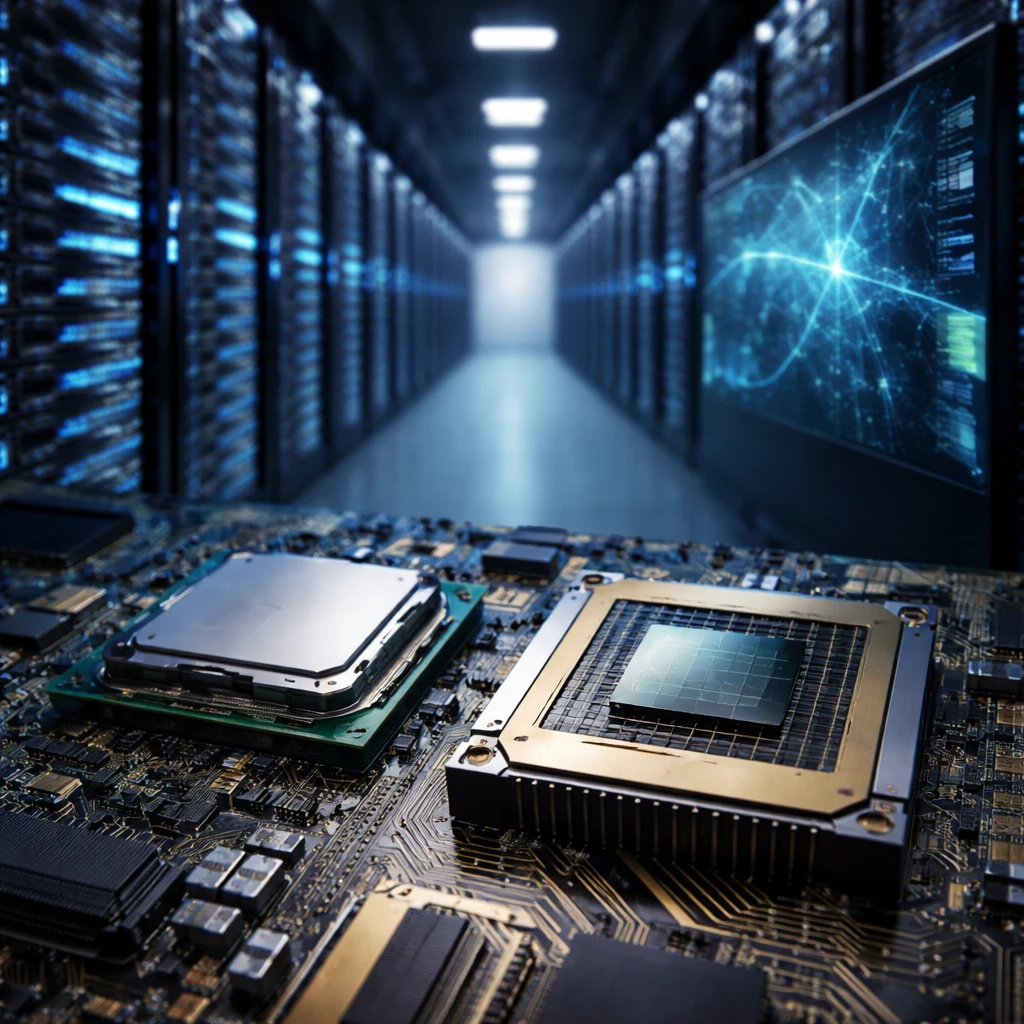
Shares of Nvidia rose 5% on Friday after a blockbuster session for the semiconductor sector spurred by Intel's quarterly report. The technology group rallied as investors digested data showing a pickup in demand for central processing units from AI service providers.
Intel's first-quarter results indicated that demand from AI cloud and service firms exceeded what the company had anticipated. The company reported sales of processors it had previously written off, a development that helped push Intel shares up 24% to $83. That move lifted Intel's market capitalization above $416 billion, clearing a level not seen since its dot-com era peak in 2000.
The strength at Intel rippled across the chip industry. Advanced Micro Devices gained 14% and Arm climbed more than 13% as market participants increased their conviction that inference - the step in which AI models generate answers to user queries - could restore central processors to a more prominent role. For years, graphics processing units have been the workhorses for training large AI models; the recent market action reflects a reassessment of CPUs' place in AI infrastructure, particularly for inference workloads.
Nvidia stood out as the largest mover in dollar terms on Friday due to its roughly $5 trillion market capitalization. The company has also been extending its product set into CPU territory, a space historically dominated by Intel and AMD. Last month Nvidia unveiled a new central processor, marking a notable expansion of its hardware portfolio.
Nvidia's prior entries into CPU designs include the 2023 Grace processor, an ARM-based chip built to operate alongside Nvidia GPUs in configurations such as Grace Hopper and Grace Blackwell Superchips. Those combinations are designed to mitigate data bottlenecks that can limit performance in AI workloads.
At the company's GTC 2026 event, Nvidia introduced the Vera CPU, which features a custom Olympus core and a Spatial Multithreading architecture. According to Nvidia, Vera is intended to deliver approximately twice the efficiency of conventional x86 CPUs for agentic AI tasks.
While the market reaction on Friday favored companies tied to both GPU and CPU strategies, the developments underline shifting investor expectations about hardware roles in AI applications. The session illustrated how stronger-than-expected enterprise demand for CPUs can influence valuations across the semiconductor ecosystem.