
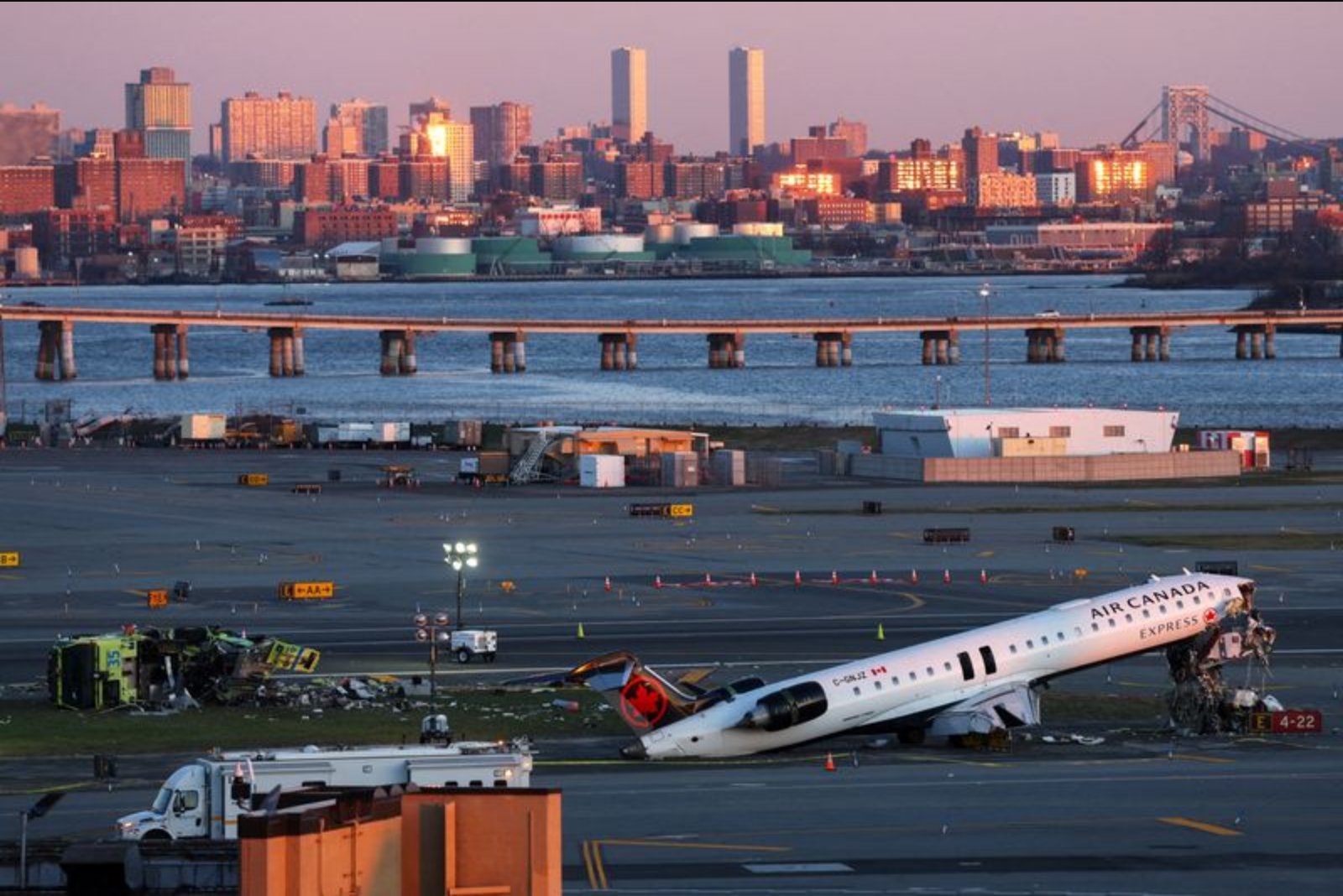
The National Transportation Safety Board said in a preliminary report that a key runway safety function did not activate ahead of the March 22 collision between an Air Canada Express regional jet and a fire truck that resulted in the deaths of two pilots.
The NTSB reported that red runway entrance lights - signals that tell vehicle operators when it is unsafe to cross a runway - remained illuminated until roughly three seconds before the time of impact. The board noted the system is intended to extinguish those lights about two to three seconds before an arriving aircraft reaches each intersection.
According to the preliminary findings, the Air Canada Express CRJ-900 had touched down approximately two seconds before the collision and was traveling at about 104 mph at the moment it struck the fire truck. The agency is leading the formal investigation into the crash, which involved the CRJ-900 operated by Air Canada’s regional partner.
The collision sent 39 of the 76 passengers and crew to hospital for treatment, including six people who sustained serious injuries. Two pilots were killed in the incident.
The NTSB also reported that the airport’s ground surveillance system did not produce an alert warning of vehicle proximity to the runway at the time of the event. In addition, the fire truck involved in the collision did not have a transponder that would have broadcast its position to air traffic control systems.
In a cockpit- and vehicle-centered detail from the NTSB summary, the turret operator aboard the truck recalled hearing a transmission on the tower frequency that said, "stop stop stop," but did not immediately know who the transmission targeted. The operator then heard, "Truck 1 stop stop stop," at which point they realized the warning was meant for their vehicle and noticed they had entered the runway.
The board provided information on staffing and experience levels for the controllers on duty. The local controller assigned to the arriving Air Canada Express had about 18 years of experience, while the ground controller, who was also acting as controller-in-charge and was responsible for aircraft taxiing, had about 19 years of experience.
The Federal Aviation Administration has for some time encouraged airports to outfit fire trucks with transponders because the devices make emergency vehicle movements easier to track at busy airports. The NTSB preliminary report highlights both the lack of a transponder on the truck and the absence of a ground surveillance alert as elements being examined as the investigation proceeds.
Context and next steps
The NTSB is continuing its investigation and is collecting data on system performance, communications, and the sequence of events leading up to the collision. The preliminary report documents the initial findings on system behavior, vehicle equipment, controller experience, passenger and crew injuries, and the immediate communications recalled by the vehicle operator.