
Shares of Knight-Swift Transportation Holdings Inc. (NYSE:KNX) declined about 3% in after-hours trading after the company revised down its earnings outlook for the first quarter of 2026 and released a forward-looking range for the second quarter.
Management now forecasts adjusted earnings per share for Q1 2026 of $0.08 to $0.10, a sharp reduction from its prior guidance of $0.28 to $0.32. That revised range sits well below the consensus analyst estimate of $0.26 per share.
The company attributed the bulk of the shortfall to several discrete items and operational headwinds. Knight-Swift identified an $0.08 per-share negative impact from claims development in its less-than-truckload (LTL) business, largely tied to a significant unfavorable arbitration award stemming from a 2022 incident. Additional downward pressure includes a $0.05 per-share drag from deferred project business in its warehousing operations and a $0.02 per-share hit related to an adverse decision on VAT reimbursement in Mexico covering prior tax years.
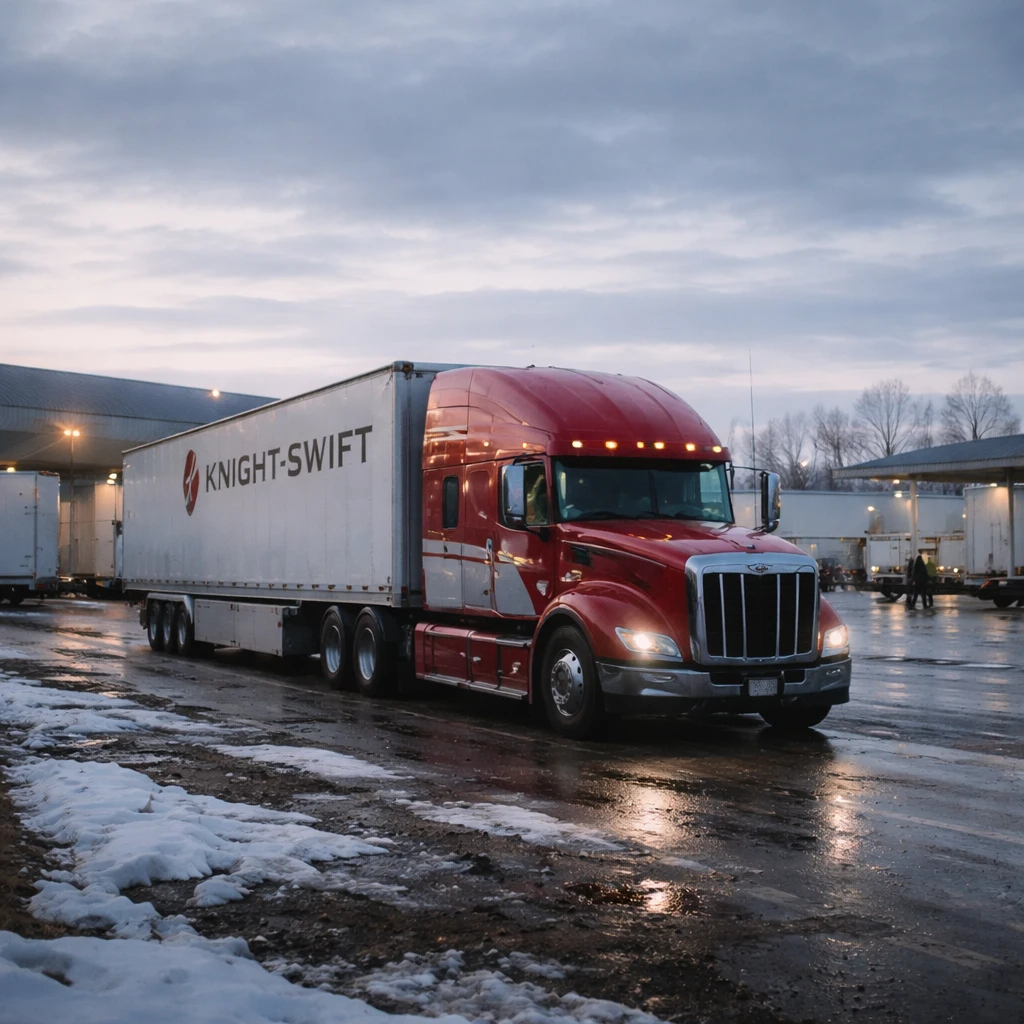
Knight-Swift also pointed to weather and fuel as material, short-term contributors to the Q1 miss. The company estimated that severe winter weather in January and a sharp rise in fuel prices in March together produced a roughly $0.05 to $0.06 per-share negative effect.
Looking ahead to the second quarter of 2026, Knight-Swift provided an adjusted EPS range of $0.45 to $0.49, versus analyst expectations of $0.48 per share. The company said the anticipated sequential improvement reflects the non-recurring nature of many first-quarter items and what it views as strengthening freight market fundamentals.
CEO Adam Miller commented on market dynamics, saying the truckload market continues to tighten and that the bid environment is rapidly evolving. He added that while winter weather and higher fuel costs were headwinds in the first quarter, those disruptions revealed reduced truckload capacity and are expected to accelerate a downward trend in industry supply.
Summary: Knight-Swift trimmed Q1 guidance sharply due to claims in its LTL segment, deferred warehousing projects, a VAT ruling in Mexico, and short-term weather and fuel cost shocks. The company set a Q2 outlook that implies recovery as one-time items abate and freight fundamentals improve.