
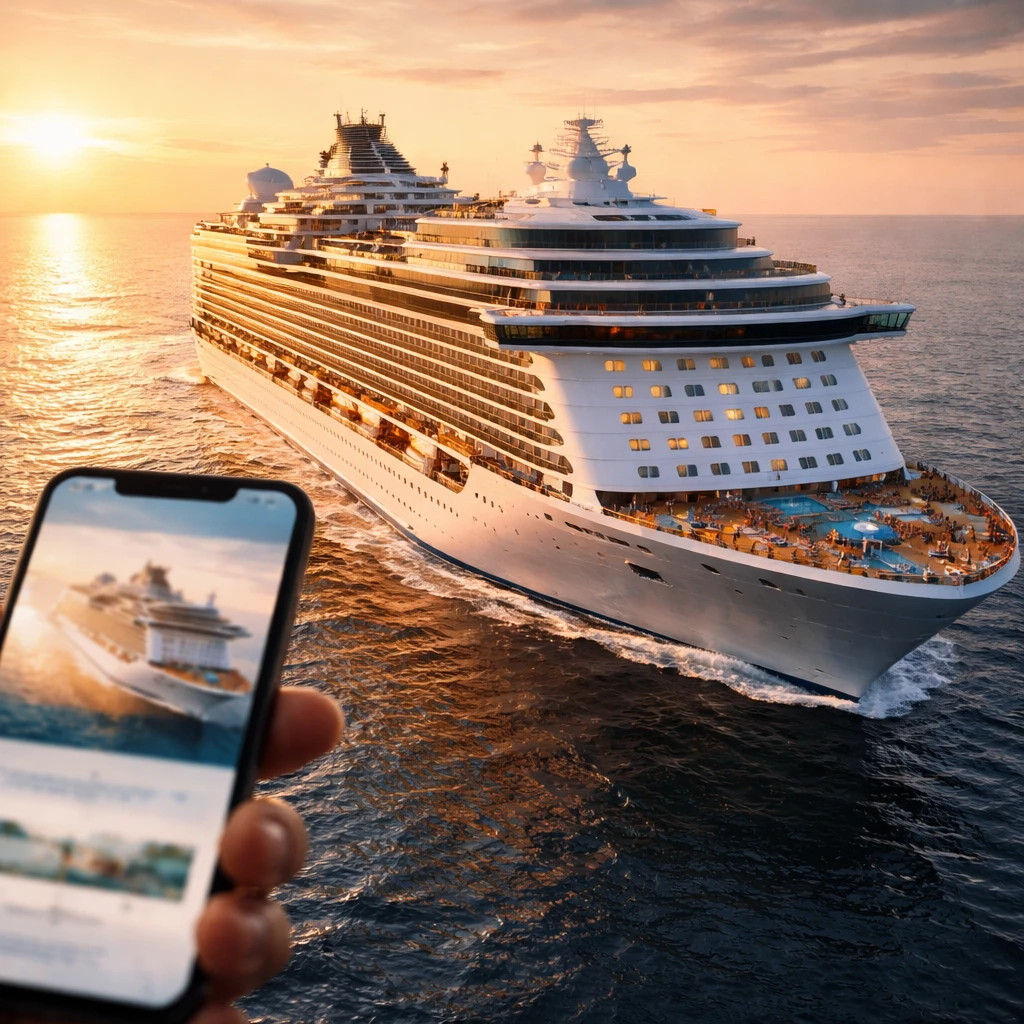
Analysts at Barclays, led by Brandt Montour, say the cruise industry stands to gain disproportionately from broader adoption of artificial intelligence. In a client note, the team identifies two core avenues for value: cutting payments to third-party travel agents through a move to direct bookings, and strengthening top-of-funnel discovery that could expand the addressable market and support pricing over time.
Barclays estimates that third-party commissions currently account for roughly 3% to 6% of total industry gross revenue. The bank’s calculations suggest that, if a meaningful share of bookings shifts away from intermediaries toward AI-enabled direct channels, the resulting reduction in commission expense could translate into an earnings-per-share (EPS) improvement in the range of 12% to 45% across the major cruise companies.
The bank emphasizes that cruise products have historically been more complex than many other travel offerings because they frequently combine flights, shore excursions and onboard packages into a single purchase. That complexity has helped sustain the role of travel agents. However, Barclays contends that AI is especially suited to simplifying and personalizing those multi-component transactions for a younger, more digitally native cohort of customers, which could permit carriers to disintermediate agents.
Within the industry, Barclays points to Royal Caribbean Cruises Ltd (NYSE:RCL) as the current leader in integrating AI capabilities, while highlighting Norwegian Cruise Line Holdings Ltd (NYSE:NCLH) as the company with the largest relative upside potential from such technology. Carnival Corporation (NYSE:CCL) is also expected to benefit, though the bank notes that the magnitude of gains for Carnival will depend on each firm’s ability to modernize and migrate legacy booking systems.
Beyond the immediate, quantifiable benefit from commission savings, Barclays sees a second, potentially powerful effect: AI-enabled discovery. Improved search, recommendation and marketing tools could draw more first-time cruisers and increase the industry's total addressable market. The analysts say this lift in discovery could, over time, strengthen pricing power, although they add that projecting those gains is currently more uncertain than estimating the direct commission savings.
Barclays further highlights two structural conditions that make AI-driven marketing attractive for cruise operators: generally high customer satisfaction scores and low market penetration. Together, those factors create a favorable environment for converting non-cruisers into customers via improved digital outreach. The bank cautions that the timing and scale of benefits will not be uniform across the 'Big Three' carriers, and that operational execution on booking-platform upgrades will be an important determinant of success.
Overall, Barclays expresses a constructive view on the sector’s prospects for using technology to protect and potentially expand margins in a competitive global travel market. The bank’s analysis frames commission reduction as a near-term, quantifiable source of upside and improved discovery as a longer-term, though harder-to-forecast, tailwind.
Summary
Barclays analysts led by Brandt Montour identify a significant AI opportunity for cruise lines that centers on cutting third-party commissions by moving bookings to direct, AI-powered channels, and on using AI to improve customer discovery. The bank quantifies potential EPS upside of 12% to 45% from commission savings and names RCL as an integration front-runner, NCLH as having the largest relative upside, and CCL as a potential beneficiary depending on system upgrades.
Key Points
- Direct booking shift could reduce third-party commission costs that Barclays estimates at 3% to 6% of industry gross revenue, creating an EPS upside of 12% to 45% for major carriers - sectors impacted: cruise lines, travel distribution.
- AI-driven discovery may bring first-time cruisers into the market and, over time, enhance pricing power, although these effects are harder to quantify today - sectors impacted: travel marketing, consumer travel demand.
- Adoption and execution will vary across the Big Three; Royal Caribbean is identified as the current front-runner, Norwegian as having the largest relative opportunity, and Carnival’s gains will be tied to legacy-system transitions - sectors impacted: technology integration, operations.
Risks / Uncertainties
- Pace of AI adoption will differ among major carriers, introducing variability in when and how much benefit is realized - impacts cruise operators and investors.
- Longer-term benefits from improved discovery and pricing are more uncertain and harder to forecast than immediate commission savings - impacts marketing and revenue management expectations.
- Carnival’s potential gains depend on successfully transitioning legacy booking systems, posing implementation and operational risk - impacts IT spend and operational efficiency.