
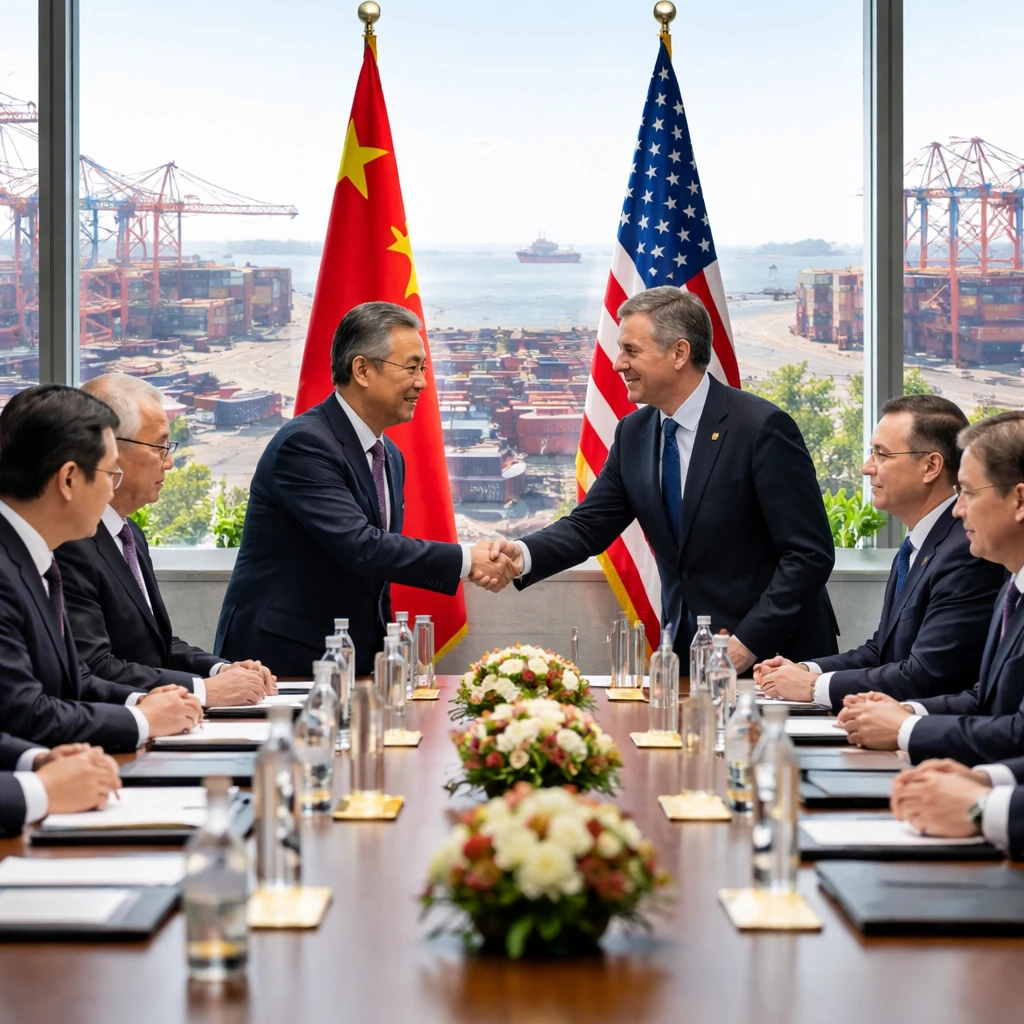
China and the United States have agreed to set up a Board of Trade and a Board of Investment as part of broader efforts to increase bilateral commercial ties, Chinese Foreign Minister Wang Yi said in a statement released by his ministry.
According to Wang, the two boards will serve as formal channels for addressing a range of trade and investment issues. He said the talks will include work on improving market access for agricultural products and on measures intended to expand two-way trade through a framework of reciprocal tariff reductions.
Wang noted that delegations from both countries are currently consulting on the details of the arrangement. He said those teams will finalize the outcomes "as soon as possible," indicating that the institutional structure and practical steps remain under negotiation.
The statement from the foreign ministry also touched on wider diplomatic matters. Wang encouraged the United States and Iran to continue working to resolve their differences through direct talks. He added a call for the Strait of Hormuz to be reopened as soon as possible, raising a maritime and regional security dimension alongside the trade announcement.
The agreement to form the two boards represents a formal commitment by both governments to pursue expanded commercial engagement through structured mechanisms. The description provided by Wang highlights two immediate priorities: agricultural market access and a reciprocal tariff reduction framework intended to broaden two-way trade. How those priorities will be operationalized depends on the consultations under way.
At this stage, officials from China and the United States are still negotiating the precise scope, procedures and timelines for the boards. Wang's statement did not include further specifics on membership, meeting cadence, or concrete tariff commitments, and he confined the public details to the broad aims of the initiative.
Beyond trade and investment, the foreign ministry statement linked the diplomatic engagement to regional security issues by urging resumed dialogue between the U.S. and Iran and calling for reopening the Strait of Hormuz. That element of the statement signals an intersection between commercial and geopolitical priorities in the current discussions.
Summary
- China and the U.S. will create a Board of Trade and a Board of Investment to expand bilateral commerce, Chinese Foreign Minister Wang Yi said.
- The initiatives will address agricultural market access and aim to expand two-way trade through a reciprocal tariff reduction framework.
- Teams from both sides are consulting on details and will finalize outcomes as soon as possible; Wang also urged continued U.S.-Iran talks and reopening of the Strait of Hormuz.