
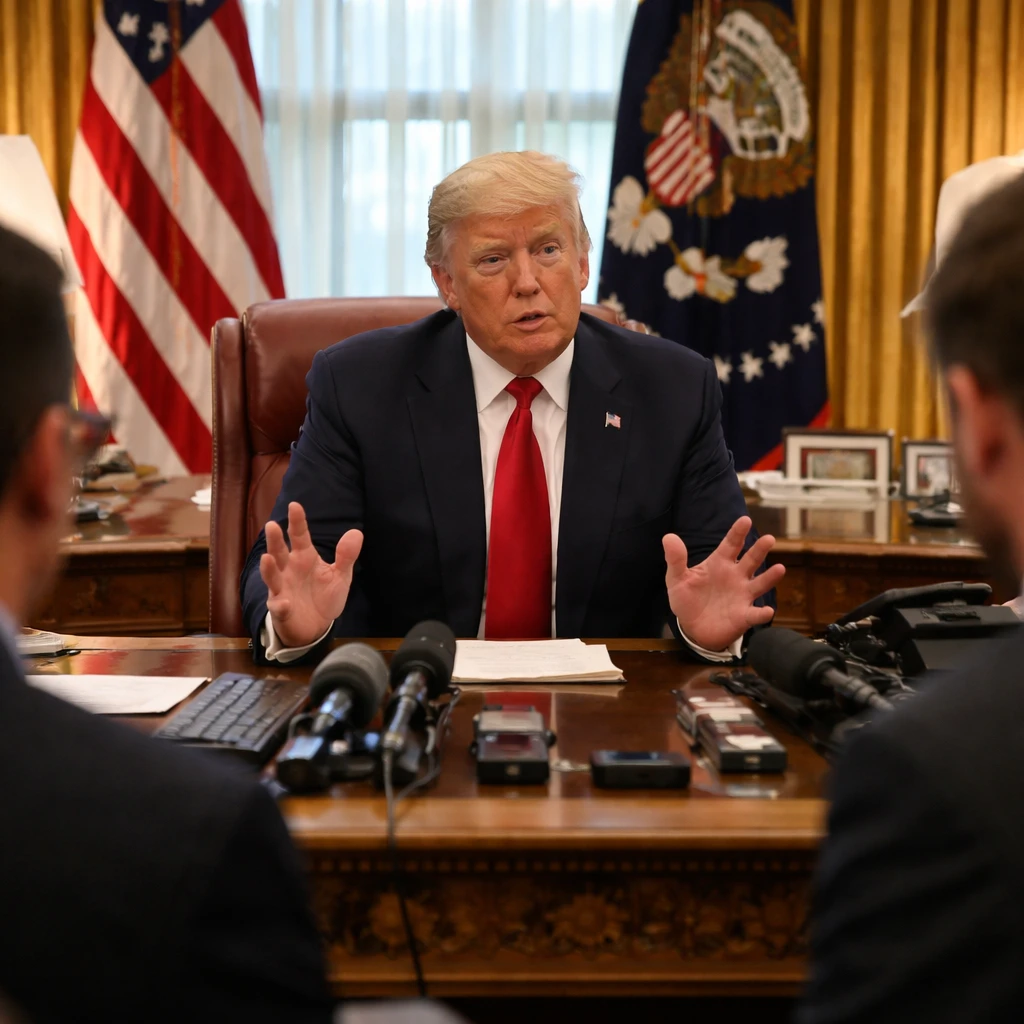
President Trump told reporters in the Oval Office on Thursday that he would not deploy a nuclear weapon against Iran, saying the United States had "decimated them without it." He framed the use of nuclear arms as unacceptable against any nation.
Trump’s comments followed a series of public threats earlier in the month. On his social platform, he warned Iran that "a whole civilization will die tonight, never to be brought back again" unless Tehran reached an agreement. That post set a deadline that concluded with Trump announcing a cease-fire shortly before it expired.
Addressing the aftermath of that pause in hostilities, Trump suggested that Iran may have "loaded up their weaponry 'a little bit' during the two-week ceasefire," but he added that the U.S. military would be capable of eliminating any such build-up swiftly.
"Their navy is gone. Their air force is gone, their anti-aircraft is gone ...maybe they loaded up a little bit during the two-week hiatus, but we’ll knock that out about one day, if they did," Trump said.
The president emphasized two themes in his remarks: a categorical rejection of nuclear weapon use and a claim of rapid conventional military capability to respond to any renewed Iranian armaments. He also recalled his earlier, more severe social media language used to press Iran toward a deal, and noted that he later shifted to announcing a cease-fire as his deadline approached.
Below are the principal takeaways and near-term considerations stemming from the president’s statements.
- Clear rejection of nuclear use - The president stated explicitly that a nuclear weapon should never be used against anyone.
- Assertion of military capability - Trump maintained that U.S. forces could neutralize any weapons Iran might have moved during the cease-fire within around one day.
- Recent escalation in rhetoric - Earlier threats made on the president’s social platform included an ultimatum that warned of catastrophic consequences unless Iran struck a deal, followed by a cease-fire announcement.
These remarks encapsulate the current public posture: strong conventional force claims paired with an avowed rejection of nuclear escalation.