
Overview
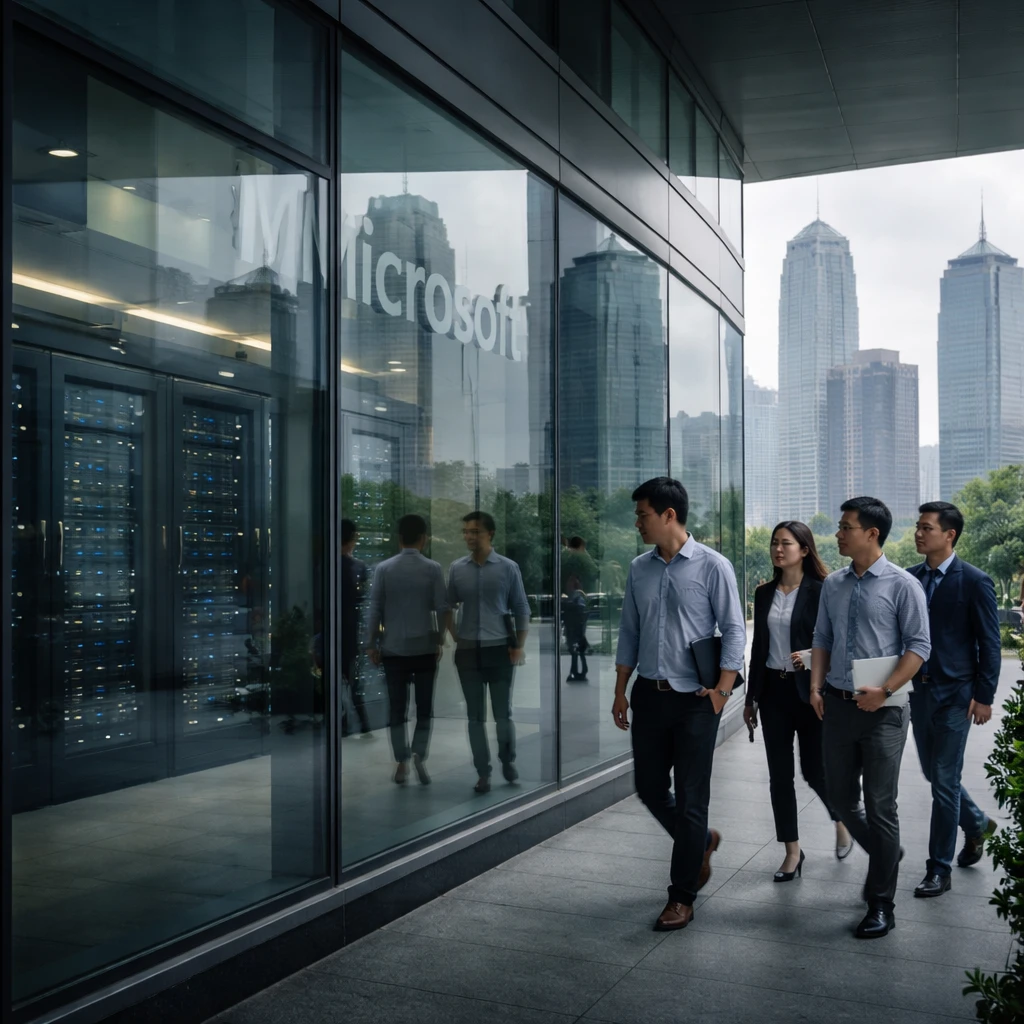
Microsoft, once publicly committed to maintaining a robust presence in China, has substantially scaled back its on-the-ground operations in recent years. Corporate filings reviewed by company sources show that at least 15 Microsoft branch offices and joint ventures in China have closed over the past five years. The retrenchment reflects mounting regulatory friction, changing procurement priorities inside China, and restrictions imposed by the United States on advanced technology exports.
Strategic reconsideration and a near-exit
According to five people with knowledge of internal discussions, Microsoft pursued what they described as a strategy of retreat. Some executives pushed in 2023 to consider leaving the market entirely, arguing that the firm was assuming rising geopolitical risk for limited economic return. Microsoft has publicly reported that China accounted for just 1.5% of global revenue in 2024. Company representatives told contacts that there are no current plans to exit the country.
Despite contemplating a withdrawal, Microsoft ultimately decided to maintain a presence in China. Three people familiar with the situation said the company had developed a profitable niche serving Chinese firms such as ByteDance, which require Western technology to run operations abroad. Two of those people also said that maintaining access to China's engineering talent was a key part of the decision to stay.
Government ties and commercial efforts
Microsoft's engagement with China dates back several decades. The company worked to build a relationship with Chinese officials through co-investments in incubators and by complying with local censorship rules that other Western technology firms had refused to accept. The firm negotiated a China-specific version of Windows - Windows 10 China Government Edition - in discussions involving top executives and Chinese finance ministry officials. Although that product gained some adoption among government agencies, it did not achieve the broader commercial traction Microsoft had hoped for, according to one former China head.
New procurement guidelines introduced by the Chinese government around 2017 emphasized buying "safe and reliable" services. Microsoft has said that no foreign operating system has been deemed fully compliant with those government policies and that non-compliance does not equate to an outright ban. Nevertheless, use of foreign systems subjects administrators to additional scrutiny, including extra security checks and additional approval steps.
Researchers reviewing government procurement guidance published between December 2023 and May 2026 found six relevant guides. Five did not recommend Microsoft, while a sixth included the Windows 10 China Government Edition but noted its use would be subject to "additional management requirements" without elaborating further.
Private-sector opportunity: Helping Chinese firms go global
While Microsoft did not become the preferred vendor for many Chinese state customers, the company found a revenue stream in serving private-sector firms with global ambitions. Chinese companies that operate significant business outside China rely on Microsoft services to comply with foreign regulations and to manage data in markets where Western standards apply. These customers include ByteDance and other firms with operations that touch Western jurisdictions, plus fast-fashion retailers and other exporters. By the mid-2020s, assisting Chinese firms to operate overseas had become Microsoft’s largest China-linked line of business, though insiders stress that these sales remain small relative to Microsoft’s global scale.
Part of this offering is the ability to give Chinese enterprise clients access, via Microsoft's Azure platform, to Western AI models from third-party providers that do not otherwise serve China. This arrangement has been a differentiator for Microsoft, but analysts and company sources noted that it depends on third-party suppliers and that domestic Chinese alternatives are improving in quality while often being cheaper.
Export controls and constraints on scaling AI and cloud
U.S. export controls on chips and advanced AI models have hampered Microsoft’s efforts to scale its lucrative AI and cloud businesses inside China. These restrictions limit the technology and models that can be deployed in-country and reduce the range of offerings Microsoft can provide to local customers. Executives and employees told observers that these constraints were a significant factor in the internal debate about whether to remain active in China.
Human capital and research footprint
Microsoft has played an important role in building China’s technology talent base since the 1990s, establishing research centers focused on advanced technologies. Microsoft Research China - now operating as Microsoft Research Asia - produced alumni who have taken senior roles at major AI firms. But U.S. export controls and geopolitical strains affected the firm’s ability to keep top engineering talent in China and curtailed the types of research Microsoft conducts there.
Microsoft acknowledged limits on research in China. "The firm doesn’t conduct research on quantum computing and other sensitive technologies in China," Microsoft president Brad Smith told U.S. lawmakers in 2023. Insiders said the company considered closing the China research operation but instead relocated some of its top researchers to labs in Vancouver, Singapore and Tokyo. The firm offered relocation to about 1,000 top engineers in 2024, but sources said only roughly a third accepted those transfers. Microsoft confirmed it offered transfer opportunities in 2024 but declined to provide additional details.
Many senior engineers chose to remain in China and instead joined local tech firms or universities, where they could conduct high-level research while remaining near family. In past years Microsoft had reduced attrition by expanding new business lines and offering global roles; attrition was about 17% in the mid-2010s and was reduced to under 10% during a later period when the firm focused on new revenue streams and staff development.
Relations with Chinese authorities and daily operations
A former head of Microsoft’s China operations described the company’s ties to Chinese government officials as unusually deep for a foreign tech firm. "Because of the geopolitics ... some days it’s a little bit harder, but we never had a crisis," he said. He also defended Microsoft’s longstanding approach to bringing technology into China. "There is up and down in terms of the number of people and maybe some of the things that were developed over there," he said. "But we never change one inch of the fact that we will bring technology into China… for China, for Chinese companies."
Microsoft did not directly address detailed questions about internal debates over its China operations but said it operates in a regulatory "environment that applies to every international supplier" and that it remains committed to the Chinese market. The company also characterized the state of its China business as a reflection of market competition, regulatory demands and technological trends.
Some Chinese customers and partners did not respond to requests for comment. Company spokespeople for a number of private-sector partners did not reply to specific queries about relationships or service arrangements.
Broader context among U.S. technology firms
Microsoft is not alone in reassessing its China exposure. Other large U.S. technology companies have altered supply chains or manufacturing footprints in response to geopolitical tensions and changing business dynamics. These strategic shifts reflect both regulatory pressures from Chinese authorities and actions by the U.S. government that restrict certain advanced technologies from being transferred.
Conclusion
Microsoft’s path in China has been neither a straightforward expansion nor an outright exit. The company has closed offices and scaled back activities while preserving targeted commercial relationships and a research presence. That approach reflects a balancing act between the limited revenue opportunity China currently represents for Microsoft, the need to support global-facing Chinese customers, and the desire to keep lines open to local engineering talent despite the constraints imposed by geopolitics and export controls.