
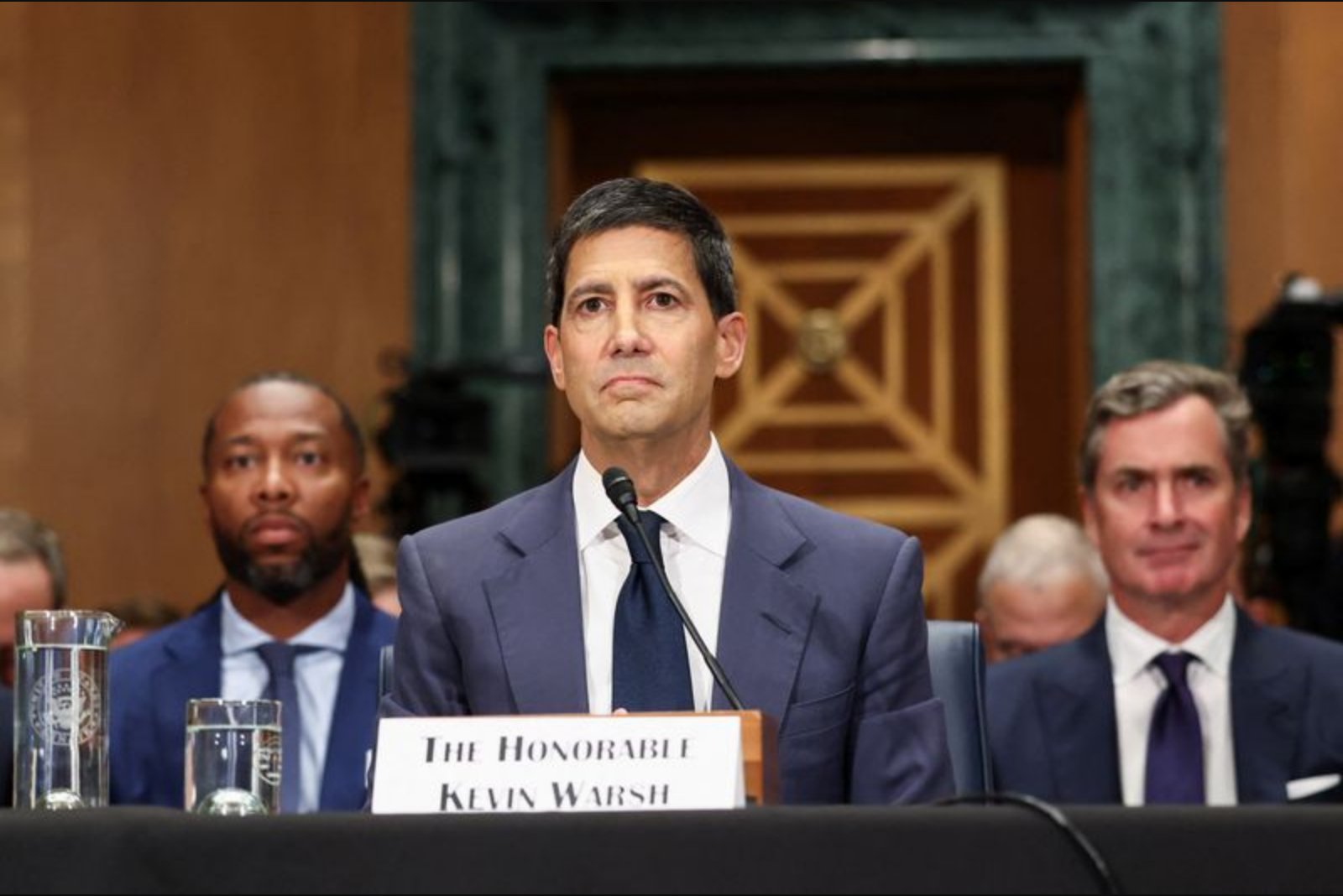
Kevin Warsh, nominated by President Donald Trump to lead the Federal Reserve, used his Senate confirmation hearing to set out a principal objective: to work with the Treasury Department to shrink the Fed's holdings of cash, Treasury and mortgage securities. Appearing before senators, Warsh framed a smaller balance sheet as a long-term project the central bank would pursue in coordination with the Treasury Secretary.
"Working with the Treasury Secretary, we're going to have to find a way in which we can take the balance sheet and make it smaller," Warsh said during the hearing to succeed current Fed Chair Jerome Powell. His remarks represent some of the clearest public commentary to date from the nominee on an issue that has become central to monetary policy discussions.
Warsh criticized the current size and role of the Fed's holdings on several fronts. He said large-scale asset purchases have come to feel like a routine policy instrument rather than an emergency tool, and he suggested that the big balance sheet advantages Wall Street relative to Main Street while constraining the central bank's ability to set lower short-term interest rates. "The big balance sheet has become an ordinary, recurring force" and "has been quite unhelpful, and is part of the reason why the Fed is in the business of politics," he said.
He added that if the Fed trimmed its holdings, interest rates could be lower, inflation could be better managed, and the economy could be stronger. Those are the outcomes he cited as motivating the push for a reduced balance sheet.
On the mechanics of how the reduction would be achieved, Warsh was largely aspirational. He said any moves under his leadership would be "well communicated" and executed "slowly and deliberatively," but he did not outline a specific timetable or the exact tools he would employ. That lack of detail leaves open questions about the means by which the central bank and Treasury would align on shrinking holdings.
Historical context provided by witnesses at the hearing
The Fed's large holdings are the product of repeated use of Treasury and mortgage bond purchases going back to the financial crisis and through the COVID-19 pandemic. The central bank's balance sheet, once under a trillion dollars prior to the 2007 financial crisis, expanded to a peak of $9 trillion in 2022 as the Fed responded to extreme market stress and provided stimulus when the policy rate approached zero.
Fed holdings now stand at $6.7 trillion. A recent report from the New York Fed projected that, based on technical factors, holdings could reach $10 trillion by the end of 2035. Those numbers underline how substantially the central bank's footprint in private markets has grown over the past decade and a half.
Supporters of the status quo stress stability and control
Most Fed officials have not signaled the same level of concern about the balance sheet's size as Warsh. For them, the priority is that the monetary framework used to control short-term rates functions well. They point to abundant liquidity as a guardrail against shocks and emphasize the effectiveness of the rate control system the Fed operates.
Arguments against a very large balance sheet, which Warsh echoed, include worries that it has left the central bank in a loss-making position and that such losses could eventually become a political issue, even if they do not affect the Fed's day-to-day operations. Critics also argue that large-scale holdings make the Fed an outsized participant in markets that would otherwise be dominated by private investors.
Uncertainty about coordination with the Treasury
Market participants and analysts said Warsh has not provided detail on how he envisions coordination between the Fed and the Treasury. Derek Tang, an analyst at research firm LH Meyer, said he expects Warsh would seek clearer communication between the Treasury and the Fed regarding Treasury debt issuance and each institution's plans. That suggests a preference for greater transparency and alignment, though it does not spell out specific policy steps.
Observers do not expect an aggressive campaign of outright Treasury sales by the Fed. Gennadiy Goldberg, head of U.S. rates strategy at TD Securities, noted that Warsh's emphasis on a gradual approach implies that large-scale asset sales are unlikely. The implication is that the reduction may instead come through other adjustments in policy and market structure rather than through immediate disposal of holdings.
Emerging framework for a smaller balance sheet
Recent work inside and outside the Fed has sketched possible pathways to a smaller balance sheet that do not rely primarily on direct asset sales. One approach focuses on easing liquidity regulations and increasing usage of central bank liquidity facilities to lower demand for bank reserves. Reduced reserve demand would, in turn, permit the Fed to hold fewer assets while still maintaining its interest rate control framework.
Some proponents of a reduced balance sheet also argue that it would push up long-term yields, which they view as an increase in monetary restraint that could allow policymakers to set a lower short-term policy rate in response. New York Fed President John Williams acknowledged that higher long-term rates resulting from a smaller balance sheet could theoretically open the door to lower short-term rates to offset those effects, but he cautioned it is difficult to quantify in advance how much lower the central bank's rate target could be.
Implications for policy and markets
Warsh's confirmation hearing introduced a clear agenda item for his potential tenure: shrinking the Fed's balance sheet in coordination with the Treasury. He presented the policy objective and framed its intended benefits in terms of interest rates, inflation management, and economic strength, while offering only general assurance on the pace and communication of any changes. His statements set the stage for further debate within the Fed and among market participants over how to rebalance the central bank's holdings without undermining its primary tools for controlling short-term rates and ensuring market stability.
As the political and technical conversations continue, the mechanics of coordination between the Fed and the Treasury, the preferred sequence of policy moves, and the balance between direct asset sales and structural changes to liquidity management remain open questions reflected in the responses of analysts and central bankers.