
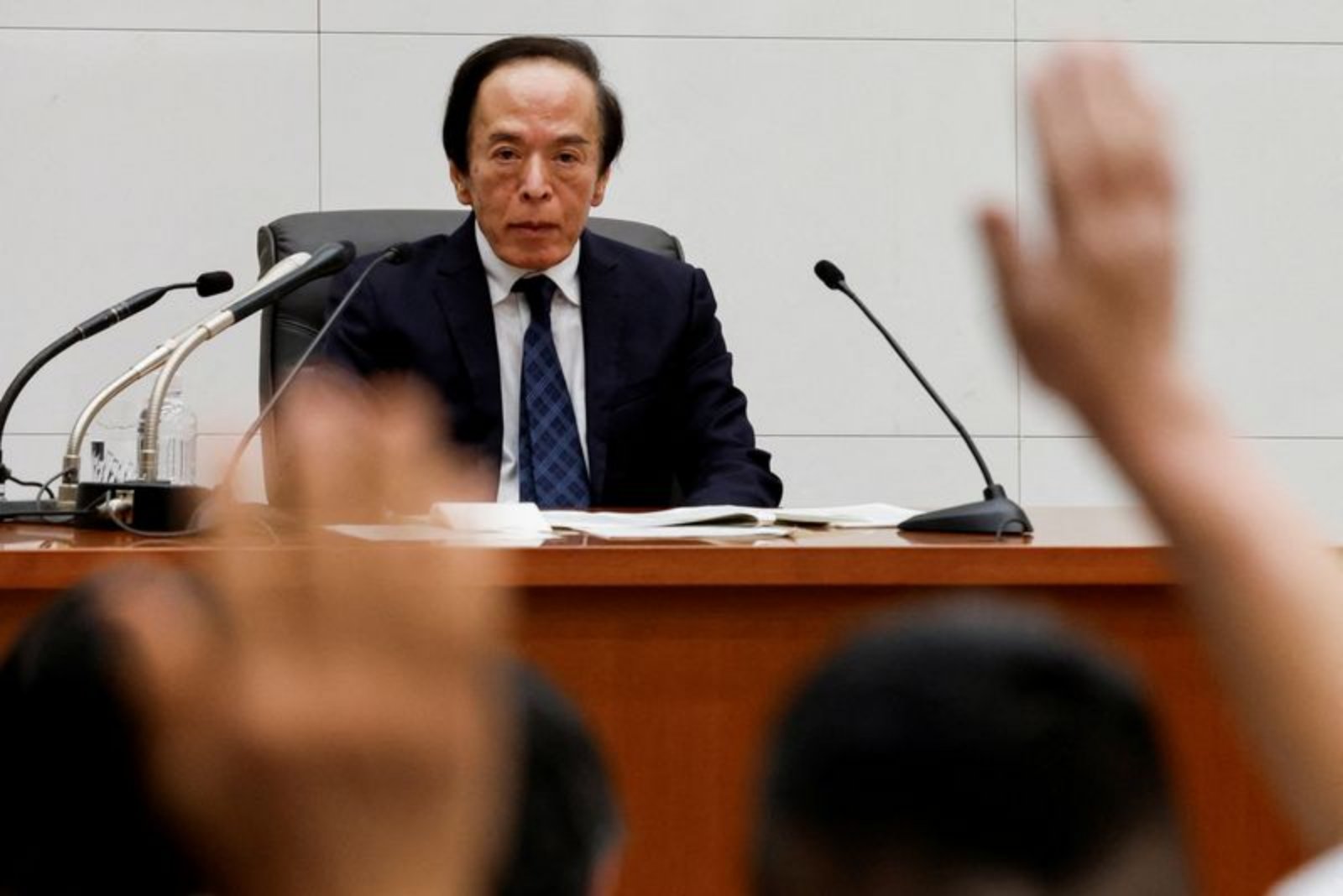
At the International Monetary Fund meetings in Washington on April 16, Bank of Japan Governor Kazuo Ueda said the central bank must consider Japan's low real interest rate when setting the timetable for interest-rate increases.
Ueda told reporters that Japan is experiencing an uptick in inflation originating from what he called a "negative supply shock." He said this type of inflation is more difficult to address with monetary policy than inflation driven by stronger demand.
"The best approach to such a shock would vary from country to country," Ueda said, underscoring that policy responses are not one-size-fits-all. Speaking after attending the IMF meetings, he added a point specific to Japan's financial conditions: "Having said that, I would note that Japan's real interest rate is currently low up to the medium-term zone of the yield curve."
Ueda emphasized that policymakers must also acknowledge the accommodative stance of Japan's financial environment when weighing the timing and pace of future rate adjustments. His comments identified two interlinked considerations for the central bank's decision-making: the source of inflationary pressure and the prevailing degree of accommodation in financial conditions.
The governor's remarks focused on the interaction between the type of inflation shock and the level of real interest rates across the yield curve. He framed this as an input into the judgment about how soon the BOJ should move on policy rates, rather than as a commitment to a specific action or schedule.
Ueda's public comments following the Washington meetings highlighted the central bank's analytical approach: distinguishing supply-driven price pressures from demand-driven ones, and calibrating monetary policy decisions to the domestic financial environment, including real rates in the medium-term part of the yield curve.
Key takeaways
- Japan's low real interest rate through the medium-term yield curve must be taken into account when deciding the timing of BOJ rate increases.
- Ueda identified rising inflation in Japan as stemming from a "negative supply shock," which he said is more difficult to tackle with monetary policy than demand-driven inflation.
- He noted that the appropriate policy response to such shocks will differ across countries and stressed that Japan's financial environment remains accommodative.
Risks and uncertainties
- Uncertainty over how effectively monetary policy can rein in inflation arising from supply-side shocks - the governor said such shocks are harder to control with policy measures.
- Ambiguity around the timing of rate increases given low real rates up the medium-term yield curve and the accommodative financial environment.
- Cross-country variation in optimal policy responses - Ueda cautioned that the best approach will vary by country, leaving scope for divergent outcomes among major economies.