
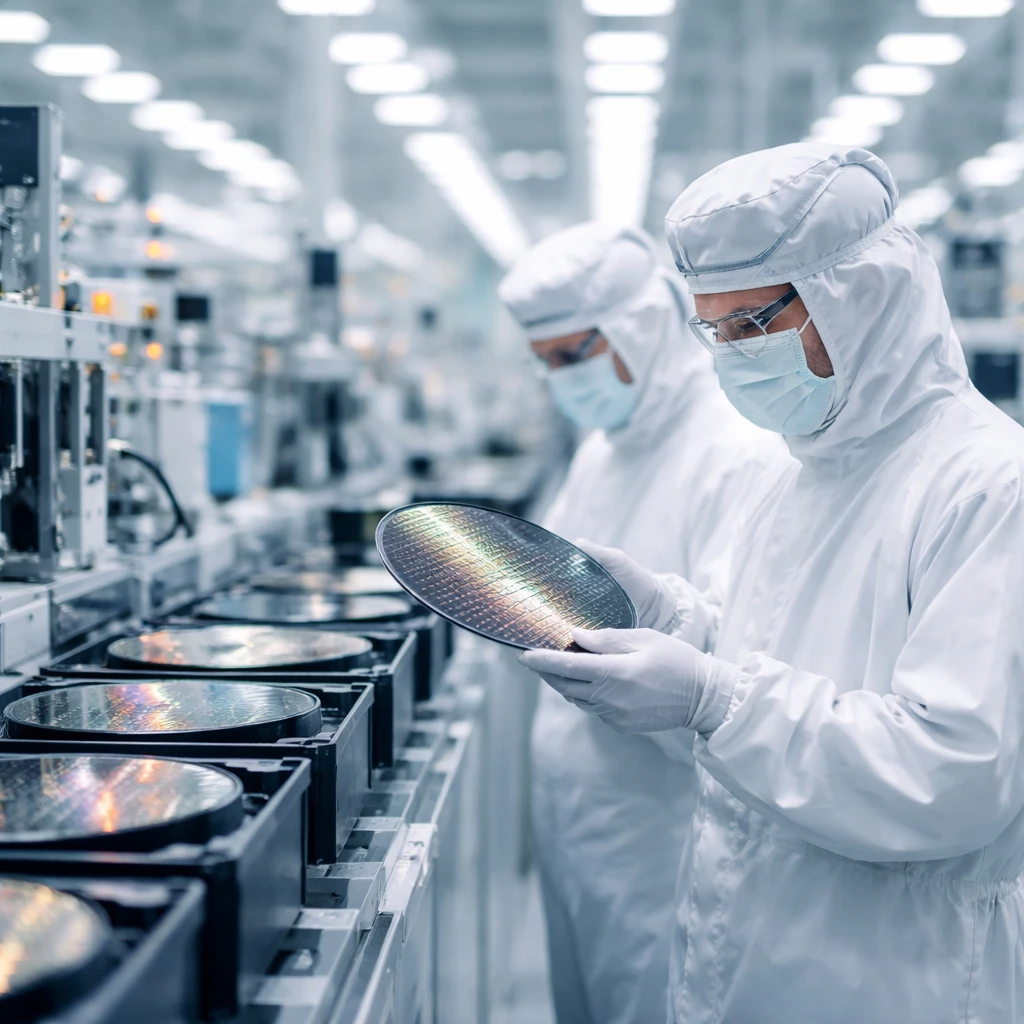
Global equity rankings are being reshaped as the artificial intelligence-led demand for advanced semiconductors drives outsized gains in Taiwan and South Korea. Data cited in recent market reports show Taiwan’s stock market is now valued at nearly $4.3 trillion, moving it ahead of the United Kingdom in the list of the world’s largest equity markets. South Korea is quickly following, positioned roughly $140 billion behind Taiwan, and both markets have outpaced comparable valuation growth in France and Germany.
The principal engine behind this reordering is a concentrated cohort of hardware suppliers that together underpin modern AI systems. Taiwan Semiconductor Manufacturing Co. (TSMC) has seen its market capitalization swell, while South Korean memory leaders Samsung Electronics and SK Hynix have experienced similar valuation appreciation. These firms serve as foundational suppliers to Nvidia and other compute-intensive AI applications, anchoring investor enthusiasm for equities tied to chip production.
In contrast, major European equity markets retain heavy exposure to established financial institutions and industrial companies. That sector mix has left European benchmarks less correlated with the current technology-driven rally. Market observers characterize the Asian indexes as more direct plays on the semiconductor cycle, with the term "pure plays" used to emphasize this concentrated exposure.
Analysts at Fidelity International have framed the development succinctly, describing semiconductors as "the new oil" of the global economy. The observation underlines a divergence between markets dominated by high-margin, specialized manufacturing and those weighted toward more mature, traditional sectors. Despite Taiwan and South Korea having smaller gross domestic product figures relative to G7 economies, their disproportionate share of cutting-edge chipmaking capacity has attracted capital seeking exposure to the next wave of digital infrastructure investment.
Looking forward, market participants debate the implications of the concentration. Some investors express caution about the index composition in Taiwan in particular, where TSMC represents a material share of the benchmark. That concentration raises questions about index-level vulnerability to moves in a single large constituent.
At the same time, several investment managers point to signs that the AI investment theme is broadening down the supply chain. Experts at JPMorgan Asset Management note the AI story is increasingly "trickling down" as supplier relationships expand and domestic retail participation in South Korea and Taiwan grows, strengthening market liquidity and resilience at the local level.
External risks remain part of the backdrop. Global trade tensions and regional instability in the Middle East continue to pose geopolitical uncertainties, yet demand for high-performance computing appears relatively price-insensitive in the current cycle. As capital expenditure on AI hardware continues to rise, the competitive edge that North Asian firms have built in innovation, manufacturing scale, and engineering talent looks set to support their continued ascent on the global leaderboard.
Summary
The AI-driven surge in demand for semiconductors has lifted Taiwan’s market to nearly $4.3 trillion, overtaking the United Kingdom, while South Korea trails by about $140 billion. The rally is concentrated in major chip manufacturers, contrasting with European markets that are more heavily weighted toward financial and industrial sectors. Analysts highlight a widening capital flow into specialized, high-margin chip manufacturing, and note that AI investment is moving deeper into supply chains despite geopolitical and trade risks.
Key points
- Taiwan’s equity market reached nearly $4.3 trillion, surpassing the United Kingdom; South Korea sits approximately $140 billion behind.
- Valuation gains are concentrated in semiconductor leaders - TSMC, Samsung Electronics, and SK Hynix - which supply essential hardware for AI workloads.
- European indexes remain more focused on financial and industrial firms, while Asian markets act as concentrated exposure to the semiconductor "super-cycle."
Risks and uncertainties
- High concentration risk in indices, particularly the heavy weighting of TSMC in Taiwan’s benchmark, could leave markets vulnerable to swings in a single large company.
- Geopolitical and trade tensions, including regional instability in the Middle East, remain potential sources of market disruption despite robust AI demand.
- Reliance on a narrow set of high-margin semiconductor manufacturers means equity performance is closely tied to capital expenditure trends for AI hardware and to sustained demand for advanced computing.