
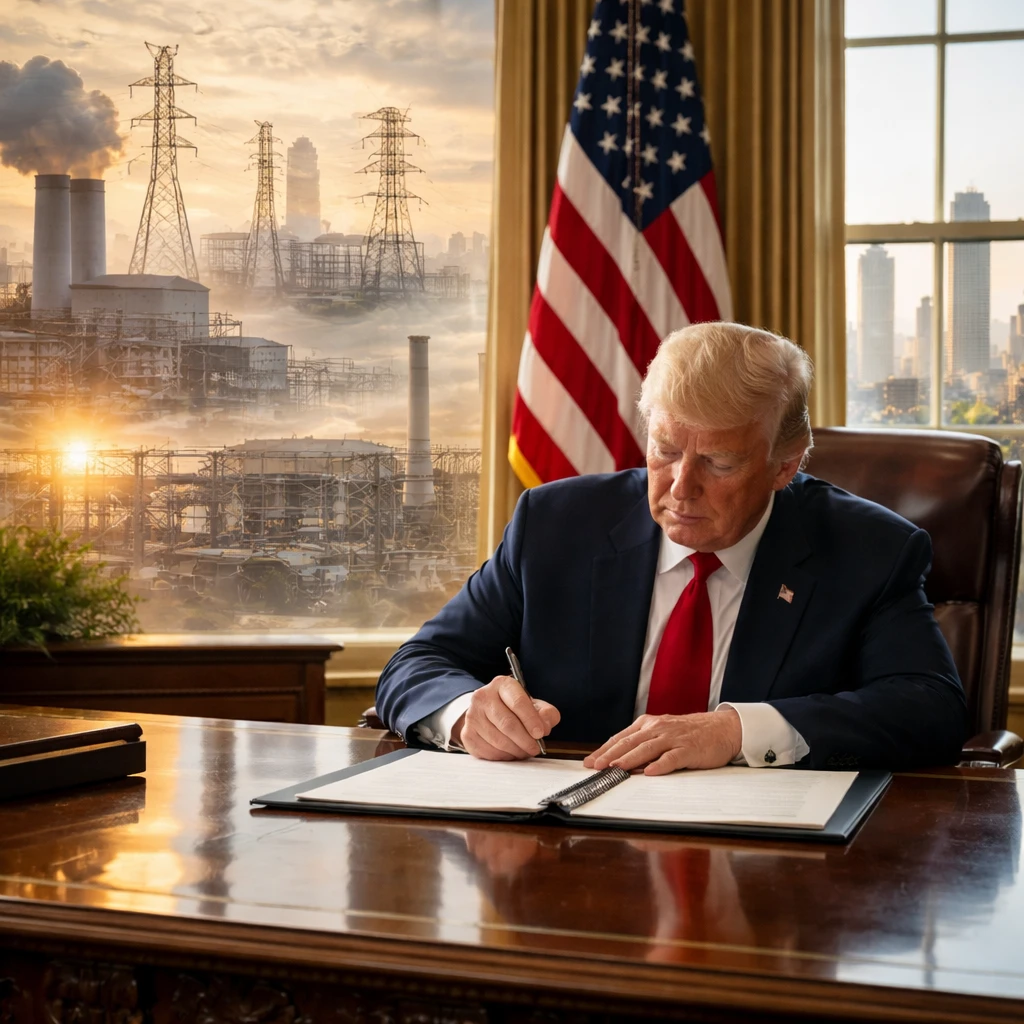
President Donald Trump on Monday signed a presidential determination that activates authorities under the Defense Production Act to speed up large-scale energy infrastructure projects.
The memorandum, which is directed to the Secretary of Energy, specifically authorizes the use of section 303 of the Defense Production Act of 1950. The administration says the move is intended to address what it describes as inadequate domestic capacity for energy production and infrastructure.
The determination refers to Executive Order 14156, issued on January 20, 2025, which declared a national energy emergency. That executive order stated that insufficient energy production, transportation, refining and generation pose a threat to both the nation’s economy and its national security.
According to the presidential memorandum, current market conditions are not sufficient to support the development and deployment of large-scale energy infrastructure. The document points to financing risks, regulatory delays and market barriers as the constraints preventing adequate domestic capability.
Under the terms of the determination, activities tied to large-scale energy projects are classified as industrial resources and critical technology items essential to national defense. The classification covers a wide set of functions, including engineering, site acquisition, permitting, early-stage risk mitigation financing, the build-out of domestic manufacturing capacity, and the necessary enabling infrastructure.
The memorandum also waives certain requirements under section 303 of the Defense Production Act, invoking that authority on the grounds that an industrial resource shortfall would otherwise impair national defense capability.
The Secretary of Energy is empowered to carry out the determination. That authority explicitly includes making purchases, entering commitments and deploying financial instruments designed to enable the development, manufacturing and deployment of energy infrastructure projects.
Context and scope
The presidential determination frames the identified energy shortfalls as risks to economic stability and national security and assigns the Department of Energy an expanded toolkit to address project-level barriers. The memorandum's list of covered activities signals a focus on both the near-term enabling work - such as permitting and site acquisition - and longer-lead items like domestic manufacturing capacity and financing mechanisms.
The full memorandum designates a broad set of industrial and technological activities as critical to defense readiness and authorizes executive action to overcome market and regulatory frictions that the administration says are preventing timely project delivery.