
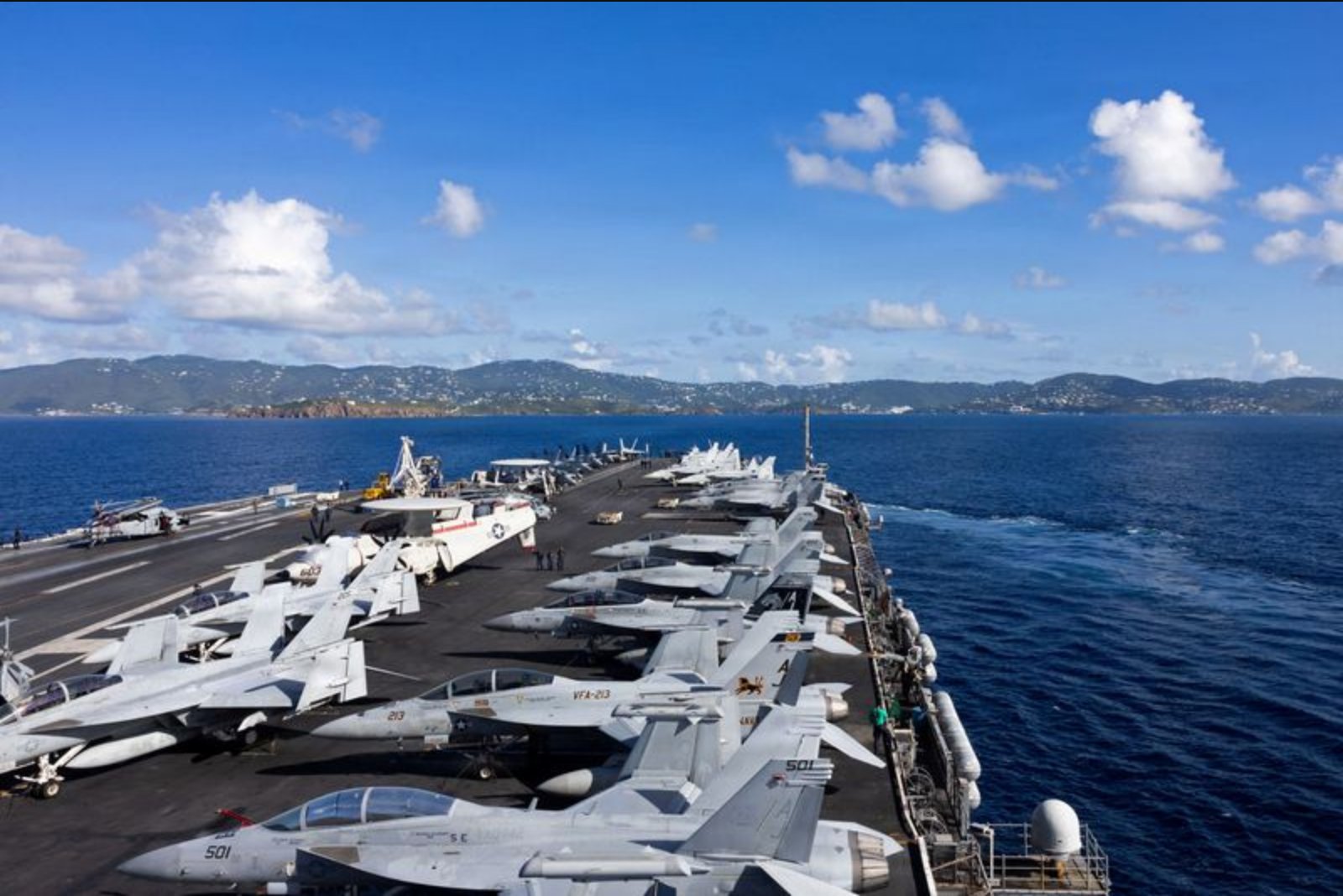
U.S. media outlets reported late on Thursday that the United States is sending a second aircraft carrier to the Middle East as tensions with Iran persist. The reports said the USS Gerald R. Ford and its accompanying escort ships will sail to the region from the Caribbean, citing U.S. officials familiar with the deployment plan.
Earlier this month, the carrier USS Abraham Lincoln and several guided-missile destroyers arrived in the Middle East. The newly announced movement will add a second carrier strike group to the area, according to the media accounts.
The White House and the Pentagon did not immediately respond to a request for comment outside of regular business hours.
President Donald Trump had told reporters earlier in the week that he was weighing the option of dispatching a second aircraft carrier to the Middle East if a deal with Iran is not reached. On Thursday he reiterated the urgency of reaching an agreement, saying the United States "has to make a deal," and suggested that an agreement could potentially be concluded within the next month.
"We have to make a deal, otherwise it’s going to be very traumatic, very traumatic," the president told reporters.
Israeli Prime Minister Benjamin Netanyahu commented on Thursday that he hoped the president's actions were helping to create conditions favourable to negotiating an outcome with Iran that would avoid military action.
Key context and implications
- The deployment involves the USS Gerald R. Ford and its escort ships moving from the Caribbean to the Middle East.
- The USS Abraham Lincoln and multiple guided-missile destroyers are already in the region, having arrived in January.
- U.S. officials have signalled that a second carrier could be used as leverage if diplomatic efforts with Iran do not produce a timely agreement.
Assessment
From a strategic posture perspective, adding a second carrier strike group increases naval presence and operational flexibility in the Middle East. Political leaders in Washington and Jerusalem have publicly linked the deployments to efforts to press for a deal with Iran, while also emphasizing a preference for avoiding open conflict.
Key points
- Second carrier - the USS Gerald R. Ford - will be sent from the Caribbean to the Middle East, according to U.S. media reports citing officials.
- The USS Abraham Lincoln and several guided-missile destroyers are already deployed to the region this month.
- President Donald Trump said he wants a deal with Iran and indicated an additional carrier could be dispatched if negotiations fail; Israeli leaders said they hoped actions would help secure a diplomatic resolution.
Risks and uncertainties
- Diplomatic uncertainty - It is unclear whether negotiations with Iran will produce an agreement within the timeframe suggested by U.S. political leaders, creating potential for prolonged military posturing.
- Response timing - The White House and the Department of Defense did not immediately reply to requests for comment outside normal business hours, leaving details of the deployment and its timing not fully confirmed in the public record.
- Escalation risk - While political statements emphasize a preference for a negotiated outcome, the augmentation of naval forces introduces the possibility of heightened tensions in the region.
Conclusion
The reported dispatch of the USS Gerald R. Ford and escort ships to the Middle East represents a significant bolstering of U.S. naval assets in the region at a moment of active diplomatic engagement with Iran. Political leaders have framed the deployments as leverage to secure a deal, while expressing a desire to avoid military confrontation. Several details about the movement remain publicly unconfirmed pending official comment.