
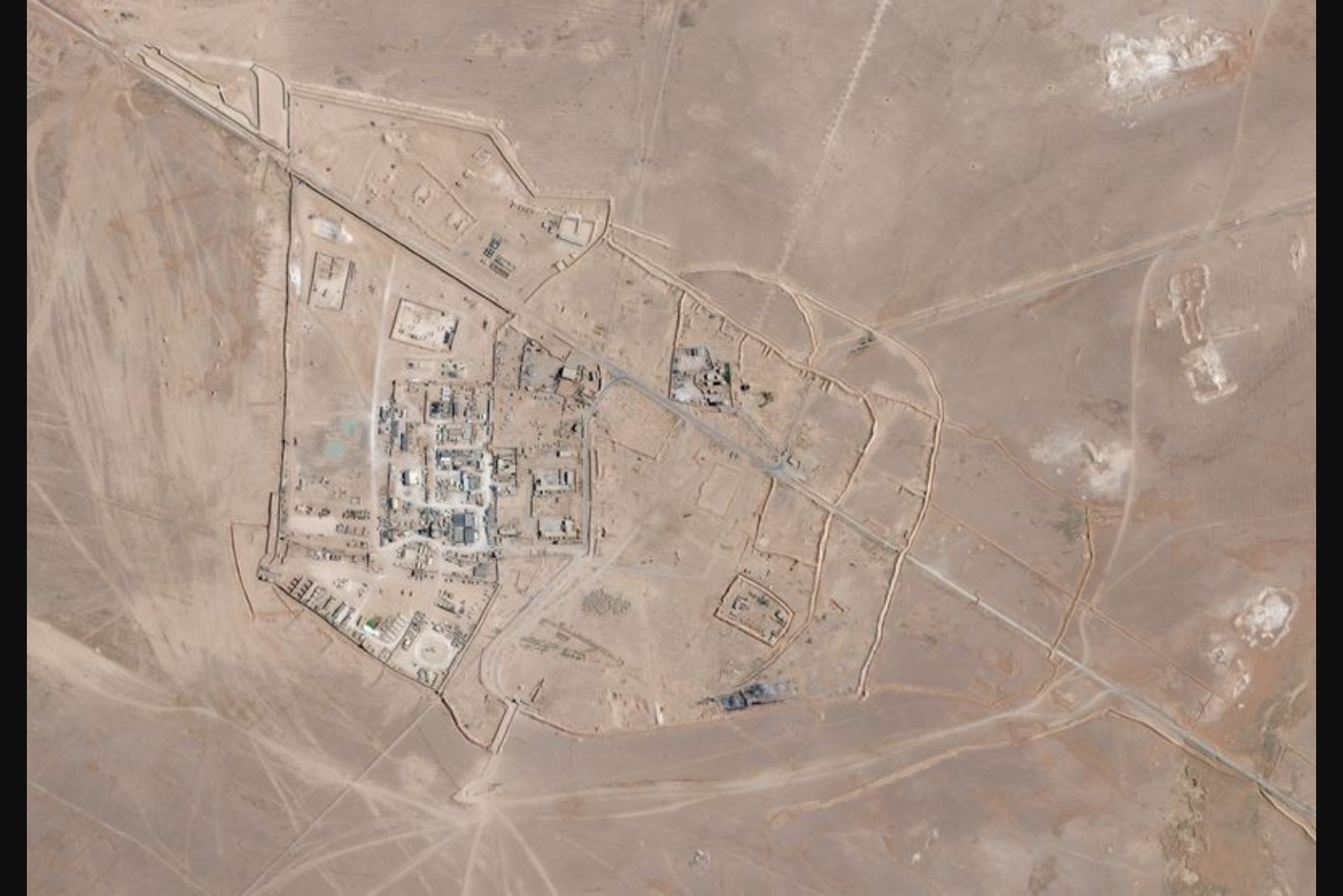
Washington, Feb 12 - The United States has completed its withdrawal from the al-Tanf garrison in Syria and turned the facility over to government forces, U.S. military officials said on Thursday. The transfer brings to a close a long-standing U.S. presence at a remote but strategically placed outpost where Syria, Jordan and Iraq meet.
Located at the tri-border confluence, al-Tanf was established during Syria’s civil war in 2014. In its early years the facility served as a base of operations for the U.S.-led coalition fighting Islamic State militants, who at one point controlled large territories across both Syria and Iraq before being routed in 2019. Over time, however, the garrison also assumed a diplomatic and strategic role in countering Iranian influence because of its position along road corridors linking Damascus to Tehran.
For Washington, the calculation about the value of retaining al-Tanf evolved as relations with Damascus changed. U.S. officials reassessed the base's role after a significant shift in bilateral ties that followed the overthrow of longtime Syrian leader Bashar al-Assad in December 2024. Those shifts included Syria rejoining the coalition confronting the remnants of Islamic State last November, an alignment that followed a White House visit by President Ahmed al-Sharaa, a former al Qaeda commander, for talks with U.S. President Donald Trump.
Observers have raised concerns about whether Syrian government forces can assume responsibilities previously managed by U.S. and allied units at al-Tanf. David Adesnik of the Foundation for Defense of Democracies in Washington questioned Damascus's capacity to replace U.S. capabilities after the handover. "And the Syrian army has incorporated thousands of ex-jihadists," Adesnik said. "The mission at Tanf also served as an obstacle to the operations of Iran and its proxies, who ship weapons across Syria to Hezbollah in Lebanon. This is an own goal."
Syria’s Defence Ministry announced on Thursday that government troops had assumed control of al-Tanf following coordination with U.S. authorities. The transfer was confirmed by U.S. Central Command in a statement that also referenced Pentagon plans, announced last year, to consolidate basing locations in Syria.
Admiral Brad Cooper, who leads U.S. Central Command, said in the statement that U.S. forces remain ready to respond to any Islamic State threats and that they will support partner-led efforts to prevent the group's resurgence.
Two sources familiar with the movements of U.S. personnel reported that troops from al-Tanf were relocating to Jordan, a redeployment consistent with the handover. Officials have previously estimated the U.S. troop presence in Syria at about 1,000 personnel prior to the al-Tanf withdrawal.
Analysts and some U.S. officials view the removal from al-Tanf as part of a broader reorientation of American commitments on the ground in Syria. One person familiar with the matter described the withdrawal as a potential milestone toward a larger drawdown of U.S. forces.
The al-Tanf departure coincides with parallel changes in U.S. responsibilities related to detention facilities holding Islamic State prisoners. For roughly a year, U.S.-backed forces guarded around a dozen prisons containing captured IS fighters and affiliates. Those facilities were primarily guarded by the Syrian Democratic Forces - a Kurdish-led group that the United States supported for a decade in the fight against Islamic State. U.S. forces have been shifting control of custody and prison security back to Syrian government forces while transferring high-level detainees out of Syria to Iraq since last month.
Washington also facilitated a deal to integrate elements of the Syrian Democratic Forces into central Syrian institutions. That agreement has been presented as one of the arrangements enabling a change in the U.S. posture inside the country.
President Trump has repeatedly signaled a desire to withdraw U.S. troops from Syria, including during his first term in office in 2019. The recent handover at al-Tanf, combined with detainee transfers and basing consolidation plans, reflects an ongoing process in which U.S. policymakers are reducing some forward deployed commitments while retaining the ability to respond to emergent threats, according to official statements.
Context and implications
- The al-Tanf garrison occupied a forward position in both counter-Islamic State operations and in efforts to limit the movement of weapons and influence by Iranian-backed actors along key routes.
- The handover followed coordinated discussions between U.S. and Syrian authorities and came after shifts in bilateral relations, including Syria's re-entry into the anti-IS coalition and high-level diplomatic contacts between the two capitals.
- U.S. officials emphasize readiness to respond to any resurgence by Islamic State, even as some responsibilities - including detention operations and base security - are transferred to Syrian government forces.