
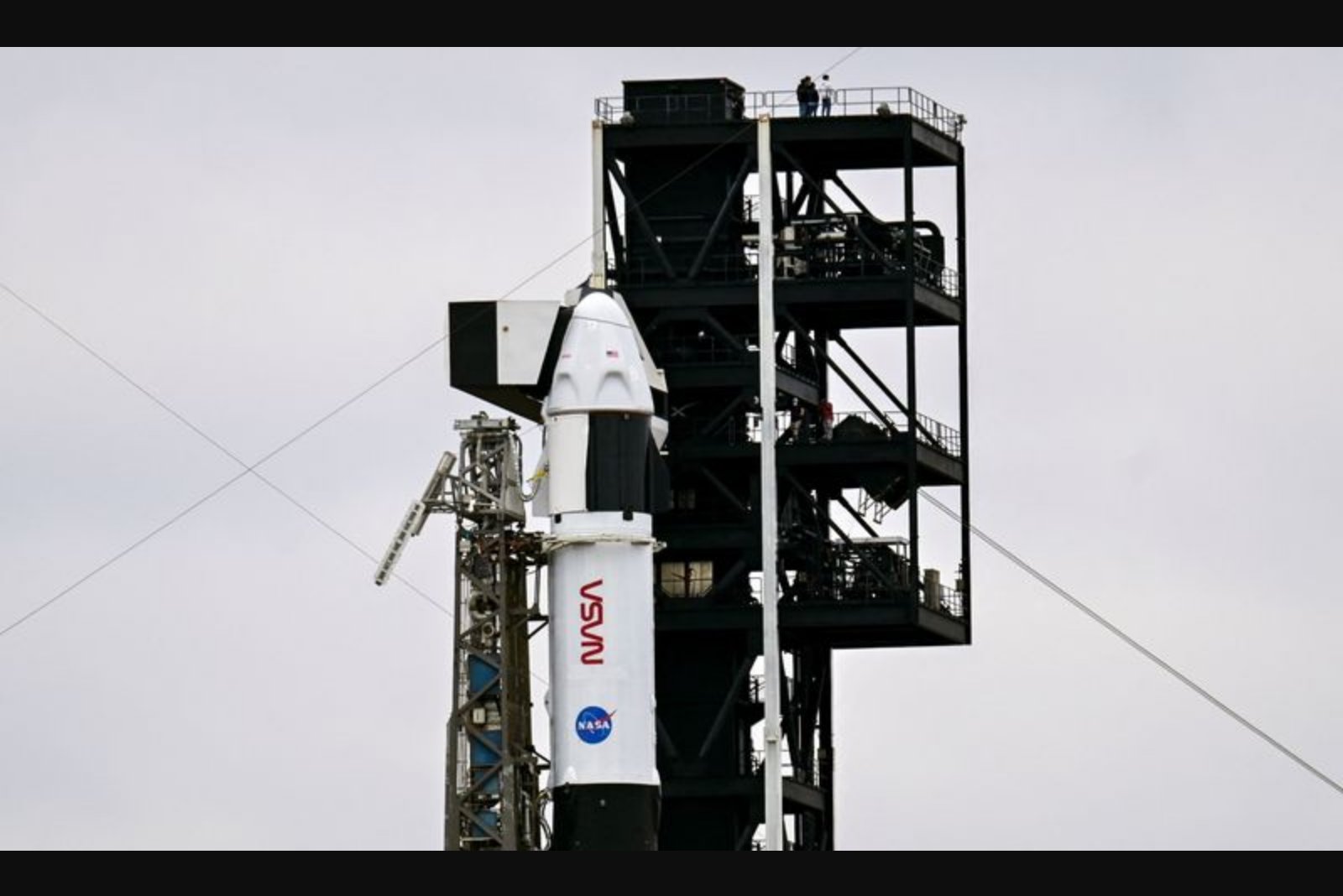
A SpaceX launch vehicle lifted off from Florida in the predawn hours of Feb. 13, sending a multinational crew toward the International Space Station (ISS) for an extended science mission.
The two-stage Falcon 9 rocket, topped by an autonomously operated Crew Dragon capsule named Freedom, departed Cape Canaveral Space Force Station along Florida's Atlantic Coast at about 5:15 a.m. EST (1015 GMT). Televised coverage from NASA and SpaceX captured the 25-story-tall vehicle leaving the launch tower as its nine Merlin engines ignited and produced towering vapor plumes and a bright reddish fireball in the sky. The coverage described the engines as gulping 700,000 gallons of fuel per second.
On board the capsule were four crewmembers bound for the station on a mission designated Crew-12. The roster includes veteran astronaut and marine biologist Jessica Meir, 48, who is returning to the orbiting laboratory for a second stint nearly seven years after she and NASA colleague Christina Koch completed the first all-female spacewalk. Joining Meir are Jack Hathaway, 43, a former U.S. Navy fighter pilot on his first spaceflight; European Space Agency astronaut Sophie Adenot, 43, a master helicopter pilot from France; and Russian cosmonaut Andrey Fedyaev, a former military pilot making his second mission to the ISS.
The team is expected to reach the space station on Saturday afternoon following a roughly 34-hour flight. Docking is planned with the orbiting laboratory platform that circles Earth at an altitude of approximately 250 miles (420 km).
Once aboard the ISS, the Crew-12 team will begin a schedule of scientific, medical and technical research tasks carried out in microgravity, according to NASA. Planned work highlighted by the agency includes studies aimed at better understanding pneumonia-causing bacteria to inform treatment approaches on Earth, and experiments examining interactions between plants and nitrogen-fixing microbes to help improve food production in space.
Upon arrival, Crew-12 will be greeted by three current station residents: NASA astronaut Chris Williams and Roscosmos cosmonauts Sergey Kud-Sverchkov and Sergei Mikaev. The new arrivals will relieve teams and expand the station's capacity to conduct ongoing experiments across disciplines.
Crew-12 represents the 12th long-duration ISS expedition that NASA has flown on a SpaceX launch vehicle since the company, founded in 2002, began transporting U.S. astronauts to orbit in May 2020. The private venture's repeated human spaceflight missions have become a regular element of U.S. access to low Earth orbit.
Operational context for the arrival includes a recent alteration to station staffing: four members of the preceding Crew-11 who had been expected to remain aboard until Crew-12's arrival returned to Earth several weeks early after an undisclosed serious health condition affecting one of their number prompted an unprecedented medical evacuation flight home in mid-January. That early departure briefly altered the composition of the station's complement ahead of the new crew's arrival.
The ISS itself remains the largest human-made object in space and spans roughly the length of a football field. It has been continuously operated by a U.S.-Russian-led consortium that also includes Canada, Japan and 11 European countries. The first hardware destined for the outpost was launched more than a quarter century ago, and the station was conceived as part of a multinational initiative intended to improve ties between Washington and Moscow following the collapse of the Soviet Union and the end of Cold War rivalries that sparked the original U.S.-Soviet space race in the 1950s and 1960s.
NASA has stated it is committed to keeping the space station operating until the end of 2030.
The Crew-12 mission continues a pattern of international cooperation and sustained scientific activity aboard the ISS while restoring and maintaining the station's operational cadence following an atypical early crew return earlier this year. The handover of responsibilities and the transfer of experiments between successive crews ensures continuity of research objectives, as the station supports studies with direct relevance to both space exploration and terrestrial applications.