
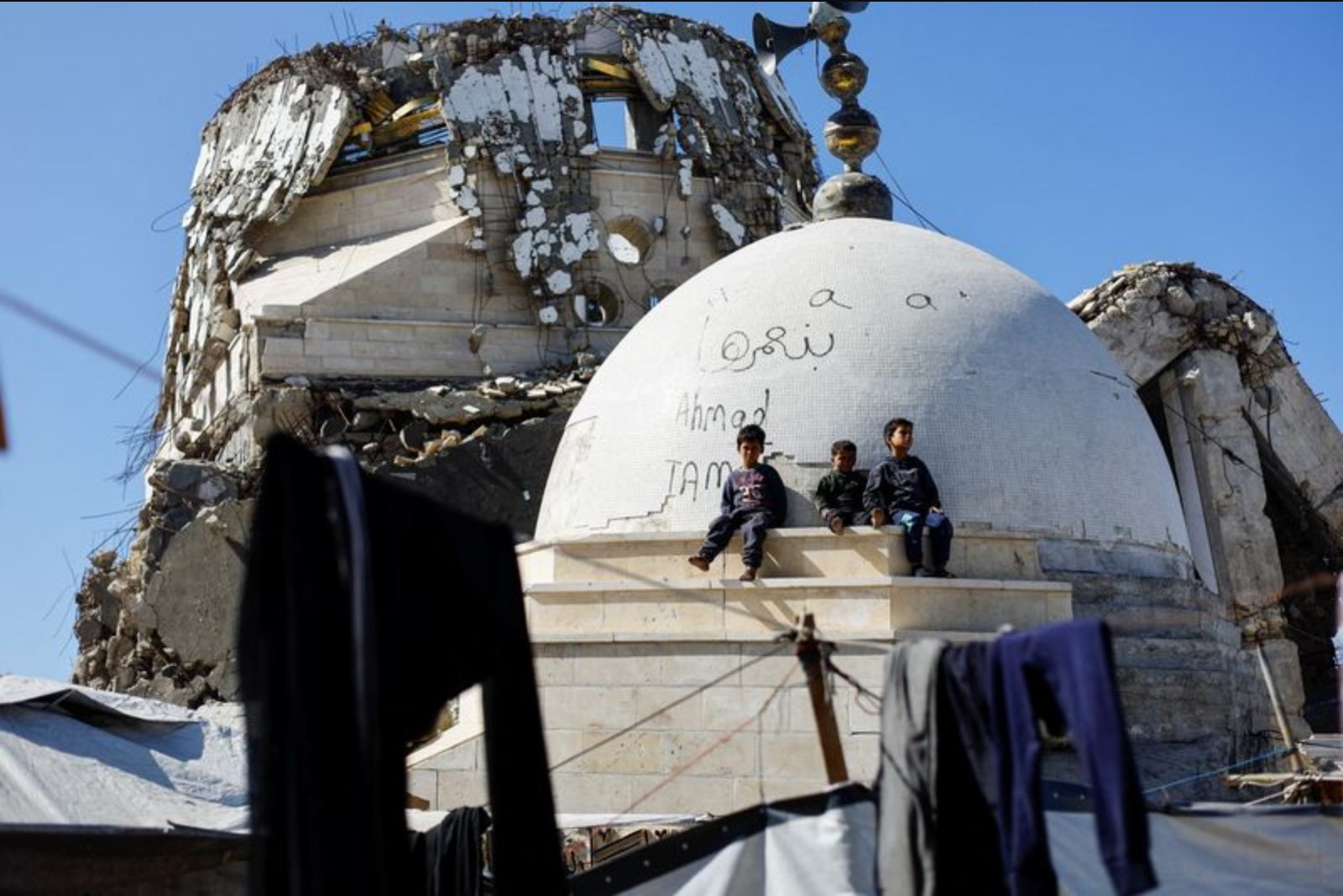
As the holy month of Ramadan commenced in Gaza on Wednesday, Palestinians converged on the remains of damaged mosques or assembled in makeshift prayer areas fashioned from tarpaulins, wood and other salvaged materials. The mood across affected neighbourhoods was one of mourning for lives lost and for places of worship reduced to rubble.
In Gaza City, the dome of the Al Hassaina mosque lies atop a heap of debris. The courtyard that once hosted congregational gatherings now serves as a living area for families who sleep and cook among the ruins, with washing lines strung across the broken space.
"I can’t bear to look at it," said Sami Al Hissi, 61, a volunteer at the mosque, standing on the rubble where rows of worshippers once stood shoulder to shoulder in prayer. "We used to pray comfortably. We used to see our friends, our loved ones. Now there are no loved ones, no friends, and no mosque," he added.
Children were seen climbing over cracked domes while women gathered laundry hung between shattered columns. Al Hissi said the mosque had historically attracted worshippers from other districts, including Shejaia and Daraj, particularly during Ramadan.
"It would be filled with thousands," he said. "But now, where are they supposed to pray? It’s all rubble and destruction. There’s barely enough space for a hundred people."
Israel launched its air and ground campaign in Gaza after a Hamas-led cross-border attack on October 7, 2023 that killed 1,200 people, according to Israeli tallies. Health authorities in Gaza report that Israel’s assault has killed 72,000 Palestinians. The Hamas-run Gaza government media office states that Israeli forces have completely destroyed 835 mosques and partially damaged 180.
The Gaza government media office also said that Israeli forces have struck churches on multiple occasions and have destroyed 40 of Gaza’s 60 cemeteries. Israel says it targets militant infrastructure and accuses Palestinian armed groups of operating in civilian areas, including mosques, an allegation Hamas denies.
Prayer in tents
For many residents, the loss of mosques is both a spiritual and communal blow. Displaced and now staying at a mosque, Khitam Jabr said: "We wished we could welcome Ramadan in a different atmosphere." She added: "We don’t have enough mosques. All of the mosques were destroyed and there’s nowhere to pray. Now we pray in tents, and the mosques became centres for the displaced."
Despite the devastation and acute material shortages, attempts to re-establish places of worship have taken place on a small scale. Amir Abu Al-Amrain, director of the religious affairs ministry in Gaza City, reported that 430 prayer areas have been rebuilt using whatever resources are available.
"Four hundred and thirty prayer areas have been rebuilt, some using plastic sheets from greenhouses, some made of wood, and some constructed with plastic sheets from tents," he said.
The improvised prayer areas are varied in construction and scale. Some use reused greenhouse plastic to create enclosed spaces; others are simple wooden frames covered with tent fabric. Many of these sites are modest in size compared with the congregational mosques that previously served thousands of worshippers.
As Ramadan proceeds, these improvised sites and remaining mosque ruins are serving dual roles as places of worship and as centres accommodating displaced families. The combination of destroyed religious infrastructure, displaced populations and shortages of rebuilding materials has reshaped how residents observe the month and how communal life is organised amid ongoing hardship.