
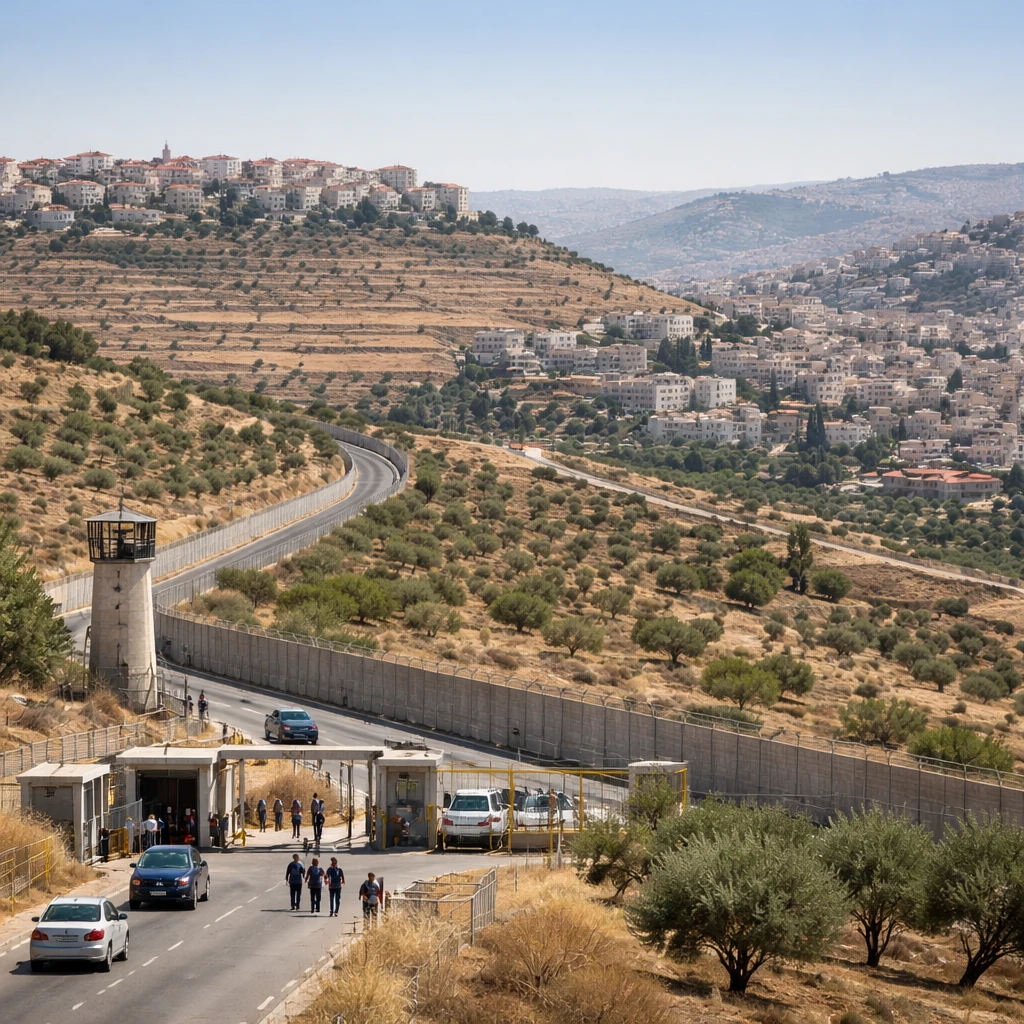
Israeli authorities announced a package of steps intended to simplify the acquisition of land by Jewish settlers in the occupied West Bank and to broaden Israeli enforcement activity in portions of the territory where Palestinians exercise limited self-rule. Palestinian officials and others view the measures as deliberate moves that further weaken the prospect of creating an independent Palestinian state alongside Israel on land taken during the 1967 Middle East war.
A joint statement from the Israeli finance and defence ministers said the decisions would speed up settler land purchases by making previously confidential West Bank land registries public and would repeal a Jordanian law that governed land purchases in the West Bank when Jordan controlled it from 1948 until 1967. The ministers also said Israel would enlarge "monitoring and enforcement actions" in parts of the West Bank designated Areas A and B, "regarding water offences, damage to archaeological sites and environmental hazards that pollute the entire region."
Territorial divisions and control under the Oslo Accords
The Oslo Accords divided the West Bank into three categories often referred to as Areas A, B and C. Under that framework, the Palestinian Authority holds full administrative and security control in Area A, which comprises 18% of the territory. Area B, which accounts for about 22%, places civil administration with the Palestinian Authority while security responsibilities remain with Israel. Most Palestinians in the West Bank live in Areas A and B. Israel retains full control over Area C - roughly 60% of the West Bank - which includes the border with Jordan and most Israeli settlements.
Palestinian President Mahmoud Abbas responded to the announced measures by saying they breach international law and are designed to undermine Palestinian institutions and any future two-state arrangement. Ultranationalist Israeli Finance Minister Bezalel Smotrich described the package as a "real revolution," adding, "We will continue to kill the idea of a Palestinian state."
How the two-state idea developed
The two-state proposition has its roots in the conflicts that emerged in British-ruled Palestine as Jewish migrants fled antisemitic persecution in Europe and sought a national home while Arab inhabitants asserted their own national claims. In 1947 the United Nations approved a partition plan to create separate Arab and Jewish states with international oversight of Jerusalem. The plan allocated 56% of the land to the Jewish state; Jewish leaders accepted it while the Arab League rejected it.
Israel declared independence on May 14, 1948. The next day five Arab states launched a military campaign. The first Arab-Israeli war concluded with Israel in control of 77% of the territory. In the fighting and its aftermath roughly 700,000 Palestinians fled or were expelled from their homes and became refugees in neighbouring states and in territories such as the Gaza Strip, the West Bank and East Jerusalem.
In the 1967 war Israel captured the West Bank, including East Jerusalem, from Jordan and the Gaza Strip from Egypt. The two-state vision later formed the basis of U.S.-backed negotiations that accelerated after the 1993 Oslo Accords. That agreement, signed by Israeli Prime Minister Yitzhak Rabin and Palestine Liberation Organization Chairman Yasser Arafat, saw the PLO recognize Israel's right to exist and renounce violence. Palestinians had hoped the accords would pave the way to independence with East Jerusalem as their capital, but progress has been repeatedly stalled by violence and political reverses on both sides.
Past negotiations, violence and impasses
Attempts to reach a final settlement have been derailed multiple times. Between 1994 and 2005, Hamas carried out suicide attacks that Israel says killed more than 330 Israelis. In 2007 Hamas forcibly took control of Gaza from the Palestinian Authority in a brief civil conflict. Hamas' original 1988 charter called for the demise of Israel; in recent years Hamas has said it would accept a Palestinian state along the lines of the 1967 borders, a position Israel regards as a tactical move and not a genuine acceptance.
High-profile efforts to negotiate a comprehensive deal also failed. In 1995 Prime Minister Rabin was assassinated by an ultranationalist Israeli opposed to land-for-peace compromises. In 2000, U.S. President Bill Clinton convened Yasser Arafat and Israeli Prime Minister Ehud Barak at Camp David to try to conclude an agreement, but they did not reach a deal, with the future of Jerusalem identified as a central obstacle. The relationship deteriorated into the second Palestinian intifada from 2000 to 2005. Subsequent U.S. initiatives have not produced a lasting agreement, and the last major peace bid collapsed in 2014.
Contemporary barriers to a Palestinian state
Settlement activity is one of the most frequently cited impediments to the possibility of a viable Palestinian state. Israeli settlements in the West Bank and East Jerusalem grew from roughly 250,000 residents in 1993 to about 700,000 three decades later, according to the Israeli advocacy group Peace Now. Palestinians contend that such expansion erodes the territorial continuity and sovereignty a future state would require. Settlement construction accelerated sharply after the 2023 start of the Gaza war.
During the period of the second intifada, Israel built a barrier in parts of the West Bank that it said was intended to prevent Palestinian suicide bombers from entering Israeli population centres. Palestinians characterise the barrier as a de facto land grab. The Palestinian Authority, led by President Abbas, administers enclaves of West Bank territory encircled by a broader zone of Israeli control that includes Area C and the Jordanian border, alongside the settlements - arrangements that trace back to the Oslo Accords.
Israel's current government, led by Prime Minister Benjamin Netanyahu, is widely described as the most right-wing in the country's history and includes religious nationalist parties that derive strong political support from settlers. Some senior figures have made statements that reject the notion of a distinct Palestinian people. Hamas and Israel have engaged in repeated military confrontations over the last two decades, culminating in the attacks on communities in southern Israel on October 7, 2023 that sparked the Gaza war.
Assessment and outlook
The package of Israeli measures targeting land ownership transparency, the repeal of a Jordanian land law and a widening of enforcement activity into Areas A and B has been presented by Israeli leaders as administrative and environmental interventions. Palestinian officials and some international observers view the steps as deliberate policy choices that diminish the prospects for a negotiated two-state settlement. The contours of control in the West Bank established by the Oslo Accords - a patchwork of Palestinian-administered areas surrounded by Israeli-controlled territory - remain central to the debate about what a viable Palestinian state would require, and how changes on the ground alter that calculation.
Absent new agreements acceptable to both sides, the structural features described above - settlement growth, divided territorial control, and deep political divisions - continue to complicate any pathway to a Palestinian state existing side by side with Israel.