
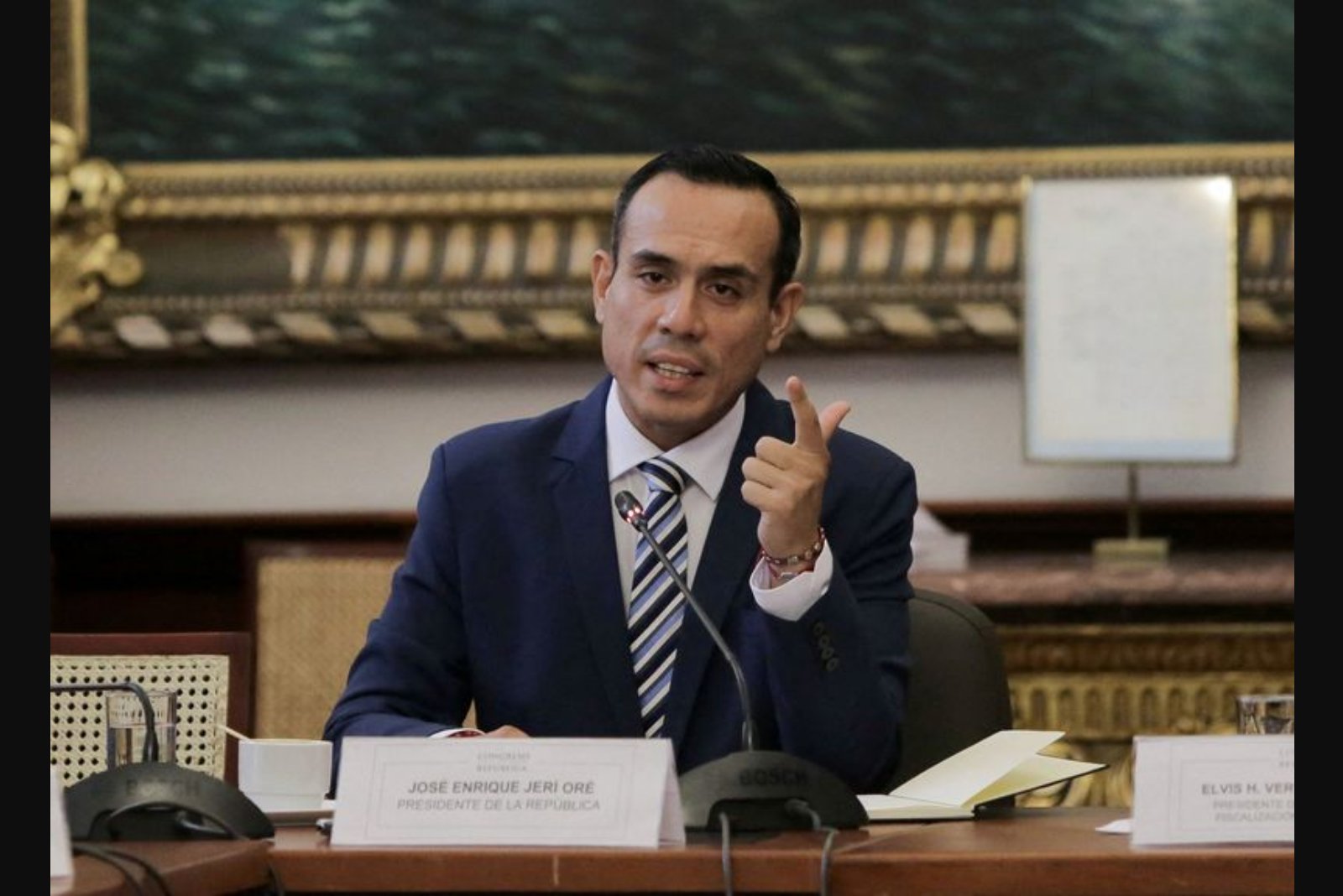
After a tenure that lasted only four months, Jose Jeri has been dismissed from the Peruvian presidency by Congress, marking the third straight leader in the Andean nation to be removed by lawmakers. Jeri, who assumed the presidency in October following the abrupt impeachment of Dina Boluarte, was among the world’s youngest heads of state during his time in office.
At 39 years old, Jeri had been serving as president of Congress since last July, placing him next in the constitutional line of succession after Boluarte’s dismissal because she had no acting vice president. His elevation made him Peru’s seventh president since 2018.
His short administration was quickly eclipsed by controversies. Most prominently, Jeri met privately with Zhihua Yang, a Chinese businessman who owns retail stores and holds an energy concession and who had already been the subject of state scrutiny. A video showed Jeri wearing a hoodie while meeting Yang in a Chinese restaurant, a scandal the media dubbed "Chifagate," referencing the local term for Chinese restaurants. The former president apologized after the encounter and maintained that no illegal activity occurred.
Despite Jeri's apology and his denial of wrongdoing, political pressure mounted as the April presidential elections drew nearer and politicians sought to consolidate support within an increasingly crowded field. The atmosphere in Congress and among political actors left Jeri with limited political capital to withstand calls for his removal.
"His legitimacy as president was always weak," said Martin Cassinelli, assistant director at the Atlantic Council’s Adrienne Arsht Latin America Center. The ouster, he added, was "less an act of justice" and "more an act of political self-interest by a congressional majority."
Even with Jeri's brief period in office, he was not the shortest-serving Peruvian leader of the decade. The 2020 interim presidency of Manuel Merino ended in resignation after less than a week following mass protests and the deaths of two demonstrators.
Observers and analysts say Jeri’s removal underscores the continuing political volatility in Peru at a critical juncture ahead of the April presidential vote. Cassinelli warned of structural electoral fragmentation, stating, "Unfortunately, for Peruvians, the electoral system will likely result in a fragmented election that is unlikely to yield the majorities necessary for the next president to govern without having to worry about a political impeachment."
Jeri’s background is rooted in Lima, where he was born into a middle-class family. He graduated from the state-run Federico Villarreal National University in 2014 and later obtained a law degree from a private university in Lima. While studying law, he joined the conservative Somos Peru party in 2013 and made two unsuccessful bids for municipal office in the capital.
In the 2021 congressional elections, Jeri initially did not secure a seat after his party won three legislative seats. However, as the Somos Peru candidate with the fourth-largest vote total, he subsequently filled the vacancy left by Martin Vizcarra, who was disqualified from holding public office before being sworn in. Vizcarra had previously served as Peru’s president from 2018 to 2020.
Jeri’s time in office was also marked by other controversies. In January 2025, he faced an accusation of sexual assault from a woman who said the alleged incident took place at a party the month before. The attorney general shelved the case in August, citing a lack of evidence, and Jeri denied any wrongdoing. Additional scrutiny followed reports that, as president, he awarded state contracts to women after hosting late-night meetings with them in the presidential palace.
Jeri’s removal by Congress adds another chapter to a sequence of short-lived presidencies and political instability in Peru, complicating the political environment in the run-up to elections and raising questions about governance stability once a new administration is chosen.