
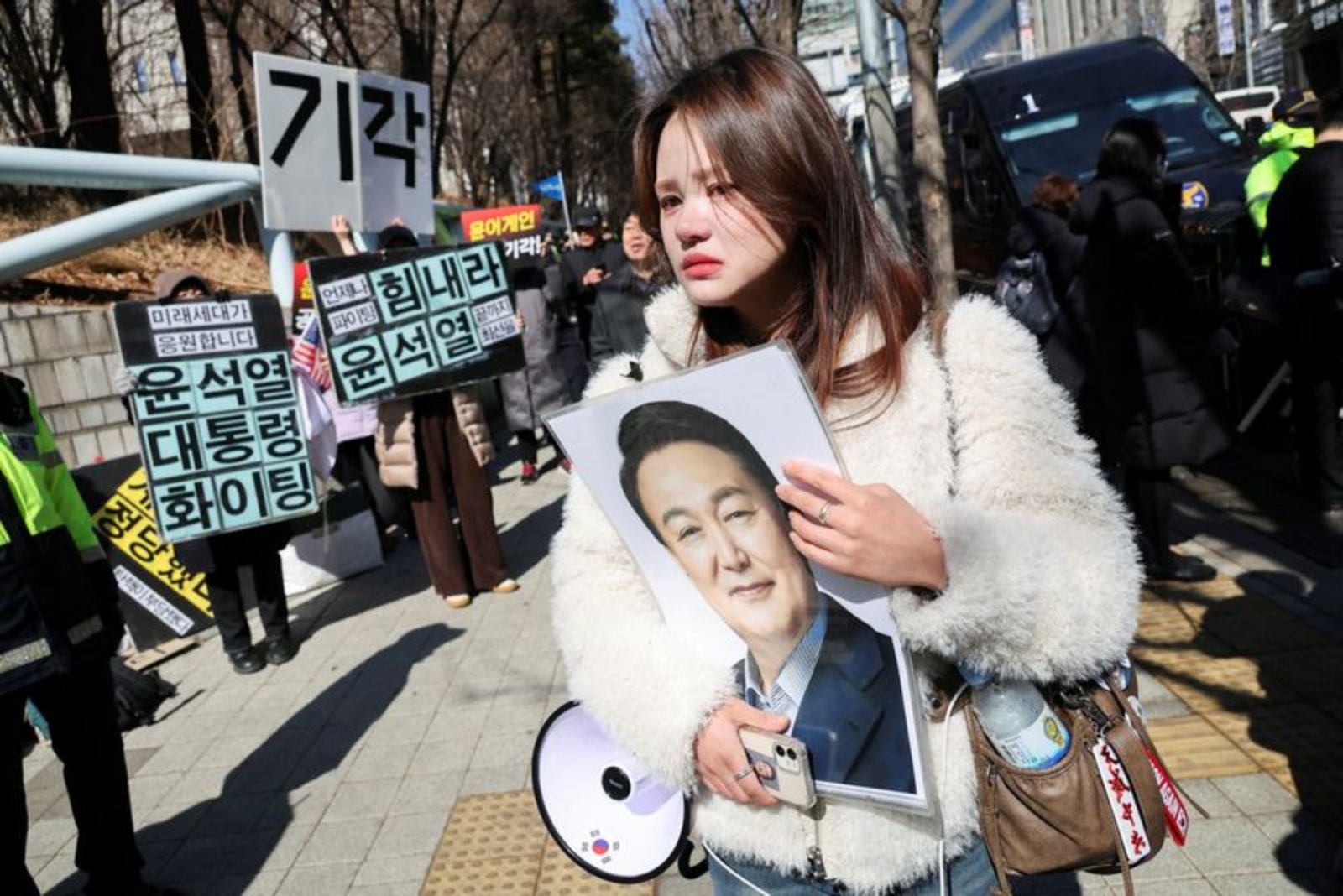
Seoul's legal and political landscape shifted dramatically after a six-hour martial law declaration by former president Yoon Suk Yeol in December 2024. On February 19, a Seoul Central District Court handed Yoon a life sentence for leading an insurrection tied to that brief attempt to impose military rule. The ruling concluded a sequence of rapid political reversals, criminal investigations and court actions that began with Yoon's national television announcement and ended with extended indictments and prison terms for several senior figures.
How events unfolded
On December 3, 2024, shortly before 10:30 p.m. local time (1330 GMT), Yoon announced on national television that he was imposing martial law. He said the measure was aimed at rooting out what he called "anti-state forces" and resolving a political impasse. Roughly an hour after the declaration, a military decree banned activities by political parties and lawmakers. Troops and police moved on the opposition-controlled parliament, meeting resistance from staffers who used barricades and fire extinguishers to hold off special operations soldiers. Lawmakers sought to evade security cordons by hopping fences as protesters gathered outside the building.
In the early hours of December 4, with 190 lawmakers present, parliament held a unanimous vote to reject the presidential martial law declaration. Troops began withdrawing, and about three and a half hours after that vote, Yoon lifted the decree. The episode lasted in total for about six hours. In the immediate aftermath, opposition parties filed a motion to impeach Yoon. U.S. Deputy Secretary of State Kurt Campbell publicly said Yoon had "badly misjudged" his decision to declare martial law.
Yoon addressed the nation on December 7 to apologise and said he would leave his fate to his ruling People Power Party, but he did not offer his resignation. A parliamentary vote later that day to impeach him failed because PPP members boycotted the session, depriving the legislature of a quorum.
Three days later, on December 8, prosecutors named Yoon as the subject of a criminal investigation into the martial law episode, and former Defence Minister Kim Yong-hyun was arrested. Two days after that, the commander of the Army Special Warfare Command, Kwak Jong-geun, told a parliamentary panel that Yoon had ordered military commanders to "drag out" lawmakers from parliament following the martial law declaration.
On December 12, Yoon said he would "fight to the end," and alleged that North Korea had hacked the South's election commission, suggesting doubt about the scale of his party's defeat in the April election. By December 14, parliament moved to impeach Yoon, with 204 of the 300 lawmakers in the single-chamber body voting in favour. That tally included at least 12 members of the People Power Party. Yoon's presidential powers were suspended and Prime Minister Han Duck-soo became acting president.
The Constitutional Court began its review of the impeachment case on December 16. A further turn came on December 27 when parliament impeached acting President Han, after which Finance Minister Choi Sang-mok took over as acting president.
Arrests, indictments and courtroom developments
On December 31 a Seoul court approved an arrest warrant for Yoon after he failed to appear for questioning; his lawyers called the warrant illegal and invalid, arguing investigators lacked authority. Attempts to execute the warrant between January 3 and January 15, 2025 met with resistance inside Yoon's compound as presidential security clashed with military troops. Authorities were unable to arrest him during those clashes, and Yoon eventually agreed to turn himself in after a local court extended the arrest warrant.
Yoon appeared at the Constitutional Court on January 21 for his impeachment trial and denied that he had ordered military commanders to drag lawmakers from parliament. On January 26, prosecutors formally indicted him on insurrection charges and sought his detention. A subsequent court cancelled his arrest warrant on March 9, and Yoon was released from detention. Nevertheless, on April 4 the Constitutional Court ruled that Yoon had violated his constitutional duty and permanently removed him from office.
Political contests continued in the wake of Yoon's removal. The liberal Democratic Party in late April nominated former leader Lee Jae Myung as its candidate for a snap election. Lee was elected president on June 3. Legal actions against Yoon and several associates continued through mid and late 2025 and into 2026.
On July 10 a court approved a special prosecutor's request to detain Yoon and he returned to jail. On August 13, Yoon's wife, former first lady Kim Keon Hee, was detained after a court approved an arrest warrant; this made the couple the first presidential pair in Korea's history to be behind bars. Kim was later indicted on bribery and other charges on August 29. On October 10 a special prosecutor indicted Han Hak-ja, the leader of South Korea's Unification Church, alleging she directed bribes to the former first lady.
Prosecutors continued to expand the charges tied to the martial law episode. On November 10, Yoon was indicted on additional counts related to the martial law declaration, including an accusation of aiding an enemy state. On November 26, special prosecutors sought a 15-year jail term for former Prime Minister Han on charges of abetting insurrection and committing perjury. On December 15 prosecutors alleged Yoon had tried to provoke North Korea into mounting armed aggression to justify his martial law declaration.
In early January 2026, on the 13th, the special prosecutor requested the death penalty for Yoon on insurrection charges. A few days later, on January 16, the Seoul Central District Court sentenced Yoon to five years in prison for charges that included obstructing arrest attempts. On January 21 the same court sentenced former Prime Minister Han to 23 years in prison for engaging in a key act of insurrection. On January 28 the court gave former first lady Kim a 20-month sentence for accepting bribes, and on February 12 former Interior Minister Lee Sang-min received a seven-year sentence for his part in the martial law bid. The legal process culminated with the February 19 life sentence for Yoon for leading an insurrection.
Aftermath and significance
The sequence of actions - a sudden military decree, a unanimous parliamentary rejection, repeated indictments and successive judicial rulings - produced one of the most consequential legal and political collapses in recent South Korean history. The short-lived martial law declaration in December 2024 set in motion a cascade of institutional responses that included impeachment, criminal investigations, and a variety of convictions for senior political figures.