
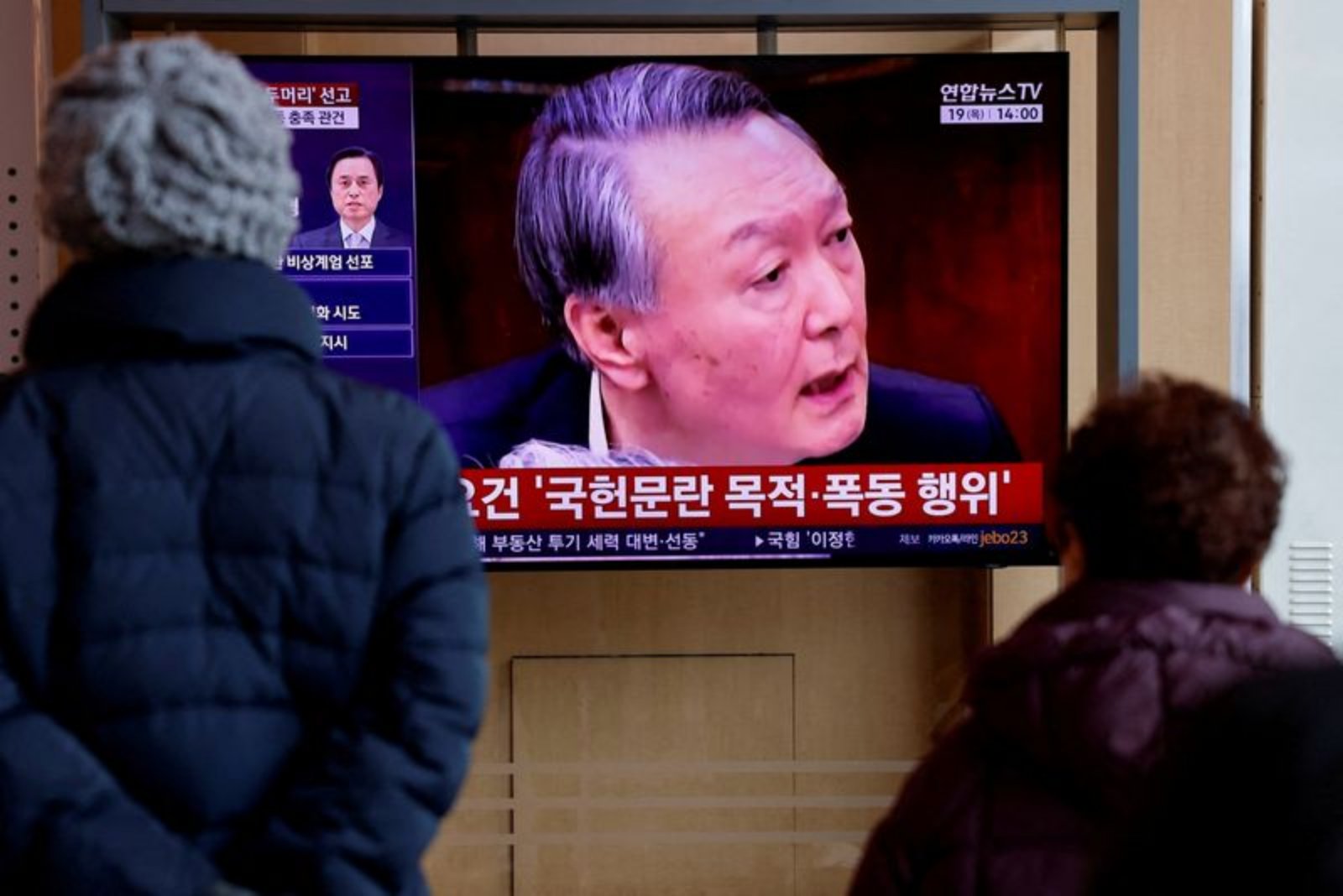
On Feb. 19, a Seoul court handed former South Korean president Yoon Suk Yeol a life sentence after finding him guilty of masterminding an insurrection by declaring martial law and deploying military forces to storm parliament and arrest his political adversaries. The ruling marks the dramatic end of a career that began in the prosecutor's office and reached the presidency within a year of Yoon's first foray into electoral politics.
The Seoul Central District Court concluded that Yoon's decision to impose martial law constituted a subversion of the constitutional order. Wearing a dark suit and appearing noticeably slimmer than before his arrest a year earlier, Yoon listened as the verdict was read, his face described as ashen. His lawyer protested the ruling and said the defense would confer with the former president on whether to lodge an appeal. Yoon has denied criminal intent, maintaining that his actions were intended to warn against what he called "anti-state" forces allegedly seeking to take control of South Korea.
Career background and rise
Yoon, 65, first became a public figure through his work as a prosecutor. Colleagues recall that he built a national profile by investigating two sitting presidents and by leading high-profile probes, including one of the justice minister that helped elevate his standing among conservatives discontented with the policies of then-President Moon Jae-in. Those investigations and his tenure as prosecutor-general contributed to his reputation as a formidable figure in law enforcement and provided momentum for his successful presidential campaign in 2022.
Former colleagues describe Yoon as having been unusually powerful in his role at the prosecutors' office. "Yoon Suk Yeol was the most powerful prosecutor-general ever," said a former official who headed internal inspection under Yoon. That same colleague added that Yoon used the prosecutorial office to pursue a plan that ultimately propelled him into the presidency, and characterized many of his actions as daring.
Escalation to martial law
Those who knew Yoon say his willingness to take bold risks helped him win power but also sowed the seeds of his downfall. Colleagues, reflecting in hindsight, point to remarks from 2020 in which Yoon, then a leading prosecutor, was quoted as telling a former judge at a dinner that "If I had gone to the military academy, I would have staged a coup." That comment has been cited by associates as an early indication of Yoon's readiness to contemplate forceful measures.
As president, Yoon faced persistent clashes with opponents that his former prosecution rival characterized as drawing out the recklessness that had long defined him. Opposition confrontations hindered his policy agenda, and political strife in the year preceding December 2024 contributed to a fraught domestic environment.
By the time martial law was imposed in December 2024, Yoon was under intense political pressure. Scandals involving his wife, Kim Keon Hee, were a focal point of controversy; she was accused of improperly accepting gifts and was later convicted of bribery by a special prosecutor following Yoon's removal from office. Kim is now serving a 20-month jail sentence. While she faced no charges at the time martial law was declared, the later conviction added to the turmoil surrounding the couple.
Supporters, advisers and legal fallout
Yoon's inner circle and some long-standing associates have been scrutinized as part of the legal unraveling. Several figures from Yoon's past have faced legal consequences in connection with the martial law decision. One former Safety Minister, a high school classmate of Yoon's, was tried and later jailed for seven years for his role in the declaration. The former Defence Minister - another alumnus of Yoon's high school and previously chief of presidential security - is on trial on charges of insurrection and is accused of being a principal adviser who urged the declaration of martial law. He has denied wrongdoing.
Analysts and academics cited by people familiar with the case attribute Yoon's downfall in part to the influence of advisers who encouraged confrontational steps rather than restraint. A political science professor observed that Yoon likely continues to believe he acted correctly when he invoked martial law, even as critics and the judiciary have concluded otherwise.
Contrast between domestic turmoil and foreign policy
Despite domestic challenges, Yoon registered some successes on the international stage. His efforts to resolve a long-standing diplomatic dispute with Japan and to advance trilateral security cooperation with Japan and the United States are viewed as policy accomplishments. Observers noted that his ability to forge personal connections was on public display during a 2023 event at the White House when he performed a popular American song, an episode that highlighted his distinctive, unorthodox style of public engagement.
Yoon's presidency had earlier been shaped by actions that drew public attention to his personal life and governance choices. Born into a well-to-do family and educated at Seoul National University law school, he struggled to pass the bar exam, succeeding on his ninth attempt at age 30. Friends and associates described him as easy-going in some settings, but increasingly ambitious after marrying Kim Keon Hee, who worked as an art curator.
Early in his administration, Yoon moved the presidential office away from the traditional Blue House complex, sparking questions about the motivations for the relocation. He denied that the decision was influenced by any belief in feng shui or consultations with a shaman. Critics also accused him of protecting loyalists after he declined to remove top officials following a tragic Halloween crowd crush that killed 159 people; among those later prosecuted in connection with the martial law episode were officials with personal ties to the president from his schooling years.
Aftermath and next steps
The life sentence pronounced by the Seoul court caps a precipitous fall for a leader who once parlayed prosecutorial authority into the presidency. Legal teams signaled an intent to consider an appeal, but the court's findings mark a high-profile legal reckoning for decisions that aimed to use extraordinary state power to address political opposition. As trials continue for others involved, South Korea confronts the legal and political reverberations of a crisis that upended its executive leadership and tested constitutional limits.