
Cambodian Prime Minister Hun Manet said in his first interview with international media that Thai military forces remain positioned deep inside areas Cambodia considers its territory, weeks after a ceasefire halted the latest round of cross-border fighting. He called on Thailand to allow the Joint Boundary Commission (JBC) to begin technical work to verify and resolve disputed border lines.
Hun Manet, who traveled to Washington to attend a meeting of the so-called Board of Peace created under a recent U.S.-brokered initiative, described the situation along the frontier as "fragile" despite the December ceasefire that stopped renewed hostilities. The board was formed to oversee a Gaza peace plan, though it has been presented by its backers as having the potential to assume a wider diplomatic role.
According to Hun Manet, Cambodian residents have been prevented from returning home in areas where he says Thai troops have installed shipping containers and barbed wire within territory that Thailand had previously recognized as Cambodian. "We still have Thai forces occupy(ing) deep into Cambodian territory in many areas. This is further beyond even Thailand's own unilateral claim... border line," he said. "This is not an accusation but it's a statement of the facts on the ground."
Hun Manet said Cambodia could not accept what he called a "violation of our sovereignty or territorial integrity." He urged the use of existing technical mechanisms - grounded in treaties and prior agreements - to substantiate and settle the competing claims. "The only way to verify that is using the technical mechanism that we have, based on treaties, based on all the agreements we have. So we hope that Thailand will agree and start to allow the JBC (joint boundary commission) to work as early as possible," he said.
Hun Manet noted that Thailand had cited its February 8 election as a rationale for delaying demarcation activity. He pointed out that Thai Prime Minister Anutin Charnvirakul campaigned amid a wave of nationalism tied to the border conflict. "Now the election is done, we hope that Thailand can start, at least on a technical level, to start measuring, start demarcating in the hot zone, so that we can go back to life," Hun Manet said.
Thai officials have responded by saying that their current troop positions are intended as de-escalation measures and have denied that they are occupying Cambodian land. The contrast between the two accounts highlights the fragile nature of the truce and the potential for renewed violence despite ongoing promotion of the peace deal by its international sponsors.
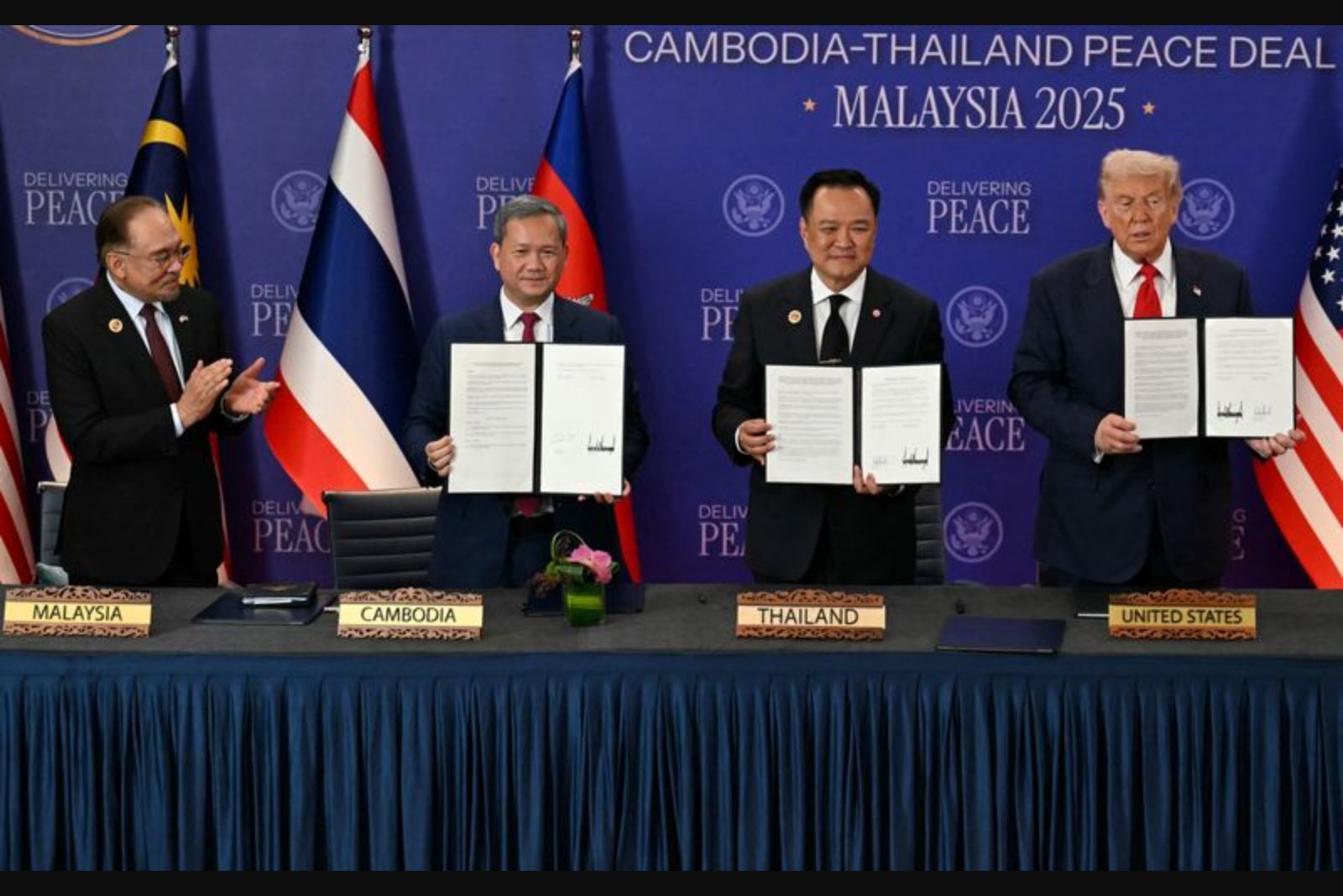
The fighting along the frontier, which began in July and was described as the worst in more than a decade, displaced hundreds of thousands of people and disrupted trade across the 508-mile (817-kilometer) border. An October agreement signed with international mediators, including U.S. and Malaysian leaders, collapsed within weeks, and a fresh ceasefire was reached on December 27.
Hun Manet, 48, who succeeded his long-time predecessor after the 2023 elections in which his party ran with virtually no competition, is a graduate of the U.S. Military Academy at West Point. Observers note that his ascension and the involvement of the U.S. in the border dispute have coincided with a warming of ties between Phnom Penh and Washington after years of closer relations between Cambodia and China.
Addressing concerns about regional relationships, Hun Manet said ties with China and the United States were "not mutually exclusive" and stated that Cambodia had "nothing to hide" regarding a naval facility at Ream that underwent upgrades with Chinese involvement. He reiterated his call for technical verification of border lines as the appropriate path to defuse the situation and allow displaced residents to return and trade to resume more fully.
Context and next steps
Hun Manet floated the JBC's resumption of work as the principal mechanism for determining the precise border in disputed sectors. He framed the appeal as a technical, treaty-based process rather than a political confrontation, urging Thailand to permit survey and demarcation efforts now that its recent national election is complete.
For Cambodia, the priority expressed by its leader is to restore normalcy for affected communities, to reassert what he describes as territorial integrity, and to use legally established mechanisms to resolve disagreements. For Thailand, the government maintains that its troop deployments are part of managing tensions and denies claims of occupation.
Implications
- Persistent military positions and obstructions to demarcation work keep the border unstable and prolong displacement of civilians.
- Trade and cross-border commerce across the 508-mile boundary remain vulnerable to disruption while the dispute is unresolved.
- Diplomatic channels and technically grounded mechanisms like the JBC are being positioned as the preferred route to verification and de-escalation.