
Hook & thesis
Cal-Maine Foods (CALM) is on the cheap side of the agricultural complex right now. At roughly $81.26 per share, the stock sits at a price-to-earnings multiple in the low single digits and an enterprise value that scarcely covers a couple years of cash flow. That combination - low valuation, strong free-cash-flow generation, and an attractive dividend yield - makes a defined long swing trade compelling: asymmetric upside if the market gives the company credit for growth in specialty eggs and prepared foods, limited downside if the business reverts to seasonal norms.
The trade thesis is straightforward: buy the company’s cash flow story and dividend while avoiding the big downside scenario with a firm stop. Fundamentals have improved over the last fiscal year with net sales momentum and investments into prepared foods capacity, yet the market remains skeptical and has priced in significant agricultural risk. That skepticism is the opportunity we want to exploit on a mid-term horizon.
Business snapshot - why the market should care
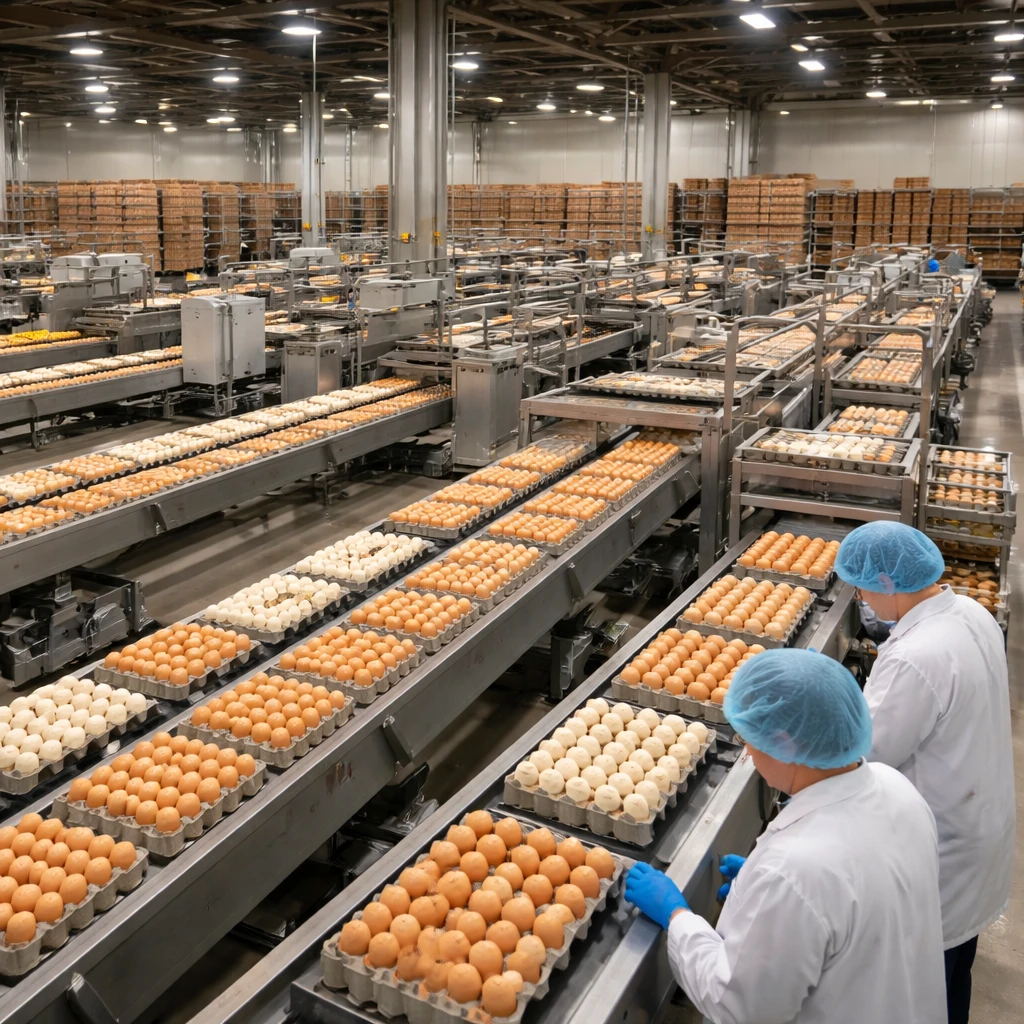
Cal-Maine is the largest shell-egg producer in the U.S., operating farms, processing plants, hatcheries and feed mills. The company sells to grocery chains, club stores, foodservice distributors and manufacturers. Scale matters for an agricultural commodity business because it helps absorb episodic shocks - avian flu, feed-cost swings - and expand higher-margin specialty and prepared-food lines.
Why investors should pay attention:
- Scale and cash flow: market capitalization is about $3.87 billion and the company reported free cash flow of roughly $1.17 billion - a material cash generation run-rate that supports dividends and reinvestment.
- Valuation: at a reported earnings-per-share figure of $24.20, the stock trades at a P/E in the low 3s. Enterprise value sits about $3.50 billion with an EV/EBITDA of ~2.3, indicating the business is priced for a worst-case scenario.
- Growth initiatives: management is expanding prepared-foods capacity - a $15 million project at Echo Lake Foods and $7 million to grow a joint venture plant - which can diversify revenue away from pure shell-egg commodity exposure.
- Income appeal: the company carries a very high dividend yield in the high single-digits. For income-oriented investors the headline yield is eye-catching, though it demands monitoring.
Supporting numbers and recent trends
Recent company results show momentum: net sales in the strongest quarter reached $922.6 million, up 17.4% year-over-year, driven by specialty and prepared-food sales. The firm’s balance sheet indicators are unusually healthy for an agricultural producer - debt-to-equity is reported at 0, the current ratio is about 8.02 and quick ratio near 6.46 - meaning liquidity risk is low.
Key valuation and cash metrics:
| Metric | Value |
|---|---|
| Current price | $81.26 |
| Market cap | $3.87B |
| Earnings per share (TTM) | $24.20 |
| P/E | ~3.4x |
| Free cash flow (recent) | $1.17B |
| EV/EBITDA | ~2.3x |
| 52-week range | $71.92 - $126.40 |
Valuation framing
Put bluntly: the market is pricing the business like a distressed commodity name. When EV/EBITDA is near 2.3 and P/E sits in the low 3s, you are looking at a valuation that assumes either a significant and prolonged collapse in margins or a one-time capital drainage. The company’s free cash flow of $1.17 billion and a near-zero debt load argue against those worst-case assumptions.
This is not a recommendation to ignore cyclical risk. Instead, the valuation argues that even modest normalization of margins or continued growth in higher-margin specialty eggs and prepared foods could produce a re-rating that moves the stock materially higher without dramatic improvements in top-line trends.
Catalysts
- Quarterly earnings and commentary: the company reported its fiscal results and will be watched for margins, feed-cost guidance, and prepared-foods progress. Prior scheduled release was 01/07/2026 and investors continue to reprice around fresh results and commentary.
- Prepared-foods capacity coming online: the Echo Lake Foods network optimization and joint-venture expansion are modest capex items ($15M and $7M) that could contribute incremental higher-margin volume by mid-fiscal 2027.
- Seasonal demand: egg demand is seasonal; a tighter supply backdrop or surging specialty demand tends to push prices and margins higher, which should be reflected in near-term results.
- Dividend attractiveness: continued dividend payments and potential yield-seeking flows could support the stock during sideways markets.
Technical and market structure context
The shares trade slightly below several short-term moving averages (10-day SMA ~$83.39, 20-day SMA ~$82.50, 50-day SMA ~$81.94) with RSI around 47 and MACD showing mildly bearish momentum. Short interest is meaningful relative to float - recent short interest reads in the 5.0-6.0 million share range with days-to-cover around 4, and recent daily short-volume prints show elevated short activity on heavier-volume days. That structure can magnify moves to the upside if buying picks up.
Trade plan (actionable)
- Direction: Long CALM
- Entry price: 81.26
- Target price: 95.00
- Stop loss: 74.00
- Horizon: mid term (45 trading days) - expect the market to re-evaluate valuation and respond to updated earnings/margin commentary in the next 1-2 quarterly updates.
Rationale: the entry is at today’s price to capture an asymmetric trade with upside to $95 driven by multiple expansion (from mid-single-digit P/E to a more normalized multiple) and continued specialty/prepared-foods momentum. The stop at $74 protects against a deeper commodity shock or an unexpected operational issue; it sits above the year low of $71.92 but provides room for normal seasonality. The target at $95 is within historical post-earnings trading ranges and represents a sensible re-rating without assuming a full recovery to the 52-week high.
Risks and counterarguments
There are explicit downside scenarios that can defeat this thesis. Below are the principal risks and a counterargument to the long case.
- Avian flu and supply shocks: an outbreak can force flock reductions, spike costs and disrupt sales channels. Those biological risks are unpredictable and can compress EPS sharply.
- Feed-cost inflation: feed comprises a major portion of production cost. A sustained rise in commodity feed prices without the ability to pass costs through would harm margins.
- Dividend sustainability: the very high yield implies the market questions payout sustainability. If cash flow weakens, the dividend could be cut, triggering downside pressure.
- Execution on prepared foods: growth projects are relatively small but require execution; delays or slower-than-expected margin contribution would keep the stock depressed.
- Market pessimism and multiple compression: the stock is already priced for bad outcomes; if the market becomes more risk-off for agricultural names, multiple expansion may not materialize.
Counterargument: The sell-side and some media expect EPS deterioration—an article flagged a potential EPS tumble and warned of feed-cost and avian-flu impacts. If management’s next updates show material margin erosion, then even a cheap multiple won’t save the share price. In that case, the appropriate response is to stick to the stop and wait for clearer evidence of margin stabilization before re-entering.
What would change my mind
I would reduce conviction if any of the following happen: an unexpected material outbreak of avian flu, meaningful deterioration in cash flow (free cash flow falling well below recent $1.17 billion levels), a dividend cut, or if management signals that prepared-food investments are not delivering incremental margin. Conversely, evidence of sustainable specialty-egg growth, better-than-expected margin recovery, or accelerating prepared-food volumes would strengthen the bull case and prompt a larger position.
Conclusion
Cal-Maine offers a classic value swing trade: strong cash generation, a low valuation baseline, and concrete catalysts to nudge the multiple higher. That said, the name is not without cyclicality. The trade respects that by using a conservative stop at $74 and a mid-term horizon of 45 trading days to capture re-rating and operatioal updates. For disciplined traders who can tolerate commodity risk, the risk/reward at current levels looks attractive.
Key dates to watch
- Dividend payable date: 02/12/2026
- Recent scheduled earnings release: 01/07/2026 - monitor follow-up commentary and quarterly cadence