
Overview
Morgan Stanley analysts examined how listed European travel and leisure companies are exposed to the ongoing conflict in the Middle East and concluded direct effects are largely contained. Their review focused on hotel portfolios, cruise deployments, airline capacity, tour operators and related service providers, assessing both geographic exposure and fuel or commodity risk via hedging positions.
Hotels and management contracts
The bank noted that two major global hotel operators, IHG and Accor, have modest shares of their room bases located in the Middle East - approximately 5% and 8% respectively. Morgan Stanley emphasized that fee-based earnings have somewhat higher exposure for those groups because the region tends to host a richer mix within the chainscale spectrum. Whitbread’s direct link is smaller: the group has some local management contracts that collectively represent under 1% of total revenues. Whitbread is also reported to be over 90% hedged on gas prices. By contrast, Scandic has no exposure to the region.
Cruise operations and fuel sensitivity
Cruise lines listed in Europe and the US show very limited exposure to the Middle East, with Morgan Stanley citing 0-3% of annual deployment for the main publicly traded players. Most of that deployment reflects ships that transit the Red Sea. The bank highlighted differing fuel hedging stances: Carnival Corporation is essentially unhedged, meaning a $10 change in oil moves roughly 5% of its fiscal 2026 earnings per share, while Royal Caribbean is about 60% hedged and would see around a 1% EPS swing for the same oil move.
Tour operators and airlines
Tour operators such as TUI have a small portion of their customer base in the Middle East - roughly 1% of guests - something the company has characterized as a minimal financial impact given it is a small winter market. TUI additionally has two cruise ships currently stranded in the region. Airlines’ exposure varies by carrier and by how capacity is measured; Morgan Stanley cited a range of 0-8% of departing capacity tied to the Middle East. Hedging approaches also differ among airlines, with some tying hedges to Brent crude and others to jet fuel.
Other service providers
Caterers generally appear insulated from direct effects, with the notable exception of SSP, and gambling operators likewise show little direct sensitivity to the conflict according to the bank.
Potential indirect effects on demand
Beyond direct exposures, Morgan Stanley considered demand displacement. The UN World Tourism Barometer figures cited in the bank’s analysis show Europe received roughly 800 million international tourist arrivals in 2025 versus about 100 million for the Middle East, with Dubai accounting for near 20 million. The bank also estimated approximately 290 million leisure travellers in Europe compared with 30 million in the Middle East and 11 million in Dubai.
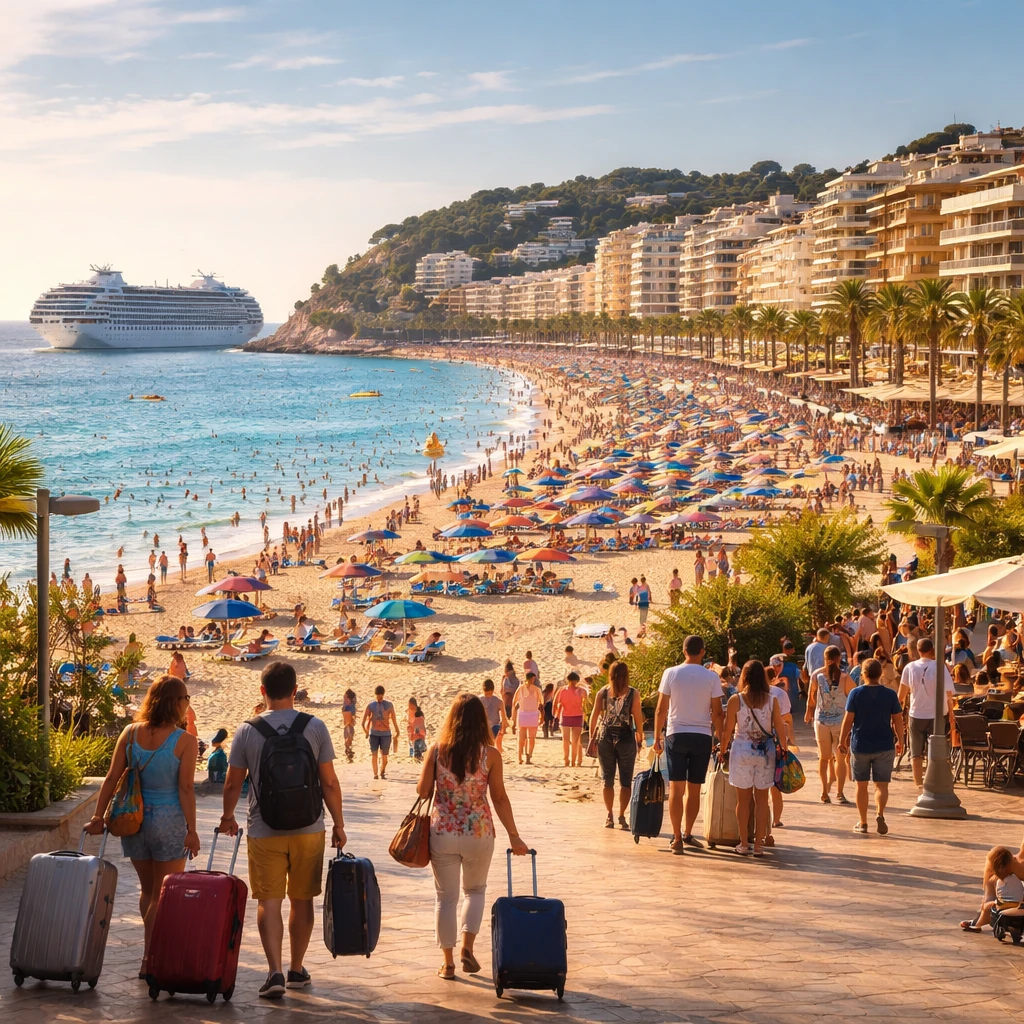
Morgan Stanley notes roughly half of Middle East demand is regional, originating in the GCC/MENA area, and that Dubai receives about 21% of its visitors from Europe, equating to roughly 2 million European arrivals. The bank modeled a scenario in which two-thirds of European visitors to the Middle East plus 20% of the Middle East’s other international visitors choose to rebook travel to European destinations. Under that hypothetical, the bank calculated roughly a 1% uplift in European hotel demand. The analysis also flagged that concentration of any redirected demand into winter sun resort hotspots - for example the Canary Islands - could produce a more noticeable localized impact.
Precedent and potential behavioral shifts
Morgan Stanley referenced a historical precedent in which coastal markets in Spain, Greece and Turkey recorded revenue-per-available-room (RevPAR) gains of 8-14% after the 2011 Arab Spring, driven principally by rate increases rather than occupancy growth. The bank also suggested that higher-priced long-haul air travel and complications with Middle East stopovers could encourage Europeans to take shorter-haul trips this summer. At the same time, the bank warned US demand for Europe might soften if American travellers become reluctant to travel; Americans account for only about 5% of hotel room nights in Europe but are noted as relatively high spenders.
Where impact could be felt across companies
Morgan Stanley’s view is that a modest increase in European hotel demand would be supportive for Accor in particular, given the company derives around half its revenue from Europe and is thus more exposed to any regional demand shifts. The bank also flagged that overall uncertainty could favor more organized travel products, which would likely benefit players such as TUI and Jet2, and could be supportive for Carnival Corporation given shifts in cruise booking behavior.