
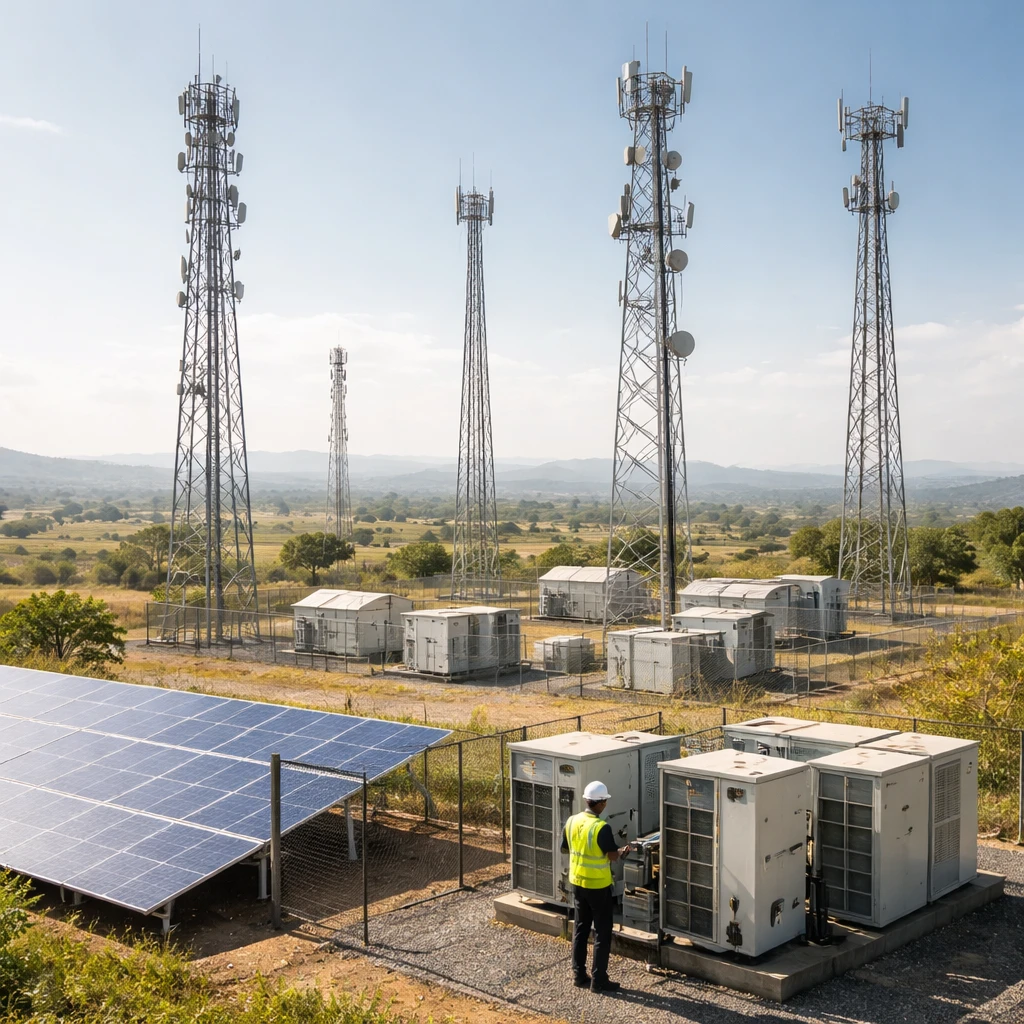
Moody's Ratings raised Helios Towers plc's credit standing on Friday, elevating the company's corporate family rating to Ba3 from B1 and upgrading its probability of default rating to Ba3-PD from B1-PD. The rating agency also upgraded the rating on $850 million of backed senior unsecured notes due in 2029, issued by HTA Group, Ltd., to Ba3 from B1. At the same time, Moody's revised the outlook for both the issuer and the notes from positive to stable.
The agency attributed the rating action to a strengthened credit profile driven by solid operational results, growing free cash flow generation and a more pronounced commitment to deleveraging. In November 2025, Helios Towers began returning capital to shareholders, a move Moody's interpreted as an indication that the company expects sustainable free cash flow over the medium term. That distribution policy is coupled with a new, tighter reported net leverage target of 2.5x to 3.5x, a notable reduction from the previous 3.5x to 4.5x range.
Moody's also upgraded its assessment of Helios Towers' governance, increasing the ESG governance issuer profile score to G-2 from G-3 and moving the Credit Impact Score to CIS-2 from CIS-3. The ratings agency cited the revised financial policy and the introduction of shareholder distributions as evidence of stronger governance practices.
On a Moody's-adjusted basis, Helios Towers reduced its adjusted debt to EBITDA to 4.5x for the twelve months ended June 2025, down from 4.8x as of December 2024. Over the same period, the company produced $46 million of Moody's-adjusted free cash flow. Moody's expects continued improvements in leverage, forecasting adjusted debt to EBITDA of around 4.2x by the end of 2025 and approximately 3.9x by the end of 2026, while projecting ongoing positive free cash flow generation.
The rating upgrade reflects the strength of Helios Towers' operating franchise. Moody's noted the firm's leading market positions in seven high-growth African telecom tower markets and its operations in two additional countries. The company has demonstrated consistent growth, rising profitability and stable contracted cash flows supported by long-term agreements with major mobile network operators. Moody's highlighted an average remaining contract life of 6.8 years, which corresponds to $5.3 billion of expected future revenue. Those contracts include automatic price escalators that cover power cost adjustments, inflation and foreign currency depreciation.
Despite these positive elements, Moody's maintained that the credit rating is constrained by the elevated sovereign risk in key markets. Tanzania, rated B1 with a stable outlook, and the Democratic Republic of the Congo, rated B3 with a stable outlook, account for roughly 38% and 32% of Helios Towers' EBITDA respectively. The sovereign ratings of these jurisdictions act as a ceiling on the company's ratings, according to Moody's.
The stable outlook attached to the Ba3 rating reflects Moody's assessment that Helios Towers has a record of following its financial policies and is likely to keep generating free cash flow while maintaining sound credit metrics and sufficient liquidity. Moody's said that absent an improvement in the sovereign ratings of its principal markets, an upgrade of Helios Towers' ratings is unlikely.
To warrant consideration for further upgrade, Moody's specified financial milestones it would expect to see. These include adjusted debt to EBITDA sustainably falling below 3.5x and the ratio of EBITDA minus capex to interest expense comfortably exceeding 2.0x. Conversely, Moody's set out potential triggers for negative rating action: a material deterioration in the sovereign credit profiles of the company's key markets or limitations on the group's ability to upstream cash to its holding company. Additional downward pressure could result if adjusted debt to EBITDA does not improve to below 4.0x or if the EBITDA minus capex to interest expense metric fails to trend meaningfully toward 2.0x on a sustainable basis. Moody's also noted that sustained negative free cash flow and weakened liquidity would be grounds for a downgrade.
Implications for markets and sectors
The rating action is directly relevant to fixed-income investors holding Helios Towers' 2029 notes and to lenders and capital providers monitoring the company's credit trajectory. It also has implications for the telecom infrastructure sector, particularly investors focused on tower companies operating in emerging and frontier markets, where sovereign risk can place an effective cap on credit ratings.