
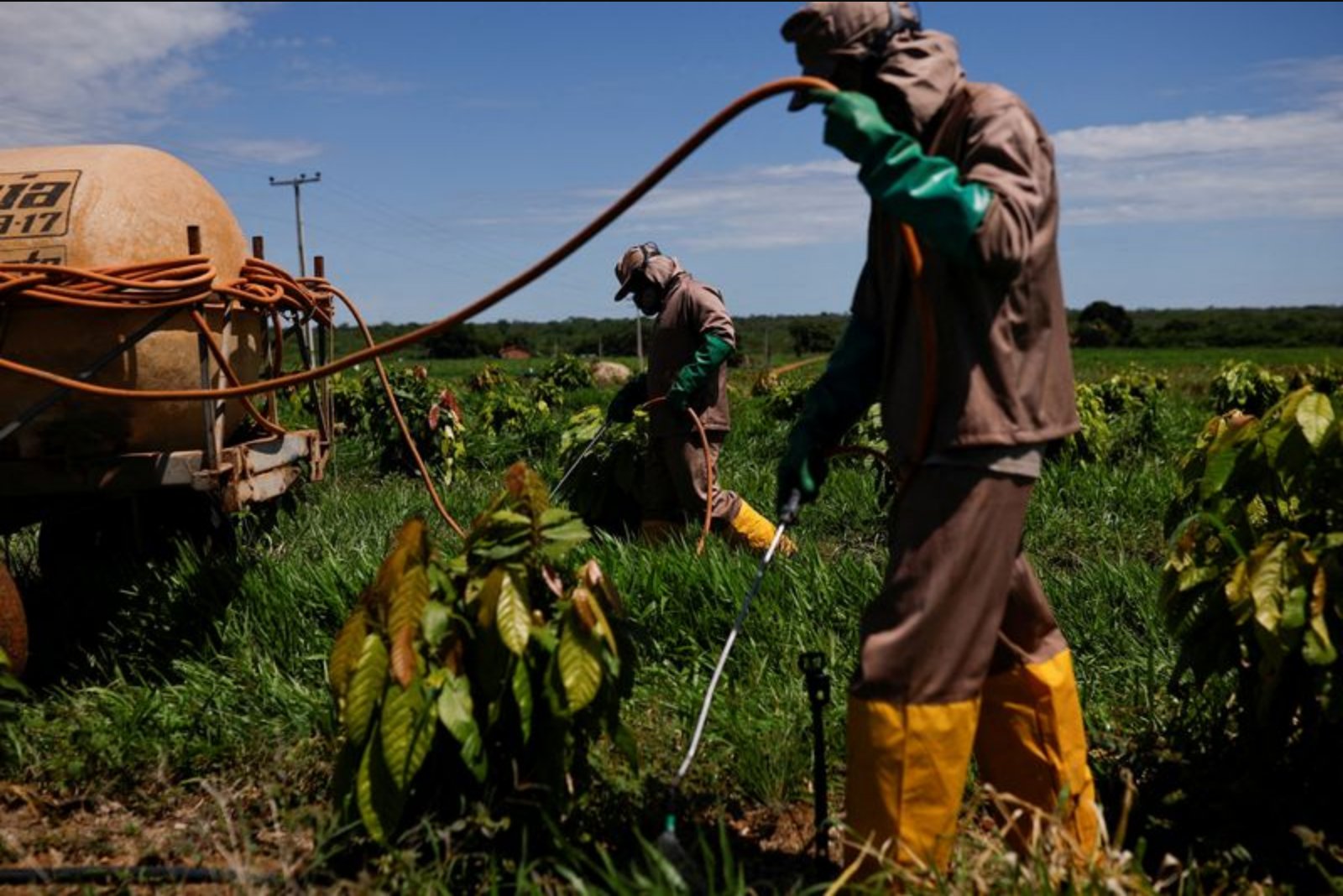
Brazil’s drive to become a major industrial cocoa supplier has hit a sudden, widespread pause as prices for beans have fallen steeply from last year’s highs. Developers and farmers that once planned to rapidly scale production across Northeastern Brazil are reassessing or abandoning projects after prices dropped to around $3,000 per metric ton - about a 70% decline from a 2024 record level.
The fallout is concentrated on large-scale, irrigated plantations that investors envisaged as a rapid way to add supply and reduce the world markets reliance on West Africa. Analysts and farmers interviewed said roughly half of those industrial projects could be shelved at current price levels.
Scale and expectations
Plans for new plantations were significant. Supply chain services provider Czarnikow estimated the projects clustered in Northeastern Brazil would add at least 75,000 hectares of growing area - a footprint that, if realized, could deliver roughly 225,000 tons of beans in four years and represent close to 4.5% of global production.
Backers of the initiatives included some of the largest industry names and investors, who saw large Brazilian farms as an alternative to the main West African producing region. Ghana and Ivory Coast together account for nearly 50% of global cocoa output, a concentration that previously left the market exposed to regional production shocks.
But the business case has weakened. "I think Brazil expansion plans have had a massive cold shower," said Paulo Torres, a London-based cocoa industry advisor who also farms cocoa in Bahia state. Torres canceled plans to add 30 hectares at his own Bahia property, saying current prices fail to cover investment and production costs needed for new fields.
For many would-be entrants, the upfront capital for irrigation, machinery and post-harvest processing is a critical variable. "If the market remains below $5,000 per ton, more than 50% of the projects are gone," said Moises Schmidt, one of the regions largest cocoa farmers, who had expected to manage as much as 10,000 hectares - roughly the size of Manhattan - of plantations.
Projects suspended or under review
At least one sizeable investment has been put on hold. Two sources - a large farmer and an agricultural equipment supplier executive - said a major project by NewAg Partners, a Switzerland-based investment company that had planned up to 22,000 acres (8,900 hectares), has been suspended. NewAgs chief executive, Detlef Schoen, said: "At this stage we prefer not to comment."
Copa Investimentos, a Sao Paulo asset manager with agriculture and forestry holdings, had been planning an industrial cocoa farm as well. One of its partners, Apolonio Sales, said the investment is now being "evaluated". Sales noted he visited new cocoa farms and spoke with traders and chocolate companies, but no final decision on going ahead has been made.
Other initiatives face uncertainty while some small-scale or government-backed efforts press on. Brazilian co-operative Cooabriel, which announced a cocoa program with Cargill last year, said it will continue to develop a small-scale project. Sao Paulo state government projects - including programs that use cocoa trees to reforest degraded farm areas - will also proceed, according to coordinator Ricardo Pereira. "In some areas, we already have seedlings almost ready to go into the field," he said, and added that commodity prices tend to rebound over time.
Market dynamics that triggered the shift
The earlier price surge that underpinned the rush into Brazil followed production setbacks in West Africa. Unfavourable weather, illegal mining and disease reduced output in 2023 and 2024, sending prices from an average of $2,500 per ton to more than $11,000 per ton and prompting traders to scramble for beans. Smuggling increased in parts of Africa as sellers bypassed official buying schemes to capture higher prices across borders, and the chocolate industry raised finished-product prices to offset exploding input costs.
Since then, West African production has recovered and other origins - such as Ecuador - have raised output. On the demand side, consumers pulled back from pricey chocolate purchases. Weight-loss drugs have also been cited as reducing demand, while manufacturers have reacted by shrinking package sizes and substituting non-cocoa ingredients like artificially flavored palm oil butter in some products. Those shifts have reduced cocoa demand and contributed to the price correction.
Small Brazilian cocoa growers have felt the squeeze. In one recent protest, a group of farmers blocked a road to the Ilheus port in Bahia and set old tires on fire to object to the arrival of imported African cocoa. Following the unrest, Brazils food supply agency Conab suspended any imports of cocoa from Ivory Coast.
Outlook and slower growth
Industry voices say Brazils cocoa output can still rise, but probably at a slower, more incremental pace. Rather than the rapid, industrial expansion once touted, growth may occur as diversification on mixed farms where cocoa is planted alongside other crops. That model reflects lower-risk expansion and a learning curve for new producers, rather than the immediate yield jump developers had forecast.
"If some big farm had plans for 400, 500 hectares, now it will do 80 or 100, only to start learning about the crop," said Emerson Silva, a sales executive at irrigation-equipment maker Netafim, pointing to a shift toward phased, smaller-scale adoption.
Where large-scale projects are delayed or canceled, the immediate consequence will be slower supply growth from Brazil than investors had anticipated. That moderates the short-term prospect of a rapid diversification of global supply away from West Africa, and it keeps the market sensitive to future production swings in existing major producing regions.
Key points
- Steep price fall: Cocoa prices have dropped roughly 70% from 2024 highs to about $3,000 per metric ton, undermining the economics of new large-scale farms in Brazil.
- Project impact: An estimated 75,000 hectares of planned irrigated cocoa - potentially supplying nearly 5% of global demand - may be delayed or canceled, slowing expected supply growth from Brazil.
- Sector effects: The price collapse affects agriculture investment, equipment suppliers for irrigation and processing, and the chocolate industry through altered raw material sourcing and demand adjustments.
Risks and uncertainties
- Price volatility: Continued depressed cocoa prices could force further cancellations of planned projects, affecting agricultural investment and local farm incomes.
- Demand trajectory: Changes in consumer behavior, including reduced chocolate purchases and manufacturers use of non-cocoa substitutes, create uncertainty for long-term cocoa demand.
- Supply concentration: With Brazils industrial expansion slowed, global supply remains concentrated in West Africa, leaving markets exposed to production shocks in that region.
The situation in Brazil highlights the sensitivity of capital-intensive agricultural expansion to commodity price swings. Investors and farmers who had anticipated robust near-term returns from industrial cocoa production must now decide whether to adopt smaller, phased approaches, maintain existing smallholder projects, or step away until prices improve. For the market, slower Brazilian growth leaves global supply patterns more dependent on existing producers and on how demand evolves in response to changing consumer choices and product formulations.