
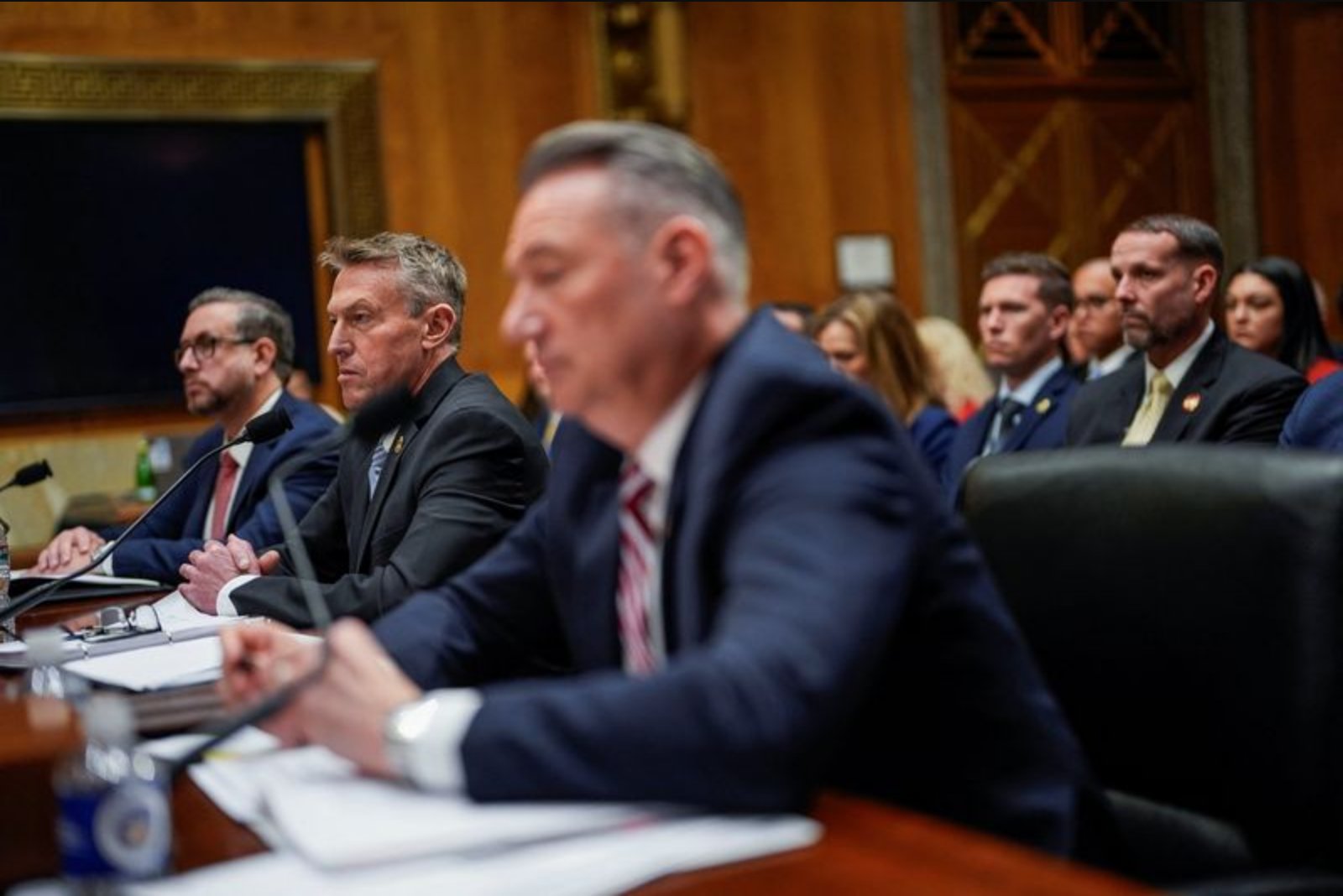
Senators on the Homeland Security and Governmental Affairs Committee played a video at a Thursday hearing that depicted the events preceding the fatal shooting of U.S. citizen Alex Pretti and pressed Trump administration immigration officials on whether their use of force was justified.
U.S. Senator Rand Paul, the committee's Republican chairman, said the footage showed Pretti moving away when an officer sprayed him with pepper spray at close range during the January incident. Paul characterized the action as escalation and said the video made clear that "he is retreating at every moment. He's trying to get away, and he's being sprayed in the face."
Rodney Scott, Commissioner of U.S. Customs and Border Protection (CBP), who testified at the hearing, said a complete inquiry would be necessary to determine whether the force applied was appropriate. During his testimony, Scott described the subject as noncompliant and said, "What I'm seeing is a subject that's also not compliant. He's not following any guidance. He's fighting back nonstop."
In a subsequent exchange during the hearing, Scott and U.S. Immigration and Customs Enforcement Acting Director Todd Lyons both acknowledged that deploying pepper spray on someone who appears to be retreating would not conform to proper procedure. That admission came as senators probed agency rules, training and the decision-making that led to the encounter.
The hearing represented the second time in one week that Scott, Lyons and U.S. Citizenship and Immigration Services Director Joe Edlow faced questioning from a congressional committee regarding the Trump administration's intensified immigration enforcement efforts. The officials defended the actions of their agencies while saying the fatal shootings of Alex Pretti and Renee Good must be fully investigated.
That stance diverged from remarks by Homeland Security Secretary Kristi Noem and other administration figures who had quickly labeled Good and Pretti as "domestic terrorists." Senator Paul criticized that rapid public characterization, arguing it undercut confidence in the administration's ability to conduct impartial inquiries. "People aren't believing there's going to be an honest investigation," he said.
Separately, White House border czar Tom Homan told officials earlier in the day that the administration would reduce its presence in Minnesota following a surge that has drawn growing criticism. Public backing for the administration's immigration agenda dropped to the lowest level of the presidency in January, according to Reuters/Ipsos polls, a decline referenced by senators during the hearing as they examined the political fallout from the surge and enforcement actions.
Senator Paul also criticized immigration officers for drawing firearms in encounters where a clear threat was not evident, comparing agency training unfavorably with police departments. "I don't think they're living up to the same standard of the police," Paul said. "I think the police, frankly, are better trained."
Democratic Senator Elissa Slotkin of Michigan questioned Acting ICE Director Lyons about whether ICE had authority to deploy personnel to polling locations, referencing a recent presidential call to "nationalize" elections. Lyons replied, "There's no reason for us to deploy to a polling facility," pushing back on the suggestion that ICE should operate at voting sites.
Earlier in the day, Minnesota officials, including Attorney General Keith Ellison, testified before the committee. Ellison urged Congress to require the FBI to carry out a full investigation into the killings of Renee Good and Alex Pretti and called for ICE to "provide a full, transparent accounting of everyone stopped, detained, arrested and deported from Minnesota." His request highlighted state concerns about both investigative transparency and the scope of federal operations in the state.
Harry Niska, the top Republican in the Minnesota State House of Representatives, criticized Ellison's legal guidance for complicating cooperation between state and federal authorities. Niska argued that making arrests outside secure settings increases risk, saying, "Arresting a suspect in the secure environment of a jail is safe and efficient. Forcing that arrest to happen in a home or a workplace ... drastically increases the risk to officers in the public."
Paul Schnell, commissioner of the Minnesota Department of Corrections, testified that there has been "wide-scale cooperation" with ICE but added that the recent surge in federal activity had strained that collaborative relationship. His comments underscored tensions between state correctional systems and the federal immigration agencies amid intensified enforcement operations in Minnesota.
Context and takeaways:
- The Senate hearing put agency leaders on the defensive about tactics used during immigration enforcement operations and about the public messaging that followed the fatal shootings.
- Senators from both parties pressed for clarity on procedures and investigations, while Minnesota officials demanded federal transparency and independent inquiries.
- Testimony highlighted friction between federal immigration agencies and state authorities over operational control and cooperation.