
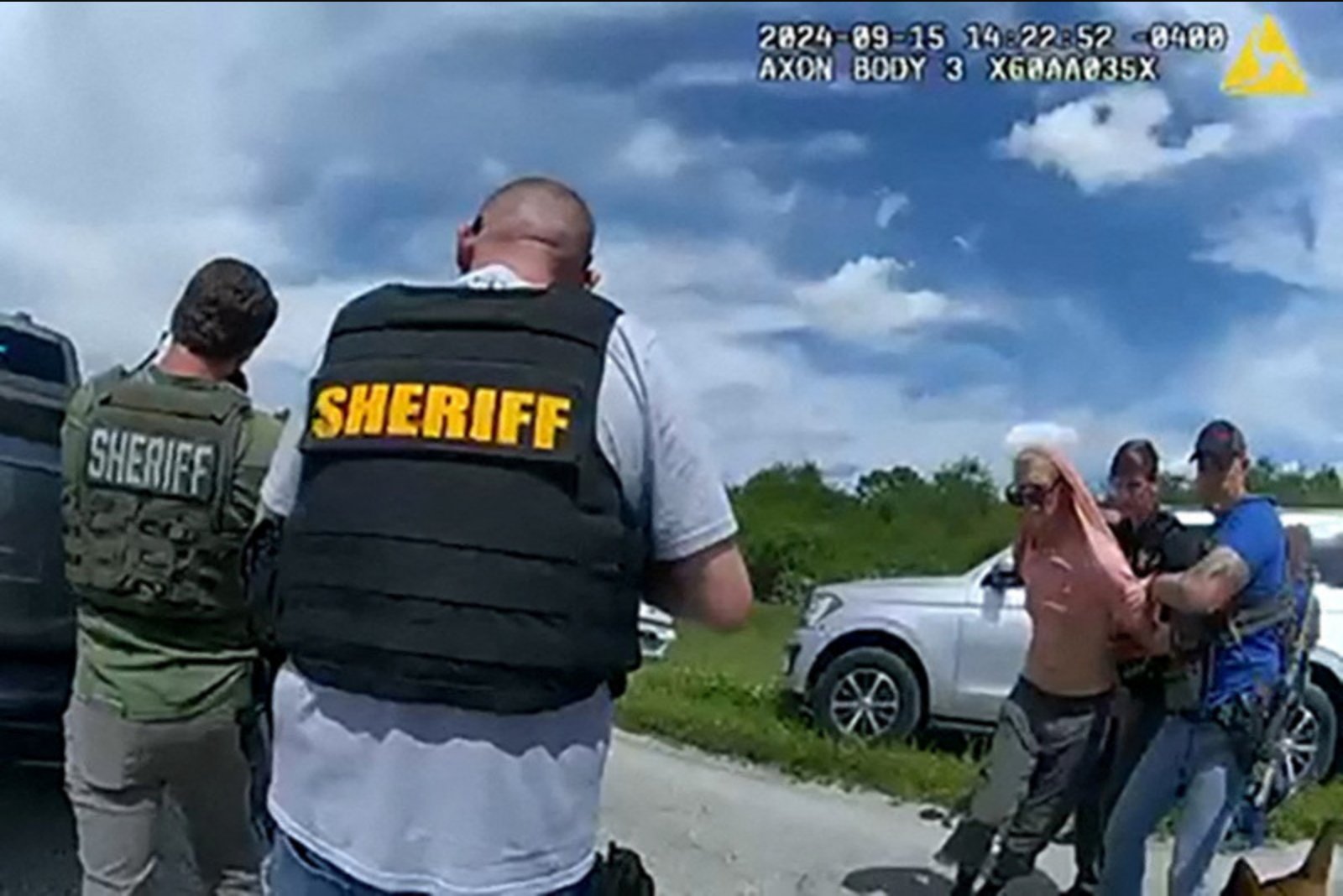
FORT PIERCE, Florida - A federal judge on Wednesday sentenced Ryan Routh to life imprisonment after a jury last September convicted him on five criminal counts, including attempted assassination of Donald Trump.
U.S. District Judge Aileen Cannon imposed the life term in Fort Pierce, emphasizing the calculated and premeditated character of the attack. "It’s clear to me that you engaged in a premeditated, calculated plot to take a human life," Cannon said during sentencing.
Routh, 59, who represented himself at trial despite having no formal legal training, appeared in court shackled at the hands and wearing beige prison clothing. At the sentencing hearing he read from a prepared 20-page statement that largely did not address the specifics of the case. Instead, his remarks touched on foreign wars and his expressed wish to be exchanged for political prisoners abroad. Judge Cannon interrupted and cut off his remarks after roughly 15 minutes, deeming them irrelevant to the proceedings.
Prosecutors had urged the court to impose a life sentence. Routh had asked the judge to set a 27-year term. After the hearing, Routh’s attorney, Martin Roth, characterized his client as a troubled and complex individual who nonetheless had "a very good core" and cared about the welfare of others. Roth said he intends to appeal both the conviction and the sentence.
Courtroom behavior and defense filings
At sentencing, Routh described himself as a "failure," asserted that his own sentence was "totally unimportant," and lamented that "sadly, execution is not an option." In an earlier court filing he denied any intent to kill Trump and stated a willingness to accept psychological treatment for a personality disorder while in prison. He also suggested jurors had been misled by his inability to mount a conventional defense after he fired his lawyers and chose to proceed pro se.
Following the jury's guilty verdict, Routh appeared to attempt to stab himself with a pen and had to be restrained by U.S. marshals. His daughter called out in court that he had not hurt anyone and vowed to work to free him from prison.
Prosecutors' characterization and the judge's reasoning
Prosecutor John Shipley urged the court to make clear that political violence is unacceptable, arguing Routh’s actions were aimed at "upending American democracy." Attorney General Pam Bondi issued a statement saying Routh "will never walk free again" and called the attempted assassination "a direct assault against our entire democratic system."
Delivering the sentence, Judge Cannon highlighted both the seriousness of the offenses and Routh’s extensive criminal history. She referenced a rap sheet of at least 36 prior convictions, including convictions for possession of a mass destructive device, illegal possession of a firearm and larceny, as evidence that he had repeatedly disregarded societal rules. "There has been much in this case about this narrative of your peaceful nature. For me, it’s the opposite," Cannon said.
Facts laid out at trial
According to trial evidence presented by prosecutors, Secret Service agents observed Routh hiding in bushes a few hundred yards from where Trump was golfing at Trump International Golf Club in West Palm Beach on September 15, 2024. Routh fled the scene leaving behind a semi-automatic rifle. Investigators later recovered the weapon along with body armor-like metal plates and a video camera that had been pointed at the golf course.
Prosecutors told the court that Routh had arrived in South Florida about a month before the incident, staying at a truck stop while tracking Trump’s movements and schedule. They said he carried six cellphones and used false names to conceal his identity. On the day of the episode, they said, he lay in thick bushes for nearly 10 hours waiting for Trump.
In addition to the attempted assassination charge, Routh was convicted of three counts of illegal firearm possession and one count of impeding a federal officer during his arrest. At the time of his arrest, he had most recently lived in Hawaii after a prior residence in North Carolina.
Related incidents and political context
The September 15 incident came two months after a different attack when a bullet grazed Trump’s ear at a campaign rally in Butler, Pennsylvania. Both episodes occurred during the period leading up to the November 2024 election, in which Trump returned to the presidency after having been defeated in the prior election. Prosecutors said the actions taken against Trump were part of the pre-election atmosphere; Trump made the attempted assassinations a campaign issue, asserting that investigations by the U.S. Justice Department under the prior administration could not be trusted.
After the jury returned the guilty verdict, Trump posted on his social media platform that "this was an evil man with an evil intention, and they caught him."
Next steps
Routh’s defense has signaled an intention to appeal. Prosecutors and federal authorities have pointed to the combination of the defendant’s prior convictions and the circumstances recovered at the scene to justify the life sentence and to underscore their position that the case represented an effort to destabilize democratic processes. The court record reflects multiple counts tied to weapons offenses and to impeding federal officers, in addition to the attempted assassination conviction that formed the centerpiece of the trial.
The sentencing concludes the trial phase in Fort Pierce, while the planned appeal will move the matter into the next phase of the federal court process.