
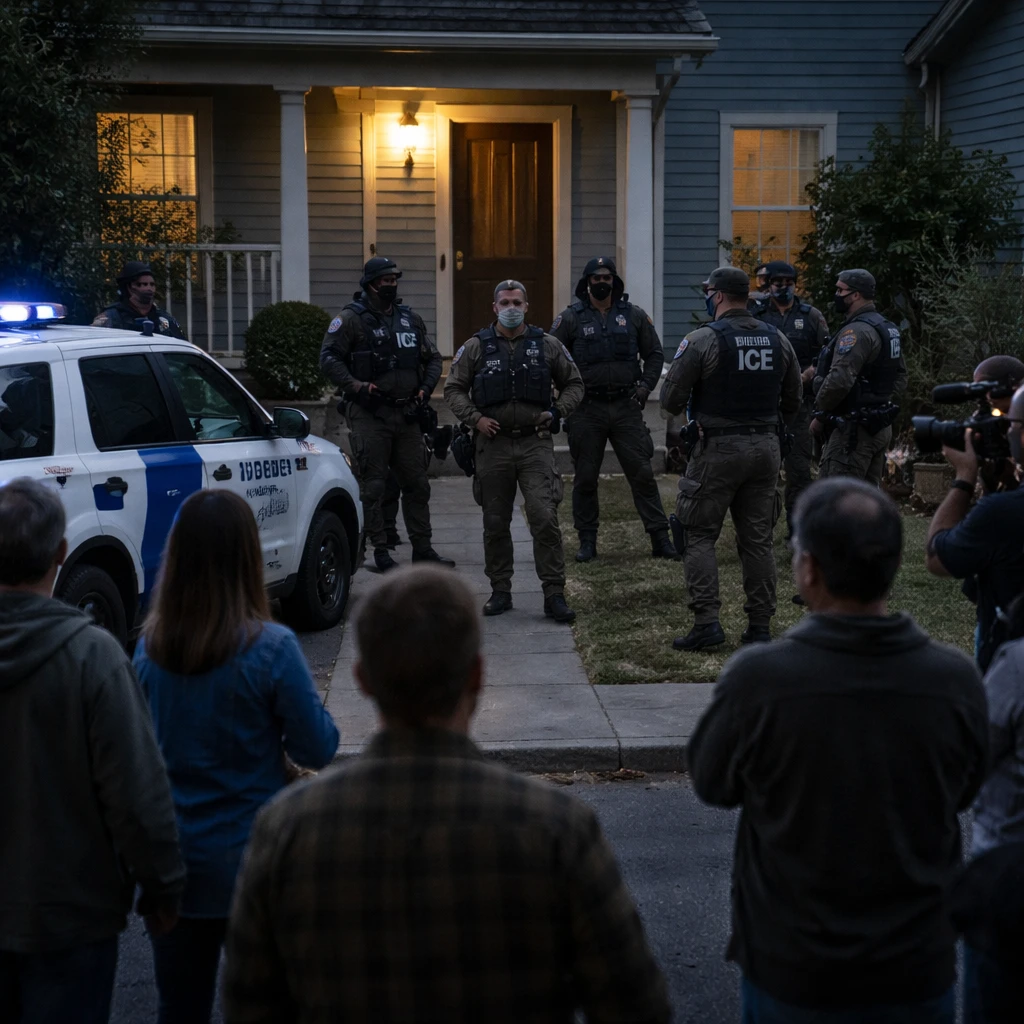
Democrats in Washington are pressing for new restrictions on the conduct of federal immigration agents after a series of confrontations that have drawn public criticism. The disagreement with Republicans, who control Congress, centers on how far to limit tactics used by Immigration and Customs Enforcement (ICE) and Customs and Border Protection (CBP) during enforcement operations - and whether those limits can be agreed before funding for the Department of Homeland Security (DHS) runs out on February 13.
At stake in the dispute are a range of operational practices adopted under the previous administration's immigration crackdown. Democrats are challenging the authority of agents to wear masks while carrying out operations, to enter private residences without showing identification or obtaining judicial warrants, and to perform broad, indiscriminate sweeps of suspects rather than the targeted arrests that were more common under earlier administrations.
Lawmakers on the Democratic side argue these changes are necessary to rein in abuses by ICE and CBP. They point to recent incidents, including the killing of two U.S. citizens in Minneapolis last month, as evidence that stronger guardrails are required. A January Reuters/Ipsos poll cited by supporters of the reforms found that 58% of Americans thought ICE had gone too far.
Republicans have countered with alternate priorities and objections. Some GOP lawmakers are proposing measures of their own, such as penalties for so-called "sanctuary" jurisdictions that do not cooperate with deportation efforts. Senate Republican Leader John Thune dismissed Democrats' 10-point package as largely "unrealistic and unserious."
White House spokeswoman Karoline Leavitt said on Thursday that President Trump is willing to enter negotiations, but that certain Democratic requests are non-starters. The administration's posture leaves open the possibility of limited concessions while rejecting others as unacceptable.
One reform that could attract bipartisan support is wider use of body-worn cameras. The DHS funding bill under consideration includes $20 million to purchase body cameras, and the Trump administration is already deploying such devices in Minneapolis, the city at the center of the recent enforcement focus. Democrats are seeking specific rules that would guarantee access to footage and set controls around how recordings are handled. Republicans have voiced support for independent oversight of ICE and CBP activities as well.
Experts on policing and accountability have weighed in on the proposals. Christy Lopez, a Georgetown University professor who previously worked on police practices for the U.S. Justice Department, said the current training and standards for federal immigration agents are weaker than those applied to state and local police. She characterized several Democratic measures as "pretty significant changes" that would increase accountability and make clear that agents are not a kind of "secret police" with unconstrained authority.
Even where there is potential agreement, concerns remain. Republican Senator Shelley Moore Capito of West Virginia, a member of the Homeland Security panel, expressed support for independent oversight, but cautioned that forcing agents to remove masks could endanger them and their families. "I’ve been doxxed myself. It’s an invasion of your own personal security," she said. The article notes that U.S. law enforcement agencies generally prohibit the use of masks in most circumstances.
Another major point of contention is Democratic language that would require DHS officers to obtain judicial warrants - rather than administrative warrants - before entering private property. House Speaker Mike Johnson rejected that demand, saying: "We are never going to go along with adding an entirely new layer of judicial warrants because it is unimplementable." Republicans argue that shifting to judicial warrants would create an impractical new hurdle for enforcement operations.
There are, however, signs of possible compromise. Representative Michael McCaul of Texas suggested on CBS' "Face the Nation" that the Trump administration might prohibit the use of administrative warrants to enter a home, indicating some room for negotiation on warrant-related procedures.
Several Democratic proposals have not yet drawn clear responses from many Republicans. Those measures include bans on operations in places such as churches, schools, hospitals and polling locations, and explicit prohibitions on racial profiling.
With the DHS funding expiration approaching, the impasse leaves open the possibility that lawmakers will have to resolve both budget and enforcement-policy disputes in short order. The outcome will shape not only how ICE and CBP operate but also the oversight, accountability and public trust surrounding federal immigration enforcement.
Summary
Democrats are seeking reforms to restrict certain practices by federal immigration agents in response to public backlash and recent violent incidents. Republicans controlling Congress have resisted key elements such as mask removal mandates and judicial-warrant requirements. The DHS funding deadline of February 13 adds pressure to reach a deal. Proposals around body cameras and independent oversight may present limited avenues for bipartisan agreement, while other Democratic requests remain contested.