
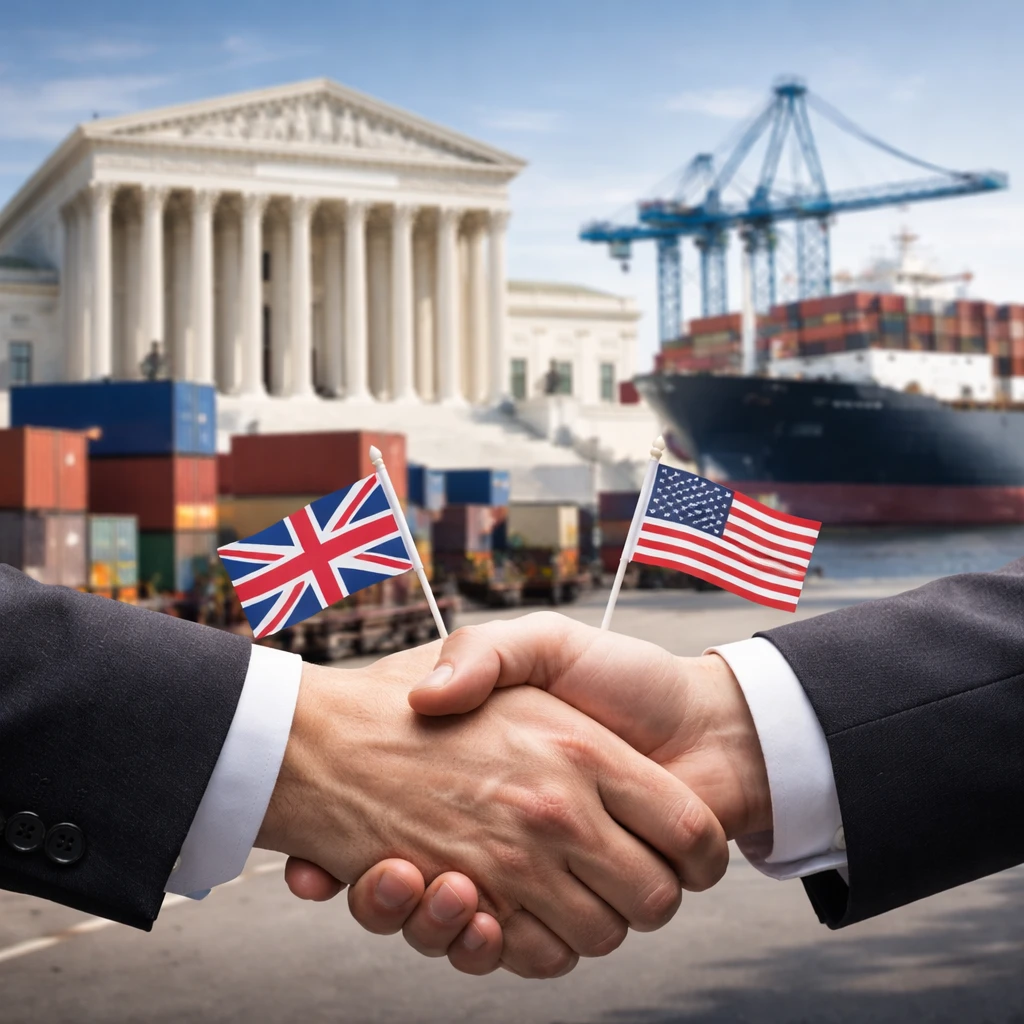
Britain reiterated on Friday that it anticipates maintaining a privileged trading relationship with the United States after the U.S. Supreme Court overturned a prior set of sweeping tariffs introduced by the previous administration.
In April of last year, then-President Donald Trump announced a program of "reciprocal" tariffs on imports from many U.S. trading partners, including the UK, citing the International Emergency Economic Powers Act (IEEPA) as the legal basis for the measures. The high court has since concluded that the use of IEEPA in this instance went beyond the president's statutory authority.
The baseline rate the UK would have faced under that reciprocal tariff framework was 10%.
Officials in London pointed out that Friday's decision does not alter the majority of bilateral trade flows covered under a distinct tariff arrangement between the UK and the United States. That bilateral arrangement is said to apply mainly to specific sectoral duties enacted under different U.S. statutory powers, and therefore remains largely unaffected by the Supreme Court's ruling.
A British government spokesperson said in a statement: "The UK enjoys the lowest reciprocal tariffs globally, and under any scenario we expect our privileged trading position with the US to continue." The spokesperson added that the government would engage with the U.S. Administration to determine the ruling's effects on tariffs for both the UK and other countries.
The statement also said the UK government will provide support to British businesses as further details emerge and the implications of the court's finding are clarified.
Context and next steps
With the Supreme Court finding that the executive overstepped the authority granted by IEEPA, the legal foundation for the earlier wide-ranging reciprocal tariffs has been removed. However, because much of the U.K.-U.S. tariff relationship rests on a separate, sector-specific framework using other U.S. powers, routine bilateral trade is not expected to be broadly disrupted by the judgment.
Government officials in London plan to consult with their counterparts in Washington to map out how the court's decision will translate into tariff policy going forward. They have also committed to helping affected British firms as concrete details are announced.